Somatic Pilates: what it is and what the evidence shows
Somatic Pilates is a slow, awareness-first style of Pilates built on gentle movement, long breaths out and pauses to notice how you feel. Here is what it is, how it differs from a regular class, what the research does and doesn't show, and a 15-minute session to try.
By the TrueMe team · Published · 10 min read · How we write
Somatic Pilates is a slow, inward-focused way of doing Pilates, where the main goal is to pay attention to the sensations of each movement rather than to work hard or count reps. Sessions use small, gentle movements, long breaths out and frequent pauses, often lying down or standing against a wall. It is a style, not a separate method, and no study has tested it under that name.
This guide explains where the idea comes from, how it differs from a regular Pilates class, what research on its parts actually shows, and what it can’t do. You’ll also find a gentle 15-minute session you can try at home and a simple way to fit it into your week.
What is somatic Pilates?
Somatic Pilates is Pilates taught with the emphasis on body awareness: moving slowly, paying attention to sensation, and adjusting each movement to what feels easy and controlled. You still use Pilates ideas such as a long spine, steady breathing and a gently braced middle, but the pace drops and the effort stays low to moderate.
A typical session includes:
- A body scan, lying or standing, noticing where you feel tense, heavy or relaxed.
- Slow breathing, usually with a long, unhurried breath out.
- Small movements of the pelvis, spine, shoulders and hips, repeated a few times and explored rather than pushed.
- Pauses between movements to notice what changed.
- A rest at the end, often with your legs up the wall or in a comfortable lying position.
You won’t find a governing body, a set syllabus or a certification for “somatic Pilates.” Different teachers use the label for slightly different things, so read class descriptions carefully.
Where does the word “somatic” come from?
“Somatic” comes from the Greek soma, the body as you experience it from the inside. In the 1970s, the philosopher and movement teacher Thomas Hanna popularized “somatics” as an umbrella term for methods that improve movement through attention and awareness rather than effort, such as the Feldenkrais Method.
Pilates already sits close to that family. Joseph Pilates called his system Contrology because it was about conscious control of movement, and researchers who study it describe the Pilates Method as a form of somatic education [1]. So “somatic Pilates” is less a new invention than a return to one side of Pilates that busy, fast-paced classes sometimes leave out.
How is somatic Pilates different from regular Pilates?
The moves can look similar, but the intent, pace and effort differ. A regular Pilates class aims to build strength and control through a set sequence; a somatic class aims to build awareness and ease, and lets you change or skip movements based on how they feel.
| Regular Pilates | Somatic Pilates | |
|---|---|---|
| Main goal | Strength, endurance, control | Body awareness, ease of movement |
| Pace | Steady, often to a count | Slow, with pauses |
| Effort | Moderate; the last reps feel hard | Low to moderate; never strained |
| Reps | Set numbers, often 8 to 10 | A few, explored rather than counted |
| Cues | “Lift, hold, lower” | “Notice, soften, try a smaller range” |
| Typical positions | Mat, reformer, wall | Lying, sitting, standing at a wall |
Neither is better in general. They do different jobs, and plenty of people use both: strength-focused sessions for most of the week and a slower, somatic-style session on lighter days.
What are the benefits of somatic Pilates?
There are no trials of somatic Pilates by that name, so any benefit has to be inferred from research on its ingredients: Pilates itself, awareness-based methods like Feldenkrais, and slow breathing. That research is promising in places, but most of the studies are small.
What the evidence on those ingredients shows:
- Mood and anxiety. A meta-analysis of eight controlled trials found that Pilates reduced symptoms of depression and anxiety and improved feelings of energy, compared with no exercise. The trials were small and of mixed quality, and the authors called for better ones [2].
- Mindfulness. In a 15-week study of college students, mindfulness scores rose in Pilates mat classes but not in general exercise classes, and those gains went along with lower perceived stress and better mood [1]. It was not a randomized trial, so it can’t prove Pilates caused the change.
- Balance in later life. A review of the Feldenkrais Method, one of the best-known somatic methods, found it improved balance in older adults, though the studies had a high risk of bias [3].
- Feeling calmer. A review of slow breathing at under 10 breaths a minute linked it to more relaxation and comfort and less anxiety and arousal in healthy adults [4]. The breathing in the session below is close to that pace.
In plain terms: a slow, breath-led Pilates session is a reasonable way to unwind and to move more easily, and the evidence for that is encouraging but not strong.
Does somatic exercise actually work?
It works for some things and is oversold for others. Gentle, attentive movement can help you relax, move with less effort and notice habits like holding your breath or clenching your shoulders. Claims that it “releases trauma stored in the hips” or “resets your nervous system” go well beyond what any study has shown.
Some honest limits:
- Strength. Somatic sessions are deliberately easy, so they build less strength than regular Pilates. In a 12-week study, a twice-weekly mat Pilates class improved abdominal and upper-body endurance and hamstring flexibility [5], but that was a full-effort class, not a slow somatic one.
- Emotional healing. Feeling emotional during slow body-focused work is common and normal. That is not the same as treating trauma, anxiety or depression. If those are part of why you’re interested, a licensed mental health professional is the right first step, and gentle movement can sit alongside that care.
- Pain. Somatic classes are often marketed for back or joint pain. If you live with pain, check with your doctor or a physical therapist first, so you know what is causing it and which movements suit you.
How do you try a somatic Pilates session at home?
Lie down or stand by a wall, slow your breathing, and move through a few small movements with full attention, stopping to notice after each one. The 15-minute session below uses moves from TrueMe’s library at a much slower pace than usual.
You need a clear stretch of wall, a mat or folded blanket, and a quiet room. Move only within a range that feels easy, and skip anything that hurts.
1. Standing check-in (2 minutes)
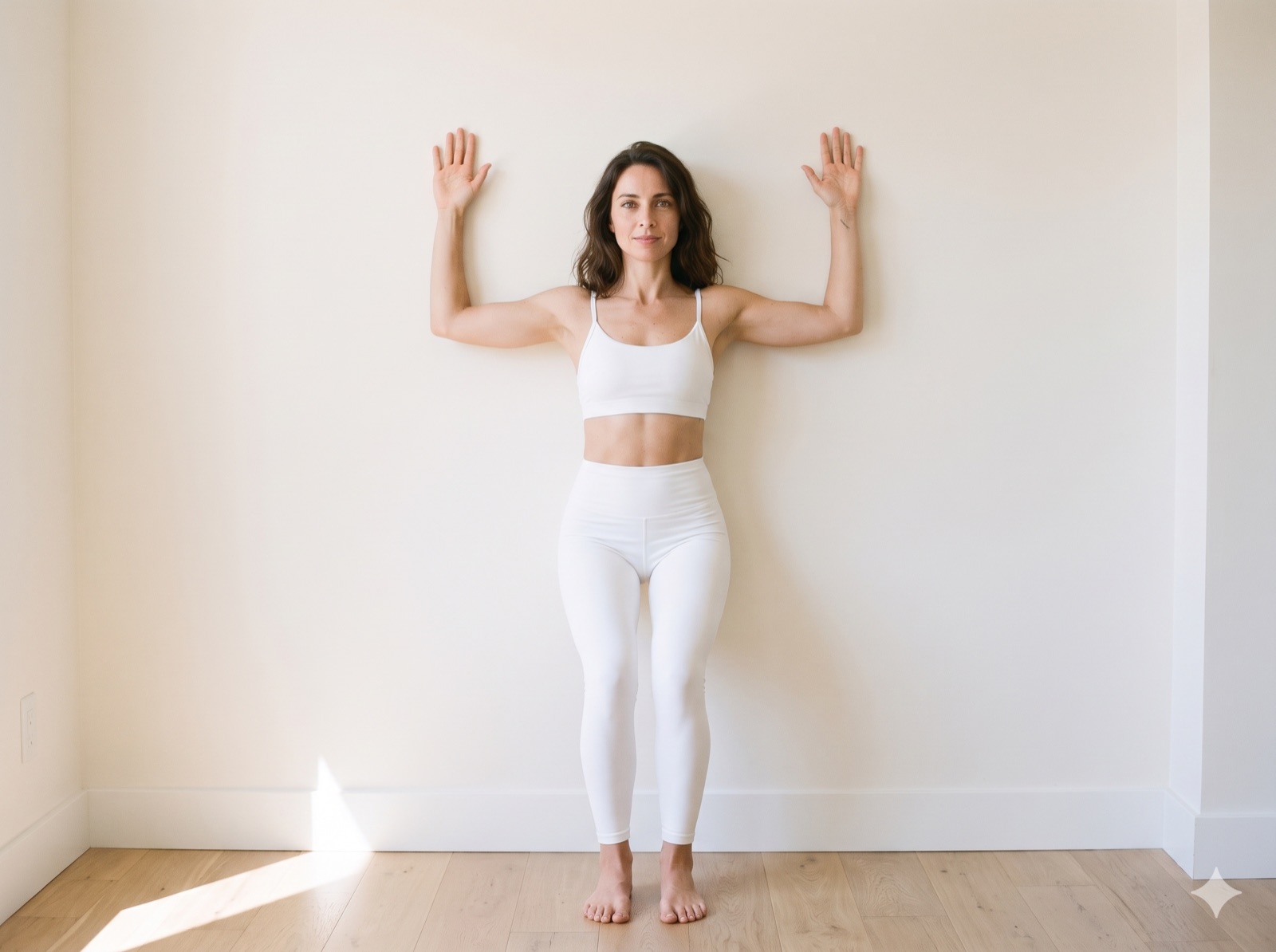
Stand with your back resting on the wall, heels a small step away from it. Close your eyes or soften your gaze. Notice which parts of your back touch the wall and which don’t, where your weight sits in your feet, and whether your jaw or shoulders are holding tension. Don’t fix anything yet; just notice.
2. Slow breathing (2 minutes)
Rest your hands on your lower ribs. Breathe in gently through your nose for about four counts and out through slightly parted lips for about six. Feel your ribs widen on the breath in and settle on the breath out. Five or six slow breaths a minute is plenty; if counting feels stressful, simply let the breath out be longer than the breath in.
3. Wall roll down, very slowly (2 minutes)
From the same position, drop your chin toward your chest and peel your spine away from the wall one small section at a time, arms hanging heavy. Stop wherever the stretch along your back feels pleasant, take a breath, then rebuild slowly from the bottom up. Do it three times, a little slower each time. See the wall roll down demo.
4. Standing wall rotation, exploring the range (2 minutes)
Step about a foot away from the wall, fold your arms at chest height and turn your ribs gently to one side while your hips face forward. Instead of pushing for range, notice where the turn starts to feel effortful and stop just before it. Repeat four times each way and see whether one side moves more easily. See the standing wall rotation demo.
5. Wall angel, half range (2 minutes)
Bring your back and head to the wall, elbows bent to 90 degrees and the backs of your hands touching the wall. Slide your arms up only as far as your hands stay in contact and your ribs stay soft, then slide down. Go slower on the way up than on the way down. Do five. See the wall angel demo.
6. Lying pelvic rocks (2 minutes)
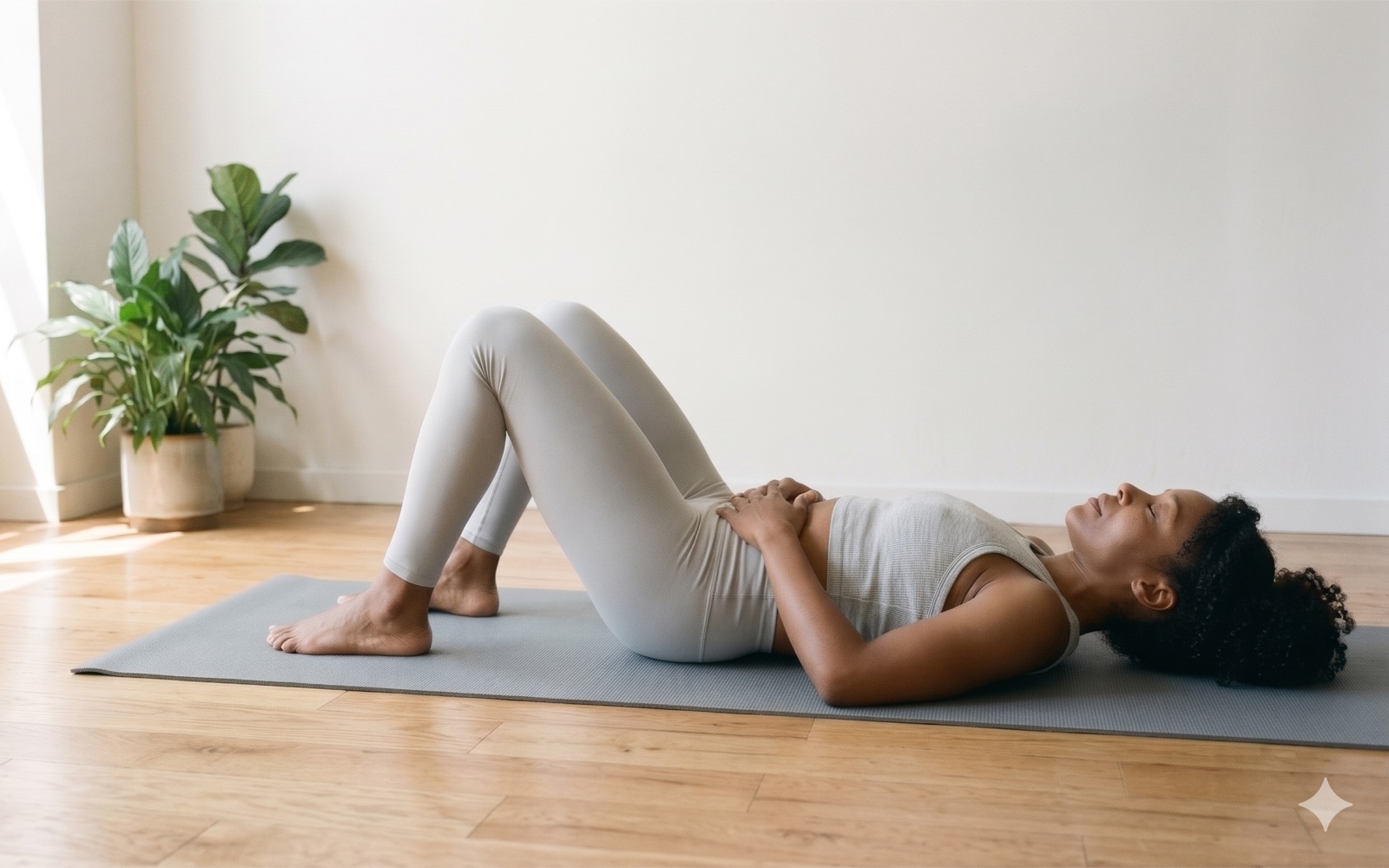
Lie on your back on the mat, knees bent and feet flat. Breathe out and gently tilt your pelvis so your lower back presses lightly into the mat, then breathe in and let it return so a small curve comes back. Keep the movement small and smooth, like a slow rocking. Do eight, then rest and notice how your lower back now meets the floor.
7. Wall chest opener (2 minutes)
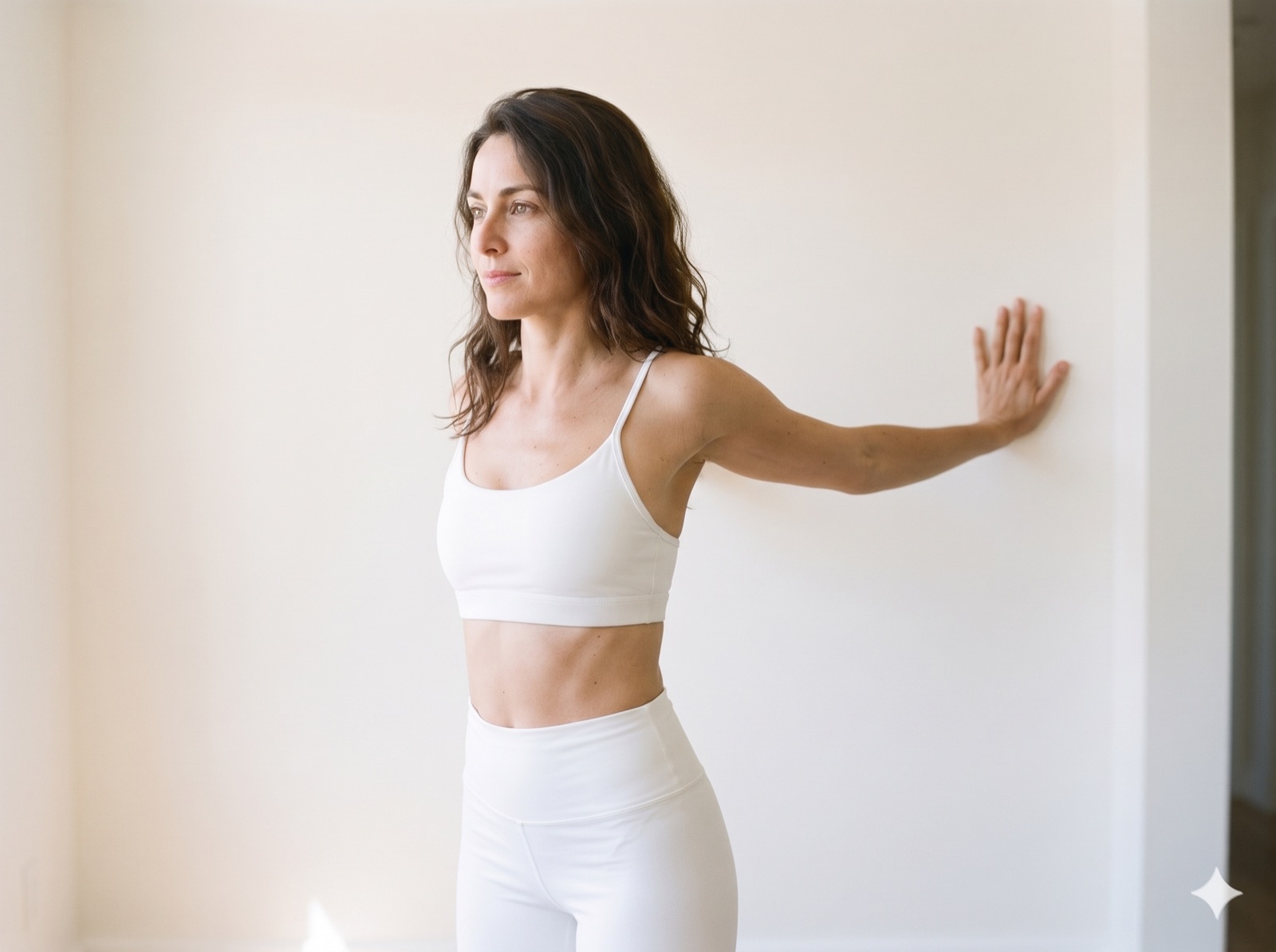
Stand side-on to the wall and place your palm flat on it behind you at shoulder height. Turn your chest gently away from the wall until you feel a mild stretch across the front of your shoulder. Breathe out into the stretch rather than pushing it. Hold for about 45 seconds each side. See the wall chest opener demo.
8. Legs up the wall rest (1 minute or longer)
Lie with your hips close to the wall and your legs resting up it, arms relaxed by your sides. Let the floor take your weight and breathe slowly. Before you get up, repeat the check-in from the start: notice what feels different from 15 minutes ago.
Does somatic Pilates help with weight loss?
Not in any meaningful way on its own. Somatic Pilates is light activity, and even regular mat Pilates has not been shown to change body composition more than other exercise or no exercise.
The numbers behind that:
- Energy use. The 2024 Adult Compendium of Physical Activities lists traditional mat Pilates at 1.8 METs and general Pilates at 2.8 METs, where 1 MET is your energy use at rest [6]. Brisk walking, by comparison, is 4.8 METs [7]. A slow somatic session sits at the low end of the Pilates range.
- Body composition. A review of 10 studies found mat Pilates was no better than other types of training or a control condition for body mass index, body fat or waist size [8].
That doesn’t make somatic Pilates pointless. It is easy to start, easy to keep doing and pleasant, which matters more than calorie counts for building a habit. If weight management is your goal, pair it with walking or other aerobic activity, strength work and attention to food and sleep. Our Pilates calories burned calculator gives an honest estimate for your own sessions.
Who is somatic Pilates good for?
It suits beginners, people who feel stiff or tense, anyone returning to exercise after a long break, and people who find fast classes stressful. It also works well as a warm-up, a cool-down or a rest-day session for people who already train harder.
It is a weaker fit if your main goal is to build strength or fitness. For that, you need sessions where the last few repetitions feel hard, which a somatic class deliberately avoids. Our guide to whether Pilates counts as strength training explains how to make Pilates challenging enough to build strength.
Check with your doctor or a physical therapist before starting if you have a back, hip or joint condition, are recovering from an injury or surgery, are pregnant or have recently had a baby, or have a condition that affects your balance. Lying-down and wall-supported moves are usually the easiest to adapt.
How does somatic Pilates fit into a weekly routine?
Use it as one piece of your week, not all of it. US guidelines advise adults to get 150 to 300 minutes of moderate aerobic activity a week, such as brisk walking, plus muscle-strengthening activity on at least 2 days [9]. A slow somatic session counts toward neither on its own, but it can make the rest easier to keep up.
A simple week might look like this:
| Day | Session |
|---|---|
| Monday | 15-minute strength-focused Wall Pilates + a 20-minute walk |
| Tuesday | 30-minute brisk walk |
| Wednesday | 15-minute somatic session (above) |
| Thursday | 15-minute strength-focused Wall Pilates + a 20-minute walk |
| Friday | 30-minute brisk walk |
| Saturday | Longer walk or an active outing |
| Sunday | 15-minute somatic session, or rest |
If you’d like a structured strength session for the other days, try the free 15-minute full-body Wall Pilates workout, and use the weekly exercise minutes calculator to check your week against the guidelines.
The bottom line
Somatic Pilates is Pilates slowed down and turned inward: gentle movements, long breaths out and attention to how each movement feels. It is a style rather than a separate method, it has roots in Pilates itself, and research on its parts suggests it can help you relax and move more easily, though the studies are small.
Enjoy it for what it is. It is a calm, low-pressure way to move, a good on-ramp for beginners and a useful rest-day session. It won’t build much strength, it isn’t a weight-loss plan, and it isn’t therapy, so pair it with walking and some harder strength work, and see a professional for pain or emotional health.
Sources
Every source was read before it was cited. Numbers in the text, like [1], point here.
- [1]Pilates, mindfulness and somatic educationCaldwell and colleagues, Journal of Dance and Somatic Practices, 2013
- [2]The effects of Pilates on mental health outcomes: a meta-analysis of controlled trialsFleming and Herring, Complementary Therapies in Medicine, 2018
- [3]The effectiveness of the Feldenkrais Method: a systematic review of the evidenceHillier and Worley, Evidence-Based Complementary and Alternative Medicine, 2015
- [4]How breath-control can change your life: a systematic review on psycho-physiological correlates of slow breathingZaccaro and colleagues, Frontiers in Human Neuroscience, 2018
- [5]Pilates for improvement of muscle endurance, flexibility, balance, and postureKloubec, Journal of Strength and Conditioning Research, 2010
- [6]2024 Adult Compendium of Physical Activities: conditioning exerciseAdult Compendium of Physical Activities, 2024
- [7]2024 Adult Compendium of Physical Activities: walkingAdult Compendium of Physical Activities, 2024
- [8]Effects of the mat Pilates method on body composition: systematic review with meta-analysisCavina and colleagues, Journal of Physical Activity and Health, 2020
- [9]Top 10 things to know about the second edition of the Physical Activity Guidelines for AmericansUS Office of Disease Prevention and Health Promotion, 2018
Found this useful? Pass it on