Pilates ball exercises: 8 moves with a small soft ball
A small Pilates ball adds a squeeze, support or a little wobble to classic mat moves. These eight Pilates ball exercises work your core, inner thighs, glutes and back, and you can swap in a cushion or towel if you don't own a ball.
By the TrueMe team · Published · 8 min read · How we write
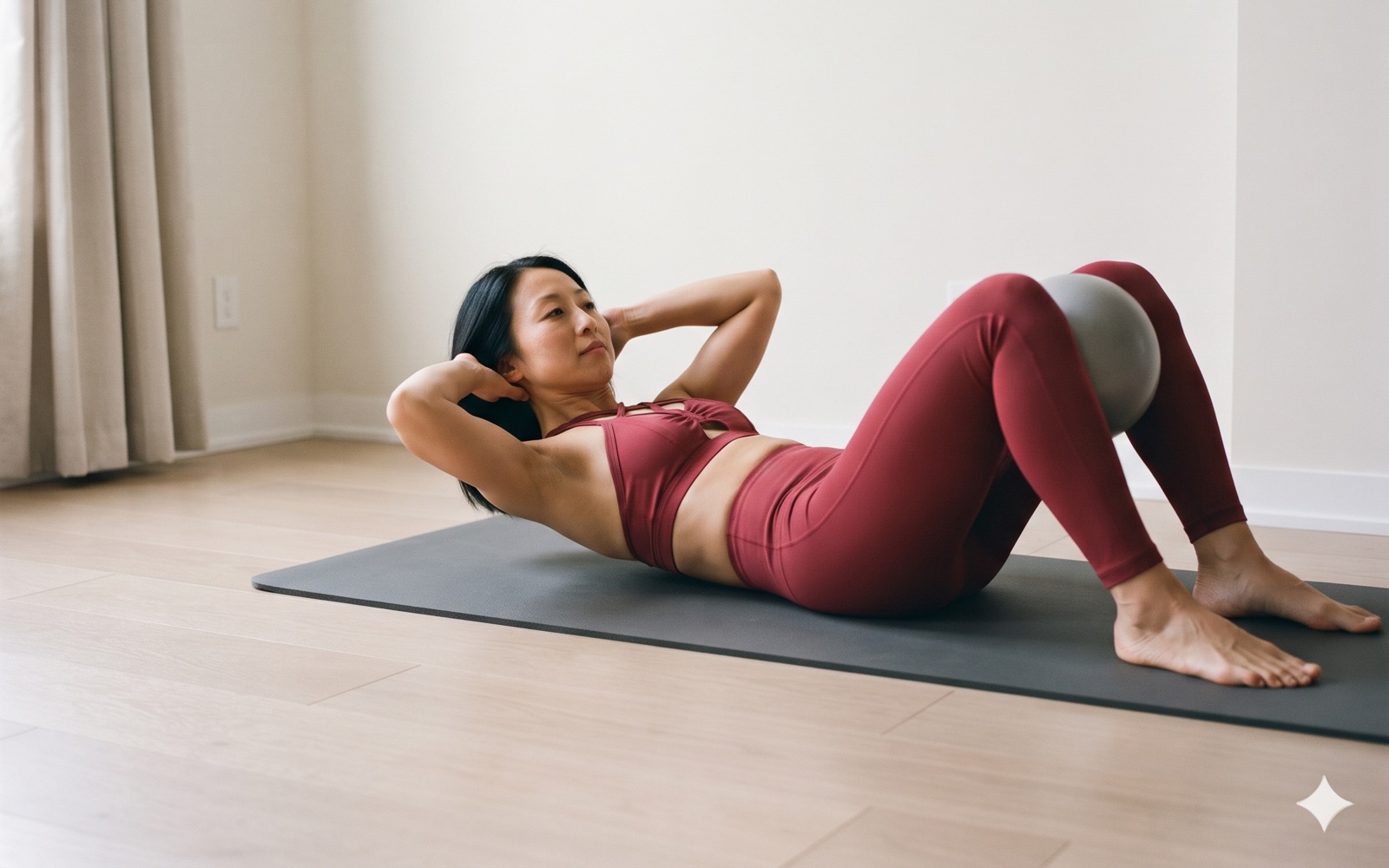
Pilates ball exercises use a small, soft, partly inflated ball to add a squeeze, a support or a little wobble to classic mat moves. Pressing the ball between your knees makes your inner thighs and deep abdominals work together, and resting your back on it makes curls and roll-backs easier to control.
This guide explains what a Pilates ball is, what it can and can’t do, eight Pilates ball exercises with step-by-step cues, a 15-minute workout, how to choose a ball, what to use if you don’t have one, and who should take extra care.
What is a Pilates ball?
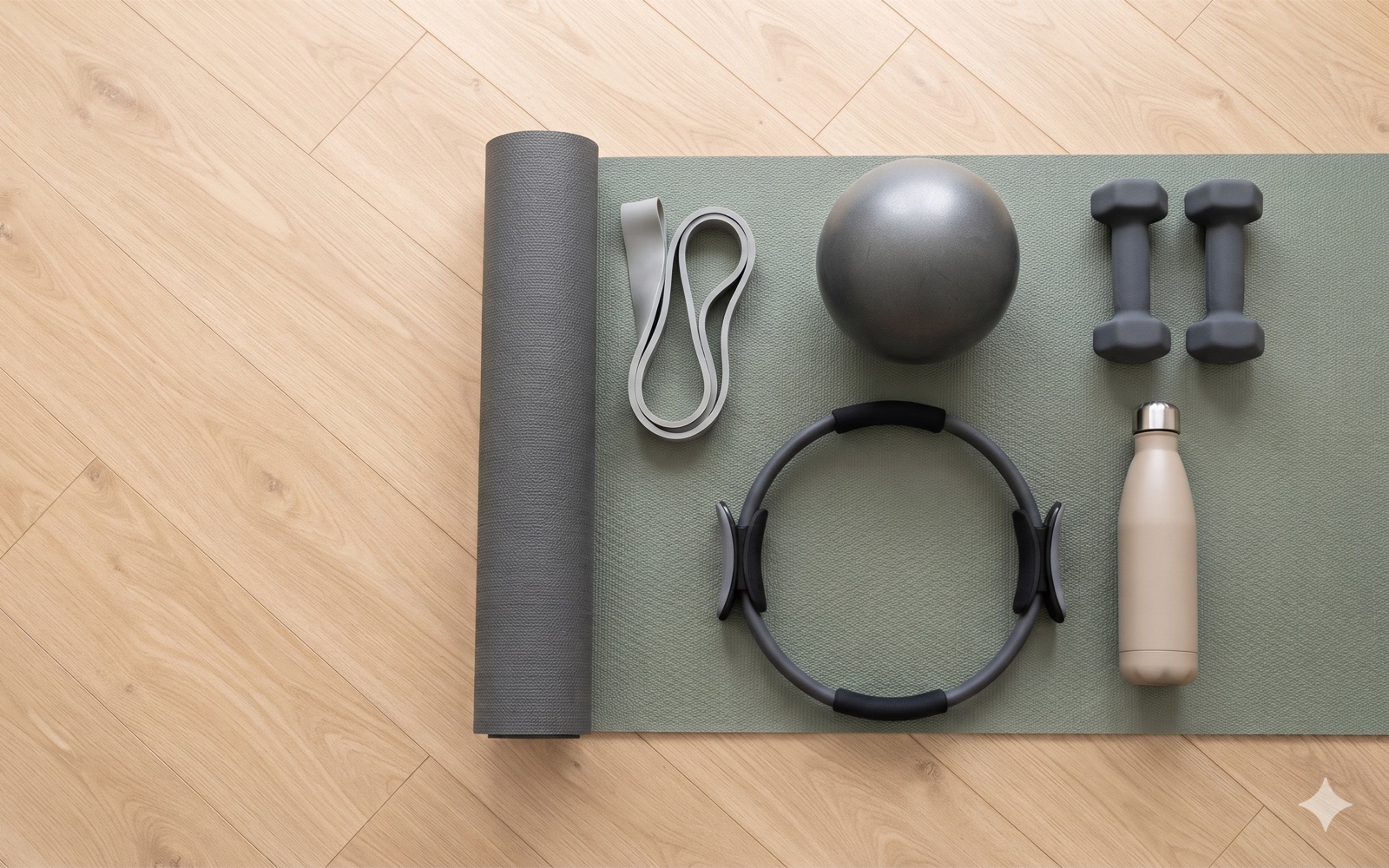
A Pilates ball is a small, soft exercise ball, usually about 7 to 10 inches (18 to 25 cm) across and only partly inflated, so it squashes when you press it. You may see it called a mini ball, soft ball, core ball or overball.
It’s very different from the large stability ball you sit on. The small ball is light, cheap and easy to store, and it can be placed between your knees, under your lower back, under your hips or under your hands. Pilates itself is a mind-body exercise focused on strength, core stability, flexibility, control, posture and breathing, done either on a mat or with specialized equipment [1]. The small ball is one of the simplest ways to add that equipment at home.
| Ball | Size | Main use |
|---|---|---|
| Small Pilates ball | 7–10 in (18–25 cm), soft | Squeezes, back support, small balance challenges |
| Stability ball | 22–30 in (55–75 cm), firm | Sitting, bridges, larger balance work |
What is a small Pilates ball good for?
A small ball is good for three things: giving your muscles something to press against, supporting your back so you can control a move, and adding a little instability. It makes familiar moves feel new, but it doesn’t replace the moves themselves.
A squeeze target. Pressing your knees into the ball switches on your inner thighs, and that effort tends to spread into your trunk. In one lab study, adding an inner-thigh squeeze to a plank increased activity in all the abdominal muscles that were measured, compared with a regular plank [2].
Support. With the ball behind your lower back, you can lean back into a curve and practise controlled rolling without dropping to the floor. That makes roll-backs and curl-ups more approachable for beginners.
A small balance challenge. Placing the ball under your hips or hands adds a little wobble. More wobble isn’t automatically better, though: a study with a large stability ball found back muscles worked harder during Pilates back extensions on the floor than on the ball [3]. Use the ball to change how a move feels, and keep stable floor work in your week as well.
As for results, the research is on Pilates programs in general rather than on the small ball. Middle-aged adults who did mat Pilates twice a week for 12 weeks improved abdominal endurance, hamstring flexibility and upper-body endurance [4], and a meta-analysis found that Pilates two to three times a week for 5 to 12 weeks improved abdominal endurance compared with no exercise [5].
8 Pilates ball exercises
Use a mat on the floor. Breathe out on the effort, keep the movements slow, and stop any move that causes pain. Start with one round of the reps shown.
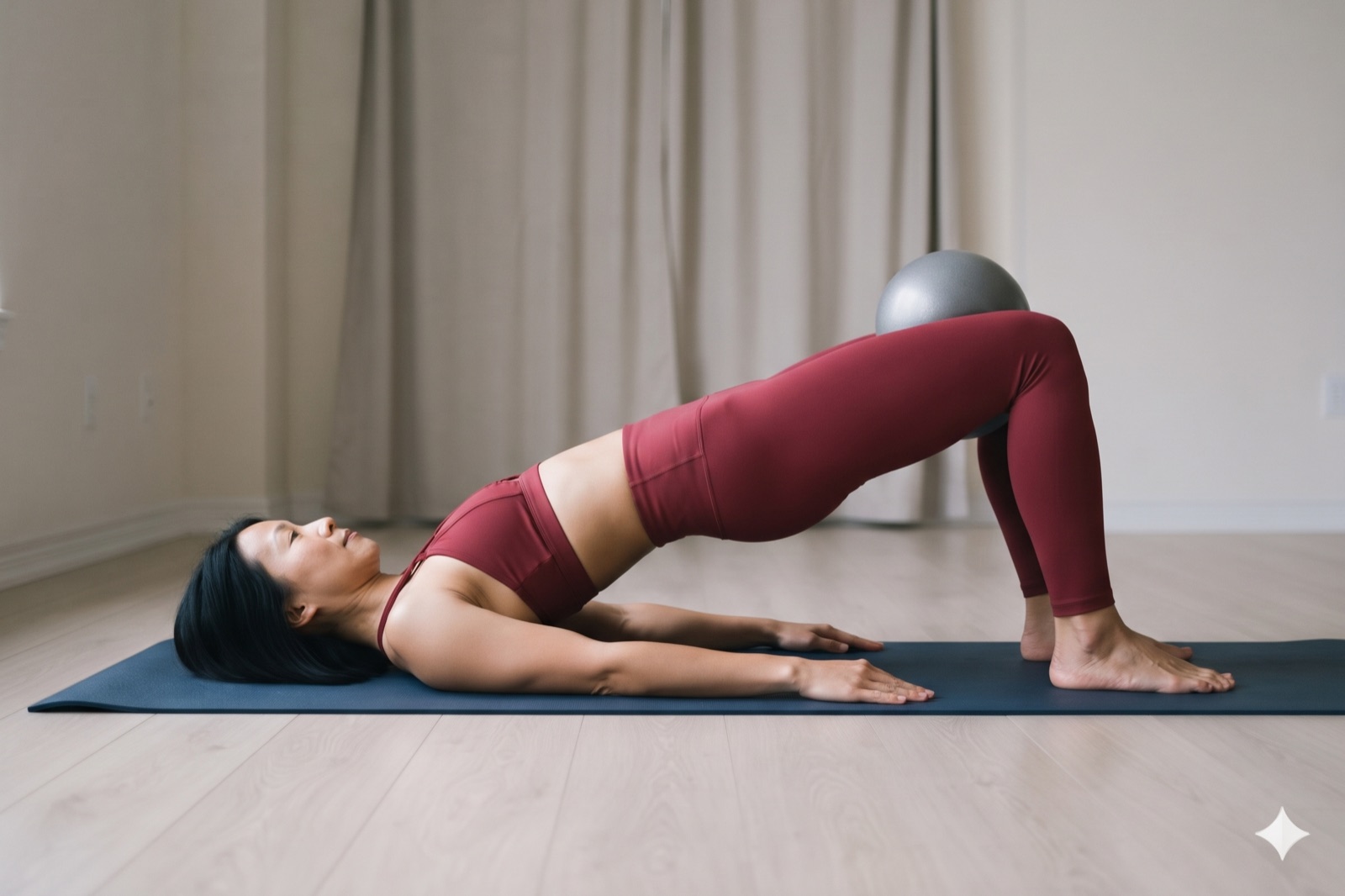
1. Bridge with a ball squeeze
Lie face up, feet planted hip-width apart and knees pointing to the ceiling, with the ball between your knees. Breathe out, press gently into the ball and peel your hips up until your knees, hips and shoulders form a line. Breathe in at the top, then roll down slowly. 8–10 reps. Keep the squeeze steady rather than crushing the ball.
2. Curl-up with a knee squeeze
Lie face up with your feet planted, the ball held between your knees and your hands cradling your head. Breathe out, squeeze the ball and curl your head and shoulders up until the bottom of your shoulder blades lifts, then lower slowly. 8–10 reps. Keep your elbows wide and your chin a fist’s distance from your chest.
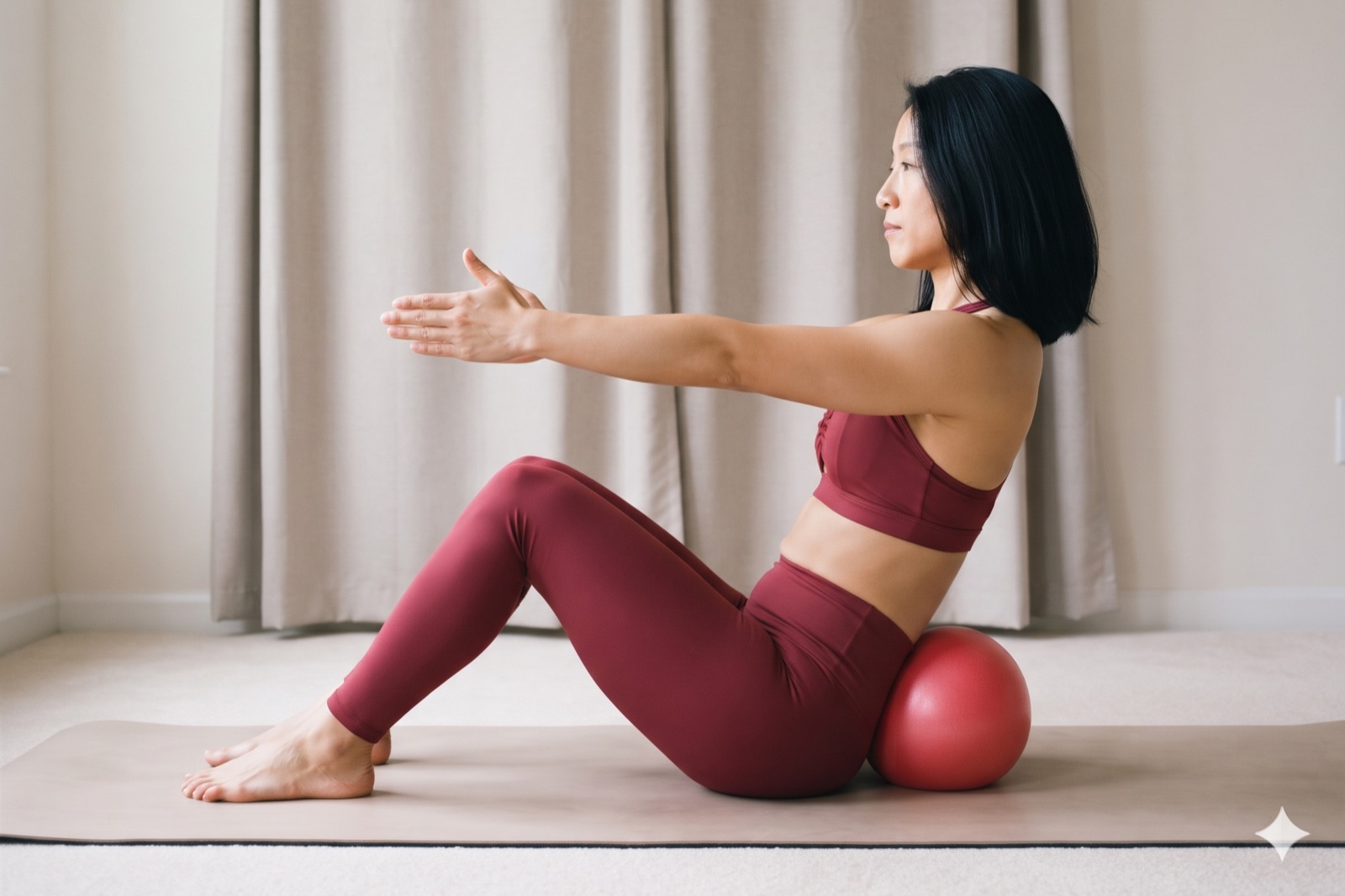
3. Supported roll-back
Sit with your knees bent, feet flat, and the ball tucked behind your lower back. Reach your arms forward, breathe out and roll back onto the ball, letting your spine curve, then breathe in and roll up to sitting tall. 6–8 reps. Easier: roll back only a few inches.
4. Tabletop toe taps
Lie face up with the ball under your lower back and hips, and lift your legs into tabletop so your knees stack over your hips. Breathe out as you lower one foot to tap the floor, then return it and switch. 8 taps each side. The ball supports your back, so focus on keeping your pelvis still.
5. Side-lying leg lifts with the ball
Lie on your side with your head resting on your lower arm and the ball between your ankles. Squeeze the ball gently and lift both legs a few inches, then lower with control. 8–10 reps each side. Keep your hips stacked so you don’t roll backward.
6. Prone back extension on the ball
Lie face down with your arms reaching forward and your hands resting on the ball. Breathe in and lengthen through the top of your head as you roll the ball slightly toward you and lift your chest a few inches, then lower. 6–8 reps. Keep your eyes on the floor and your lower back long.
7. Hip lift with the ball under your feet
Lie on your back with your heels on top of the ball and your arms by your sides. Breathe out and lift your hips a few inches, keeping the ball still, then lower. 6–8 reps. This is harder than it looks; keep the lift small at first.
8. Wall squat with a ball squeeze
Stand with your back against a wall, feet a step forward and hip-width apart, and the ball between your knees. Slide down into a wall squat, pressing gently into the ball, then slide back up. 8–10 reps. Keep your knees in line with your toes.
A 15-minute Pilates ball workout
Do one round, rest a minute, then repeat. Two or three times a week is a good start, alongside other strength work and walking.
| Order | Exercise | Reps |
|---|---|---|
| 1 | Bridge with a ball squeeze | 8–10 |
| 2 | Curl-up with a knee squeeze | 8–10 |
| 3 | Supported roll-back | 6–8 |
| 4 | Tabletop toe taps | 8 each side |
| 5 | Side-lying leg lifts with the ball | 8–10 each side |
| 6 | Prone back extension on the ball | 6–8 |
| 7 | Hip lift with the ball under your feet | 6–8 |
| 8 | Wall squat with a ball squeeze | 8–10 |
US guidelines recommend muscle-strengthening activity on at least two days a week, plus 150 to 300 minutes of moderate aerobic activity [7]. A ball session counts toward the first.
What size and firmness should a Pilates ball be?
Most adults do well with a ball about 9 inches (23 cm) across, inflated so it gives when you squeeze it. It should feel soft enough to squash a little between your knees but firm enough to support your back.
A few tips when choosing one:
- Size: 7 to 8 inches suits smaller frames and knee squeezes; 9 to 10 inches gives more back support.
- Inflation: most come with a straw for inflating by mouth. Start about two-thirds full and adjust; a softer ball is more comfortable under your back.
- Surface: a slightly grippy, matte surface stays put on a mat.
- Price: a small ball is one of the cheapest pieces of Pilates equipment, so there is no need to buy an expensive one.
What can you use instead of a Pilates ball?
You can do most of these moves without a ball at all. For the squeeze, use a firm cushion or a folded bath towel between your knees; for back support, use a rolled towel or a small pillow.
The squeeze is the key part, and a cushion gives you something to press against. You lose the roll and wobble, but the main muscle work stays the same. Our Wall Pilates core exercises and the Wall Pilates for core session need no equipment at all.
Who should be careful with ball exercises?
Most people can use a small Pilates ball safely, because it is soft and close to the floor. Take extra care if you have osteoporosis, back problems, recent surgery or a pregnancy.
People with osteoporosis are advised to avoid movements that twist the spine or bend forward from the waist, such as sit-ups and toe touches [6]. That rules out curl-ups and roll-backs; bridges, side-lying leg lifts and wall squats are better choices. If you are pregnant, have back pain or are recovering from an injury or surgery, ask your doctor or physical therapist which moves suit you. Stop any exercise that causes sharp pain, pain that travels down a leg, or dizziness.
The bottom line
A small Pilates ball is an inexpensive way to add a squeeze, support or a little wobble to classic mat moves. It doesn’t make Pilates work on its own, but it can make familiar exercises feel fresh and easier to control.
Start with the eight moves above two or three times a week, keep the squeeze gentle and the pace slow, and swap in a cushion or towel if you don’t have a ball. Choose bridges and side-lying work over curls if you have osteoporosis, and check with a professional when in doubt.
Sources
Every source was read before it was cited. Numbers in the text, like [1], point here.
- [1]Defining Pilates exercise: a systematic reviewWells and colleagues, Complementary Therapies in Medicine, 2012
- [2]Comparison of EMG activity on abdominal muscles during plank exercise with unilateral and bilateral additional isometric hip adductionKim and colleagues, Journal of Electromyography and Kinesiology, 2016
- [3]Muscle activity of the erector spinae during Pilates isometric exercises on and off Swiss ballPaz and colleagues, Journal of Sports Medicine and Physical Fitness, 2014
- [4]Pilates for improvement of muscle endurance, flexibility, balance, and postureKloubec, Journal of Strength and Conditioning Research, 2010
- [5]Effect of the Pilates method on physical conditioning of healthy subjects: a systematic review and meta-analysisCampos and colleagues, Journal of Sports Medicine and Physical Fitness, 2016
- [6]OsteoporosisMedlinePlus, U.S. National Library of Medicine, 2025
- [7]Top 10 Things to Know About the Second Edition of the Physical Activity Guidelines for AmericansOffice of Disease Prevention and Health Promotion (ODPHP), U.S. Department of Health and Human Services, 2025
Found this useful? Pass it on