Wall Pilates core exercises: 12 moves from standing to floor
Wall Pilates core exercises use a wall to guide, anchor and support slow Pilates moves for the muscles around your middle. Here are 12 of them, standing and on the floor, with a 15-minute routine and an honest look at what core training can and can't do.
By the TrueMe team · Published · 14 min read · How we write
Wall Pilates core exercises are slow, controlled Pilates moves that use a wall as a guide, an anchor or a support while you train the muscles around your middle. Standing, the wall tells you the moment your back starts to move. Lying down, it gives your feet something to press into, so you can hold good positions for longer than you could on a mat alone.
This guide walks through twelve of them: six you do on your feet, including two standing planks, and six on the floor with your feet or hands on the wall. You’ll also find how to breathe during core work, a 15-minute routine, how often to train, and an honest answer on what core exercises can and can’t change. Every move has an easier and a harder version.
What are Wall Pilates core exercises?
They are core exercises built around a wall: you lean into it, press against it or keep part of your body in contact with it while your arms, legs or spine move. The wall does two jobs. It gives you feedback, because you can feel your lower back peel away or your hips twist, and it makes hard positions manageable, because it takes some of your body weight.
Most of them fall into three groups:
- Standing moves with your back or hands on the wall: marching, roll downs, rotations and knee drives.
- Standing planks with your forearms on the wall, which load the core without getting on the floor.
- Floor moves with your feet or hands on the wall: tabletop holds, leg reaches, a dead bug, a bridge and a supported roll back.
You need a clear stretch of wall, enough floor to lie down with your feet against it, and ideally a mat or a folded blanket under your back. Bare feet or grippy socks stop your feet from sliding on the wall.
Which muscles do Wall Pilates core exercises work?
They work the whole band of muscle between your ribs and your hips, front, sides and back, along with the hip muscles that link it to your legs. Sports scientists describe core stability as the ability to control the position and motion of your trunk over your pelvis, so that force passes cleanly between your legs and arms [1]. That control is what these moves train.
- Rectus abdominis. The long muscle down the front that curls your trunk forward. It is a single muscle, so there is no separate “lower abs” muscle to isolate.
- Obliques. The layers on your sides, which twist and side-bend your trunk and stop it from twisting when you don’t want it to.
- Transversus abdominis. The deepest layer, which wraps around your middle like a wide belt and tightens when you breathe out firmly.
- Back extensors and glutes. The muscles along your spine and behind your hips, which hold you upright and keep your pelvis level when one leg moves.
Crunches train one of those jobs: curling forward. Core training in the broader sense is about keeping the trunk steady while your arms and legs move [1], and that is where the wall helps most.
How should you breathe during core exercises?
Breathe out on the hardest part of each move and keep breathing steadily; never hold your breath. In Pilates you usually breathe in through your nose to prepare and out through your mouth as you move, and that long breath out is what tightens the deep belly muscles.
Practice it once before you start:
- Stand tall with your shoulders and hips touching the wall, heels a small step out, hands resting on your lower ribs.
- Breathe in through your nose and feel your ribs widen into your hands.
- Breathe out slowly through slightly pursed lips, as if cooling a hot drink. Feel your ribs draw in and your belly gently tighten, while your back stays in light contact with the wall.
- As you breathe in again, keep a little of that tightness. That gentle, steady brace, not a hard clench, is what you hold through the moves below.
If you can’t talk in short sentences during a move, you are bracing too hard.
Which standing Wall Pilates core exercises should you start with?
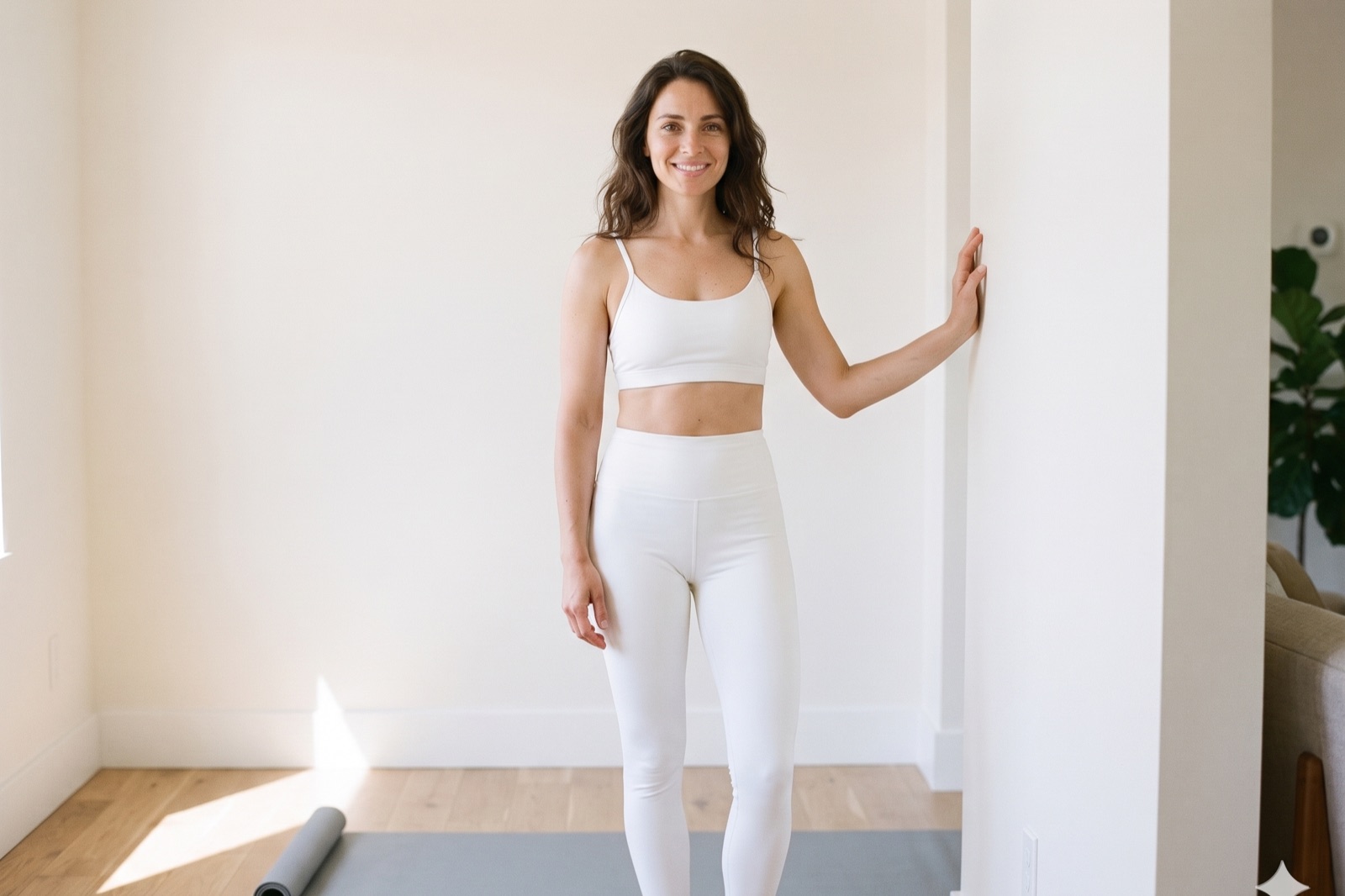
Start with wall marching and the wall roll down. Both are gentle, and both teach the main skill of core work: keeping your trunk still while something else moves. Do each move slowly, 8 to 10 times per side unless a time is given, and stop any move that causes pain.
1. Wall marching
Lean your shoulders and hips on the wall with your heels a small step out and your hands resting lightly on the wall beside your hips. Breathe out and lift one knee toward hip height without letting your lower back come away from the wall, then lower it with control and switch sides. Keep the standing knee soft. It looks simple; keeping your back still is the hard part. See the wall marching demo.
Easier: lift only your heel and keep your toes on the floor. Harder: take your hands off the wall and hold each knee up for two seconds.
2. Wall roll down
Rest your whole back on the wall with your heels a step away from it. Drop your chin toward your chest and peel your spine away from the wall one section at a time, letting your arms and head hang heavy. Then rebuild from the bottom up, placing each part of your back against the wall again. Take about four seconds down and four seconds up. See the wall roll down demo.
Easier: roll down only as far as your ribs, then come back up. Harder: pause at the bottom for three slow breaths before you roll up.
3. Standing wall rotation
Stand with your back about a foot from the wall, feet planted, arms folded at chest height. Breathe out and turn your ribs to one side while your hips keep facing forward, then come back through the middle and turn the other way. Go only as far as you can without a foot moving. This trains your obliques in the twisting pattern you use every day. See the standing wall rotation demo.
Easier: turn through a smaller range with one hand touching the wall for reference. Harder: reach your arms out long as you turn, and pause for two seconds at the end of the turn.
4. Wall knee drives
Place your hands on the wall at shoulder height with your arms straight, then walk your feet away from the wall until you lean into it in one long line. Drive one knee toward your chest, place that foot back down and switch, at a pace you can hold for 30 to 40 seconds. This is the one move here meant to raise your heart rate, so expect to breathe harder. See the wall knee drives demo.
Easier: march on the spot at the wall, keeping both feet low. Harder: step your feet farther back and pick up the pace.
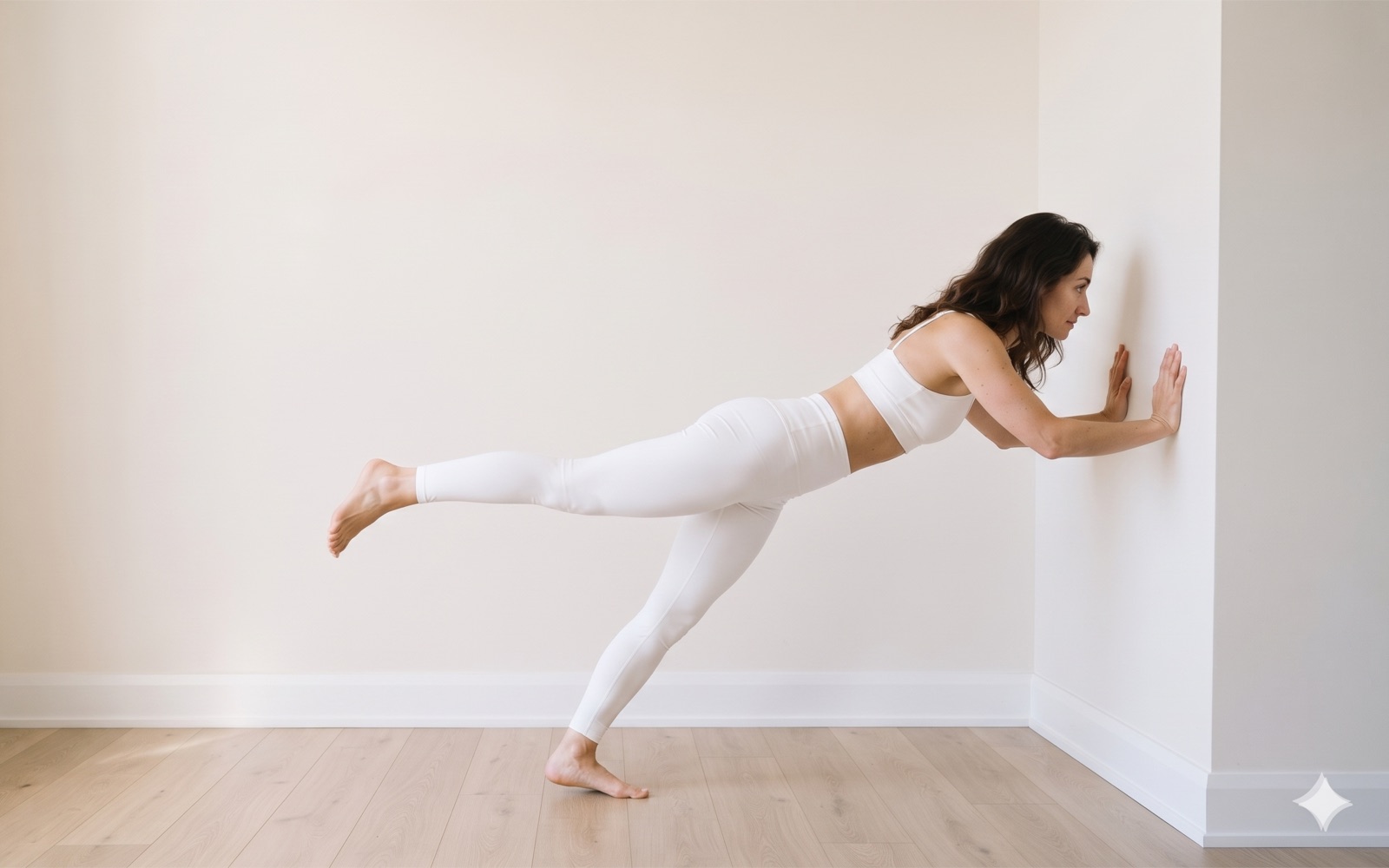
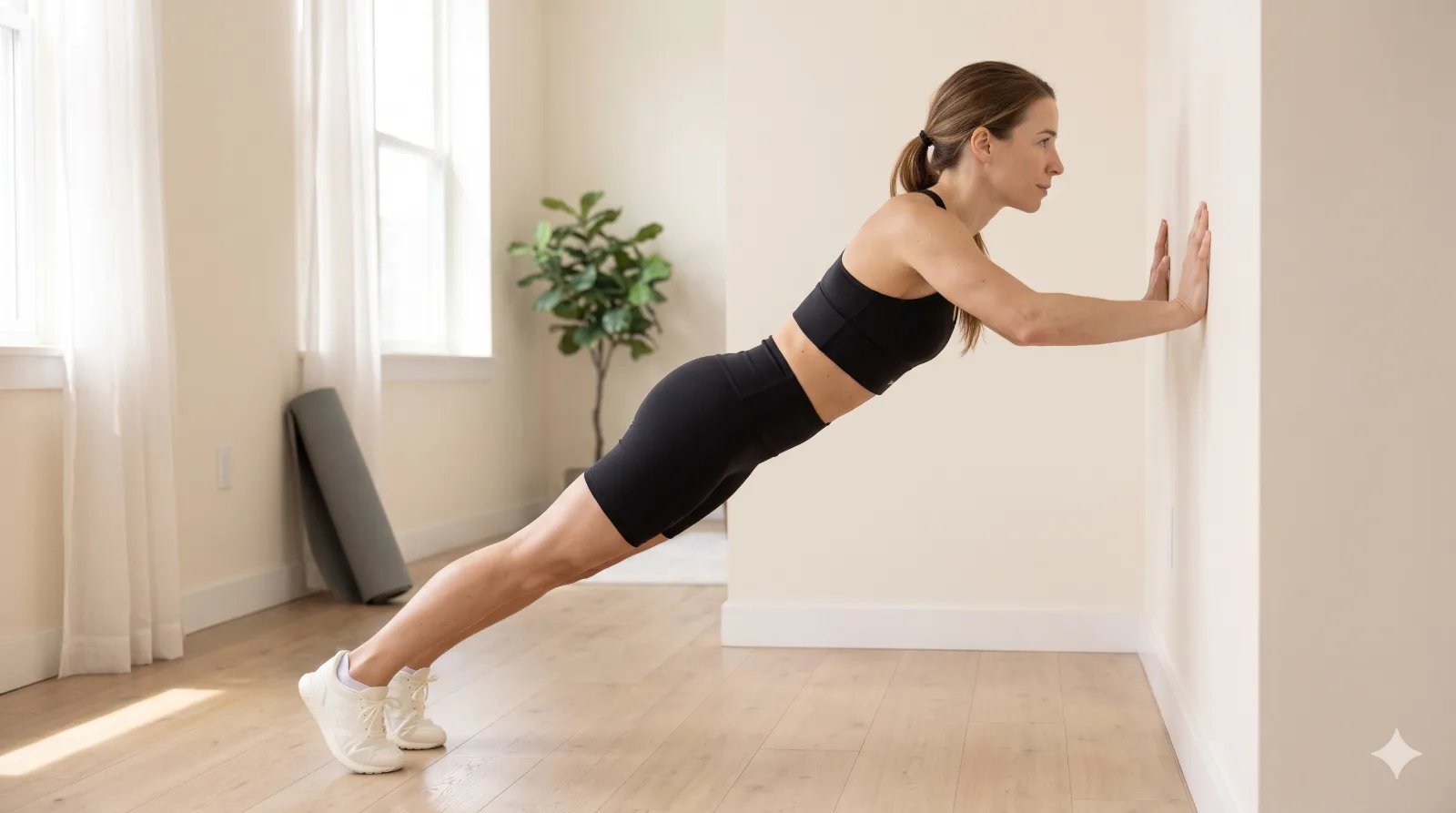
5. Wall forearm plank
Face the wall and place your forearms on it at shoulder height, elbows under your shoulders and hands loosely together. Walk your feet back until your body makes one straight, slanted line from your head to your heels. Breathe out, draw your belly gently in and squeeze your glutes, then hold for 20 to 30 seconds while breathing steadily.
The more upright your body, the less of your weight your arms and trunk have to hold. A lab study of push-up variations measured exactly this pattern: with the hands raised, the load was clearly lower than in a floor push-up [2]. That makes the wall plank a sensible step toward a plank on the floor.
Easier: walk your feet closer to the wall. Harder: walk them farther back, or lift one heel at a time while your hips stay still.
6. Wall side plank
Stand side-on to the wall and place the forearm nearest to it on the wall at shoulder height, elbow under your shoulder. Step your feet out to the side, away from the wall, so your body forms a straight diagonal line, with your feet staggered or stacked. Keep the hip nearest the wall from sagging toward it. Hold for 15 to 30 seconds, then turn around and do the other side. This works the obliques and the side of the hip together.
Easier: keep your feet closer to the wall and staggered. Harder: step farther out and reach your top arm toward the ceiling.
Which floor Wall Pilates core exercises use the wall?
On the floor, the wall works as a footrest and an anchor. With your feet pressing into it, you can hold tabletop and bridge positions that are hard to keep steady on a mat alone, and the wall tells you when your legs start to drift.
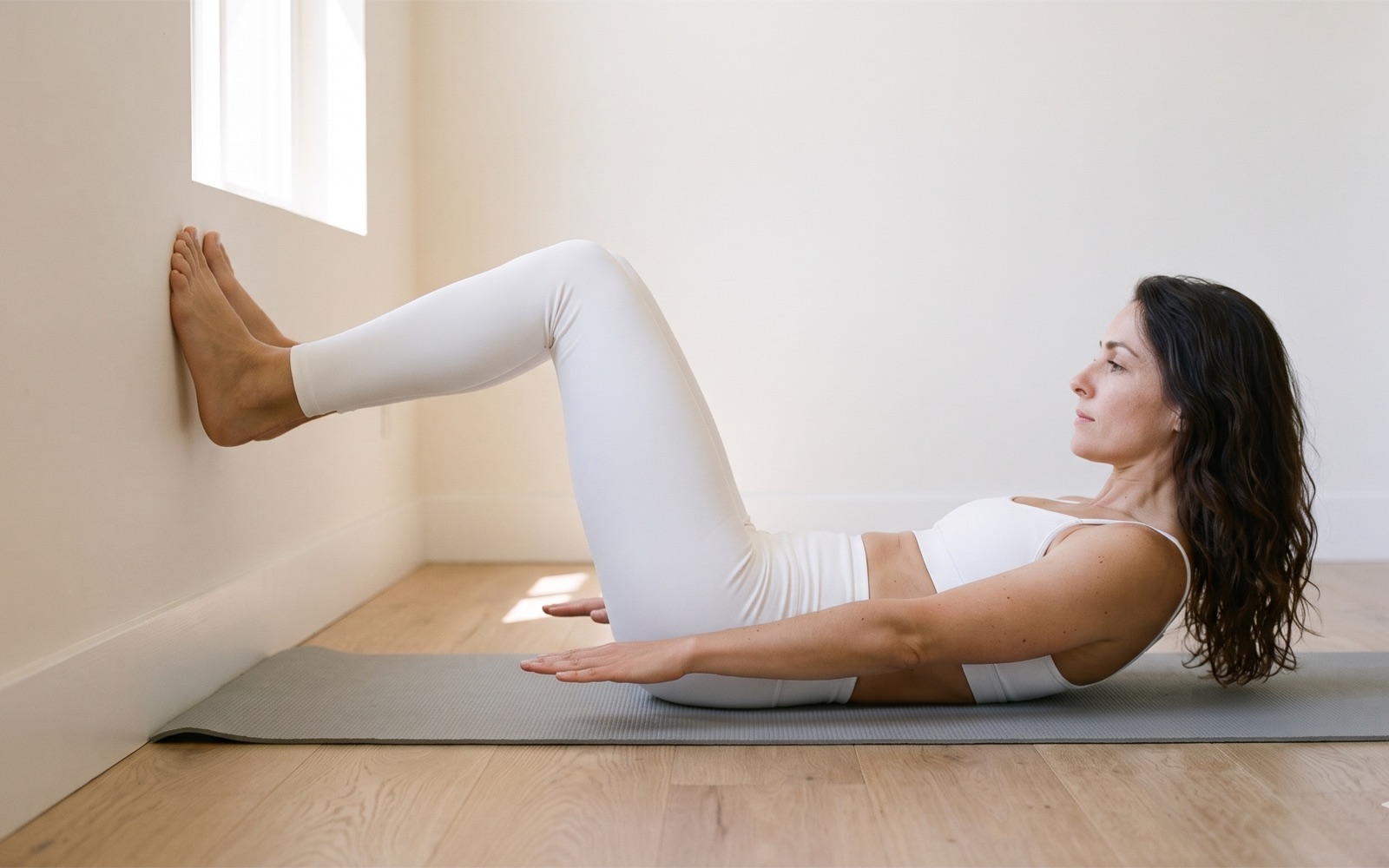
For moves 7, 9 and 10, lie on your back with your hips far enough from the wall that, with your knees bent at 90 degrees, your feet rest flat on it. Move 8 turns you around, and moves 11 and 12 have their own setup.
7. Wall tabletop pulses
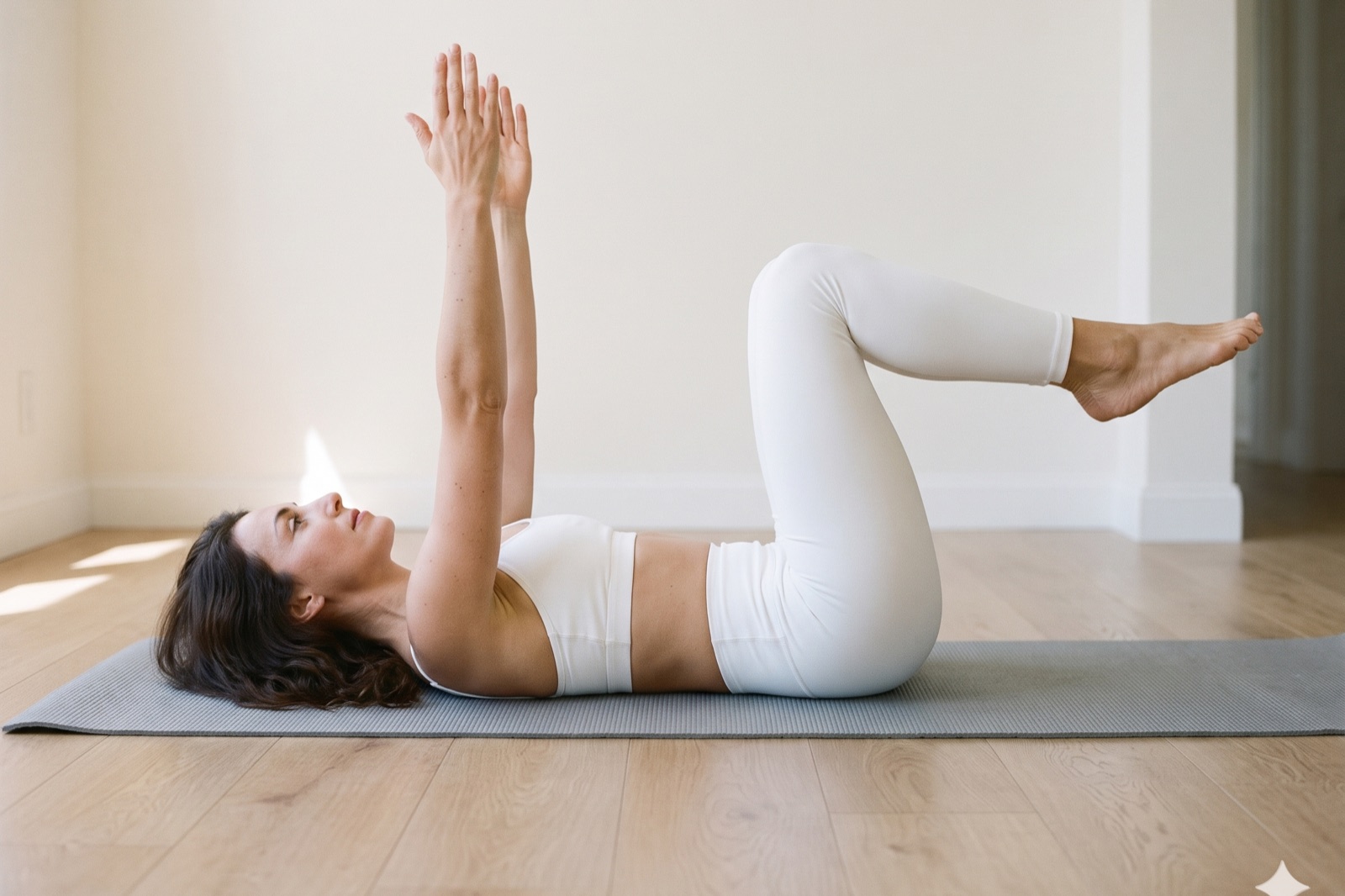
Lie with your knees bent at 90 degrees, feet flat on the wall and shins parallel to the floor. Let your lower back rest gently toward the mat. Breathe out, nod your chin and lift your head and the tops of your shoulders a little off the mat, arms long by your sides and just above the floor. Pulse your arms up and down in small, quick movements, breathing in for five pulses and out for five. Work up to 50 pulses, half of the classic Pilates hundred.
Easier: keep your head down on the mat and only pulse your arms. Harder: take one foot off the wall and hold that knee over your hip while you pulse.
8. Wall dead bug press
Turn around so the top of your head is about a forearm’s length from the wall. Reach your arms overhead and press your palms firmly into the wall, then lift your knees one at a time into tabletop, knees over hips. Keeping your lower back steady on the mat, breathe out and lower one heel to tap the floor, then bring it back and switch. Pressing into the wall gives your trunk something to brace against, which makes it easier to stop your back from arching. Do 8 taps per side.
Easier: keep one foot on the floor and move only the other leg. Harder: straighten the moving leg as you lower it and hover it just above the floor.
9. Wall single-leg reach
Lie in the tabletop position with both feet on the wall and your hands resting on the front of your hip bones. Breathe out and take one foot off the wall, straightening that leg out on a diagonal toward the ceiling. Your hands check that your pelvis stays level and still. Bring the foot back to the wall and switch. Do 8 per side.
Easier: reach the leg higher, closer to straight up, which is lighter on your belly muscles. Harder: reach the leg lower, or lift your head and shoulders as in move 7 while you reach.
10. Wall bridge with march
Lie with your feet flat on the wall, a little below knee height, knees bent at about 90 degrees. Breathe out, press your feet into the wall and lift your hips, rolling up one section of your spine at a time until your body makes a line from your knees to your shoulders. Hold it there and breathe in. Breathe out and lift one foot a few inches off the wall without letting your hips tip, then put it back and switch. Roll down slowly to finish. Do 8 bridges, with one march per side on each.
Easier: lift and lower the bridge without the march. Harder: do 5 slow marches per side in each bridge, holding each foot off the wall for two seconds.
11. Supported roll back
Sit facing the wall with your knees bent and the soles of your feet pressed flat against it, hands resting lightly behind your thighs. Sit tall. Breathe out and tuck your pelvis under, rounding your lower back, and roll back about halfway toward the mat. Pause for one breath, then breathe out and curl back up to sitting tall. Pressing your feet into the wall anchors your legs, which makes the curl back up smoother and steadier. Do 6 to 8.
Easier: roll back only a few inches. Harder: cross your arms over your chest instead of holding your thighs.
12. Legs-up-the-wall leg lowers
Lie with your hips close to the wall and your legs straight up it, heels resting on the wall. Let your lower back settle toward the mat. Breathe out and slowly lower one leg away from the wall toward the floor, only as far as your lower back stays still, then bring it back up to the wall. The wall holds the other leg, so you can focus on one side at a time. Do 6 per side.
Easier: bend the moving knee and lower it only a few inches. Harder: take five seconds to lower the leg and five to lift it.
What does a 15-minute Wall Pilates core routine look like?
Warm up on your feet, do two rounds of five moves that mix standing and floor work, and finish with a slow cool-down. Rest for 15 to 20 seconds between moves and about a minute between rounds.
| Part | Move | Amount |
|---|---|---|
| Warm-up (2 min) | Wall breathing | 5 slow breaths |
| Wall marching | 45 seconds | |
| Wall roll down | 4 slow reps | |
| Round 1 (5 min) | Wall forearm plank | 20 to 30 seconds |
| Standing wall rotation | 8 per side | |
| Wall tabletop pulses | 30 to 50 pulses | |
| Wall single-leg reach | 8 per side | |
| Wall bridge with march | 8 bridges | |
| Round 2 (5 min) | Repeat round 1 | Same amounts |
| Cool-down (2 min) | Wall roll down | 2 very slow reps |
| Legs resting up the wall | 1 minute of slow breathing |
Swap in the other moves as they get easier: the side plank for the forearm plank, the dead bug press for the tabletop pulses, or knee drives when you want your heart rate up. If you’d rather follow a voice and a timer, our free 10-minute Wall Pilates for core session uses the standing moves, with no floor work at all.
How often should you do Wall Pilates core exercises?
Two or three times a week is a good rhythm for most beginners. US guidelines advise muscle-strengthening activity at least 2 days a week, along with 150 to 300 minutes of moderate aerobic activity such as brisk walking [3]. Core work counts toward the strength part, but the guideline means all your major muscle groups, so pair these moves with leg and upper-body work.
What to expect over time:
- Endurance first. In a 12-week study, middle-aged adults who did a one-hour mat Pilates class twice a week improved abdominal endurance, hamstring flexibility and upper-body endurance compared with a group that did no Pilates [4].
- Not everything changes quickly. The same study found no measurable change in posture or balance after 12 weeks [4]. Steadiness takes practice in the positions you want to be steady in.
- Progress one thing at a time. Add five seconds to a hold, two reps to a move, or try one harder version, but not all three in the same week.
If you are building a weekly plan, our guide to how often you should do Pilates covers rest days and splits, and the weekly exercise minutes calculator checks your week against the guidelines.
Can Wall Pilates core exercises flatten your stomach?
Not on their own. Working the muscles under one area doesn’t burn the fat over it. In a six-week trial, people who did abdominal exercises five days a week built more abdominal endurance than a group that didn’t exercise, but they saw no change in belly fat, waist size or overall body fat [5].
What core training can do is make the muscles around your middle stronger and more enduring, so you feel steadier when you lift, carry, twist and get up off the floor. Changes in body shape come from your overall activity, eating and sleep over months, not from one exercise. That is also why every move in this guide has a job beyond “the abs”: control, breathing and a steady trunk while you move.
How do you do core work safely?
Go slowly, keep breathing, and shrink the movement before you lose your position. Most problems in core exercises come from rushing or from forcing a range you don’t have yet.
Common mistakes and their fixes:
- Holding your breath. Breathe out on the effort, every repetition.
- Arching your lower back in the plank, dead bug or leg lowers. Make the movement smaller until your back stays still.
- Pulling on your neck in the tabletop pulses. Nod your chin, look toward your knees, and put your head down when your neck tires.
- Going fast. Speed hides weak spots. Slow, even repetitions are harder and safer.
- Pushing through pain. Effort and mild muscle burn are normal. Sharp, pinching or radiating pain means stop.
Check with your doctor or a physical therapist before starting if you are pregnant or have recently had a baby, have had abdominal or back surgery, have a back, hip or pelvic condition, or notice a ridge or doming along the middle of your belly when you lift your head. A physical therapist can show you which versions suit you.
The bottom line
Wall Pilates core exercises use the wall to make core training easier to learn and easier to hold: standing moves for control, wall planks as a bridge to the floor, and floor moves with your feet on the wall for longer, steadier holds. Start with marching, roll downs and the wall plank, breathe out on every effort, and add the floor moves as your control improves.
Twice or three times a week, alongside walking and some leg and arm work, is enough to build real strength and endurance around your middle. Just keep the expectations honest: core work makes you steadier and stronger, and it won’t spot-reduce your stomach.
Sources
Every source was read before it was cited. Numbers in the text, like [1], point here.
- [1]The role of core stability in athletic functionKibler and colleagues, Sports Medicine, 2006
- [2]Kinetic analysis of several variations of push-upsEbben and colleagues, Journal of Strength and Conditioning Research, 2011
- [3]Top 10 things to know about the second edition of the Physical Activity Guidelines for AmericansUS Office of Disease Prevention and Health Promotion, 2018
- [4]Pilates for improvement of muscle endurance, flexibility, balance, and postureKloubec, Journal of Strength and Conditioning Research, 2010
- [5]The effect of abdominal exercise on abdominal fatVispute and colleagues, Journal of Strength and Conditioning Research, 2011
Found this useful? Pass it on