Wall Pilates arms: 9 moves for stronger arms and shoulders
Wall Pilates arms exercises use a wall as resistance for slow push, press and slide moves that strengthen your arms, shoulders, chest and upper back. Here are nine of them with easier and harder versions, a 12-minute routine, and an honest answer on what arm training can and can't change.
By the TrueMe team · Published · 12 min read · How we write
Wall Pilates arms work means slow, controlled upper-body moves that use a wall as your resistance and your guide: you push away from it, press into it or slide your arms along it. Because you lean instead of lying on the floor, you lift only part of your body weight, which makes it a gentle way to build strength in your arms, shoulders, chest and upper back.
This guide covers nine Wall Pilates arms exercises, from the wall push-up to a standing plank, each with an easier and a harder version. You’ll also find a 12-minute routine, how to make the moves harder as you get stronger, how often to train, and an honest answer to the question most people actually search: can any of this slim your arms?
What is Wall Pilates for arms?
It is upper-body training done standing at a wall, using Pilates principles: slow tempo, steady breathing and a trunk that stays still while the arms work. The wall replaces dumbbells. How far your feet are from it sets how hard each move is.
Three things make the wall useful for arm work:
- Adjustable load. Step your feet closer and the move gets easier; step back and more of your weight goes into your hands.
- Instant feedback. In moves with your back against the wall, you feel the moment your ribs flare or your low back arches.
- No floor work. You never have to get down and back up, which matters if your knees or wrists object to a floor push-up.
You need a clear stretch of wall about as wide as your outstretched arms, shoes with grip or bare feet on a floor that isn’t slippery, and nothing else.
Which muscles do Wall Pilates arm exercises work?
They work the muscles that push, the muscles that hold your shoulders in place, and the muscles of your upper back that keep you upright. Pushing moves load the chest, the front of the shoulders and the triceps; sliding and pressing moves load the upper back and the small muscles around the shoulder blade.
- Triceps. The back of the upper arm. They straighten your elbow every time you press away from the wall.
- Chest (pectorals). They bring your arms forward and together, and do much of the work in any push-up.
- Deltoids. The rounded shoulder muscles, which lift your arms forward, out to the side and overhead.
- Serratus anterior and rotator cuff. Smaller muscles that wrap the shoulder blade and hold the joint steady as your arm moves.
- Upper back (rhomboids and trapezius). They draw your shoulder blades back and down, which is the opposite of the hunch that screens and steering wheels encourage.
- Core. In every push and plank, your trunk has to hold one straight line, so your middle works too.
The biceps get less direct work here, because a wall is good for pushing and poor for pulling. They still help steady the elbow, and the chest opener at the end stretches them.
9 Wall Pilates arms exercises
Do each move slowly, breathing out as you push or lift and in as you return. Stop any move that causes sharp pain, pins and needles, or pain that lingers afterward. The first four are TrueMe’s filmed moves, so you can watch a demo on each exercise page.
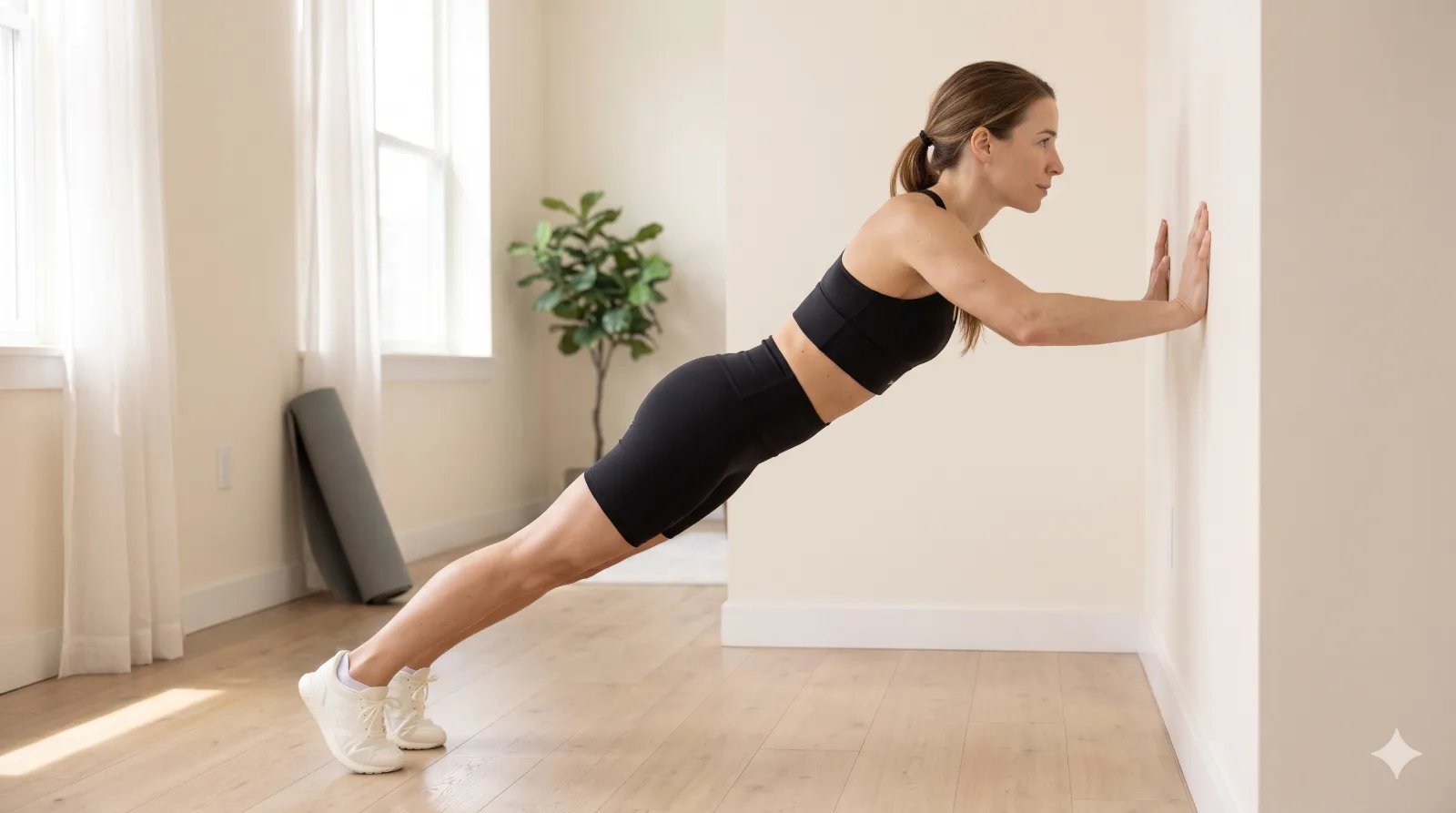
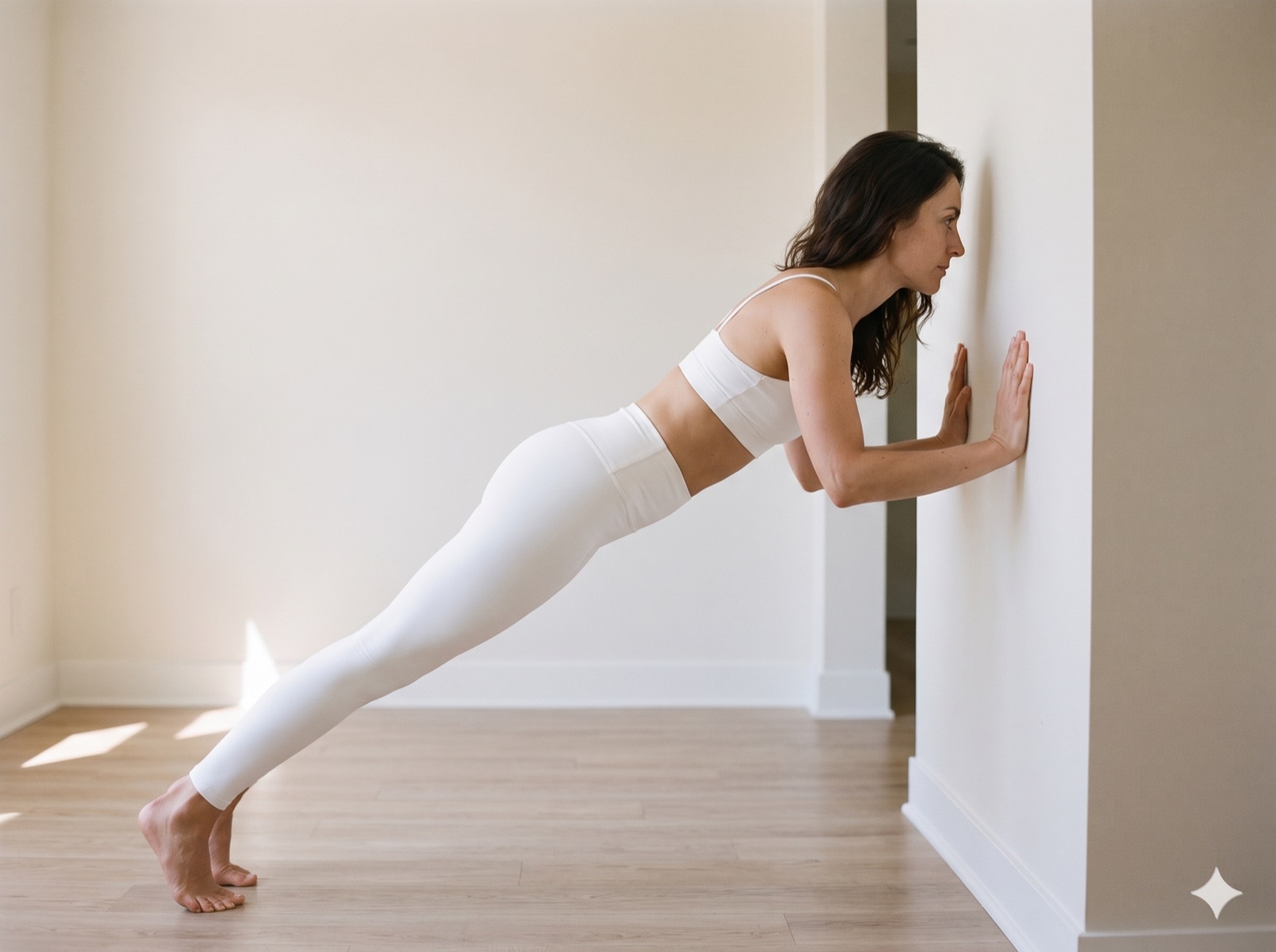
1. Wall push-up
The foundation of wall arm work, for the chest, shoulders and triceps.
- Place your hands on the wall at chest height, shoulder-width apart, and step your feet back until you lean in.
- Lower your chest toward the wall over about two and a half seconds, elbows angled back at roughly 45 degrees.
- Press back to the start, keeping one straight line from your head to your heels.
- Easier: step your feet closer to the wall.
- Harder: step further back, or take four seconds to lower each time.
Watch it: Wall Push-Up.
2. Wall angel
A slow overhead slide for the shoulders and upper back.
- Stand with your back, head and arms against the wall, feet a small step out.
- Bend your elbows to 90 degrees so your arms make a goalpost shape.
- Slide your arms up over four seconds, only as far as the backs of your hands stay on the wall, then slide down over four seconds.
- Easier: move one arm at a time and stop at shoulder height.
- Harder: step your feet closer to the wall.
Keep your ribs down; arching your back to reach higher takes the work away from your shoulders. Watch it: Wall Angel.
3. Standing wall rotation
A slow turn from the ribs that loosens a stiff upper back, so your shoulders have room to move in the other exercises.
- Stand with your back about a foot from the wall, feet planted, arms folded at chest height.
- Turn your ribs toward one side over four seconds, keeping your hips facing forward, and go only as far as you can without a foot moving.
- Return through the middle over four seconds and turn to the other side.
- Easier: turn through a smaller range and touch the wall for reference.
- Harder: reach your arms long as you turn and pause for two seconds at the end.
Watch it: Standing Wall Rotation.
4. Wall chest opener
A held stretch for the chest, the front of the shoulders and the biceps, best at the end of a session.
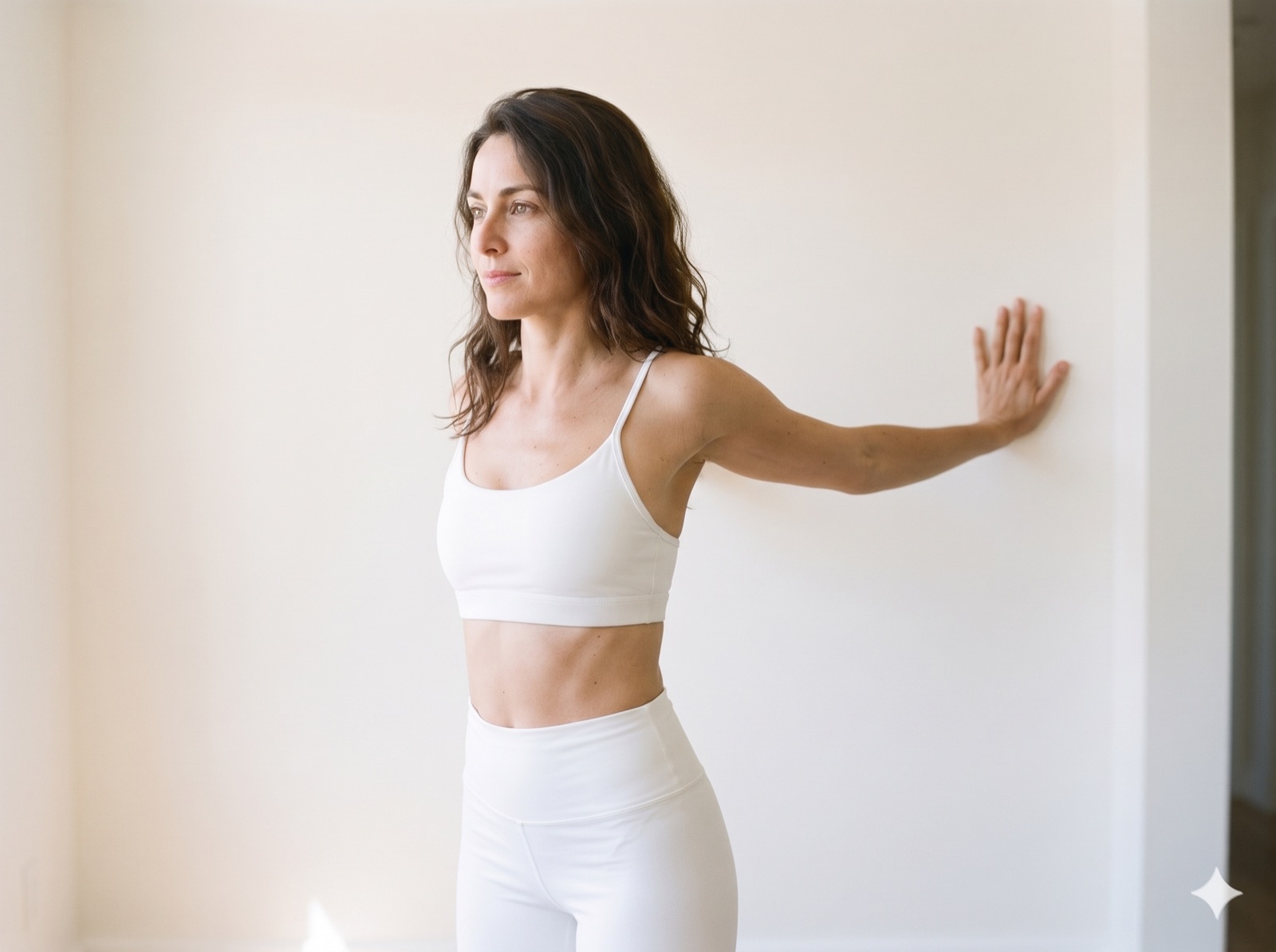
- Stand side-on to the wall and place your palm flat on it behind you at shoulder height.
- Slowly turn your chest away from the wall until you feel a stretch across the front of that shoulder.
- Breathe out into the stretch for 20 to 30 seconds, then switch sides.
- Easier: lower your hand toward hip height.
- Harder: raise your hand a little above shoulder height and turn a bit further.
Watch it: Wall Chest Opener.
5. Narrow wall push-up
A push-up variation that shifts more of the work to the triceps.
- Set up as for a wall push-up, but bring your hands in so your thumbs are a few inches apart.
- Lower slowly, keeping your elbows close to your ribs so they point down rather than out.
- Press away until your arms are straight but not locked.
- Easier: stand closer to the wall and move through a smaller range.
- Harder: step back, or pause for two seconds just before your chest reaches the wall.
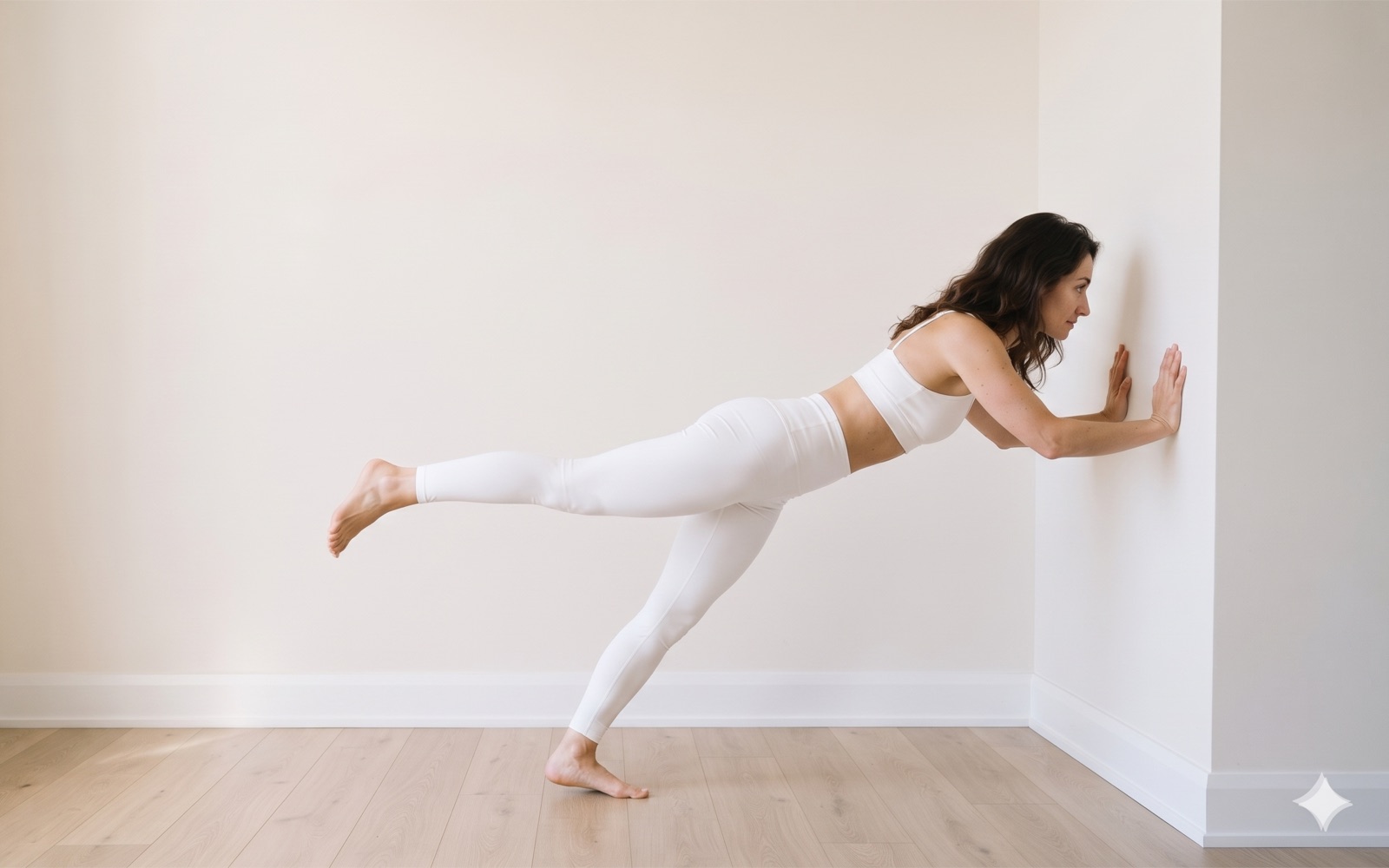
6. Forearm wall plank
A standing plank that trains your shoulders and core to hold still.
- Place your forearms on the wall at shoulder height, elbows under your shoulders, hands loosely clasped.
- Step back from the wall, one foot at a time, until you are leaning in a straight, angled line.
- Press the wall gently away so your upper back doesn’t sag between your shoulder blades, and hold for 20 to 40 seconds while you breathe.
- Easier: keep your feet closer and hold for shorter.
- Harder: walk your feet further back, or lift one heel at a time.
7. Wall plank shoulder taps
A move for shoulder stability and control across your middle.
- Start in the top of a wall push-up, arms straight, feet a little wider than your hips.
- Lift one hand and tap the opposite shoulder, then place it back on the wall.
- Alternate sides slowly, keeping your hips square to the wall.
- Easier: move your feet closer and widen your stance.
- Harder: step back and slow down to a three-second tap.
8. Forearm wall slide
A slide that trains the serratus anterior, the muscle that keeps your shoulder blades moving smoothly when you reach overhead.
- Face the wall and place your forearms on it, palms facing each other, elbows at shoulder height.
- Lean in slightly and press the wall away until your shoulder blades spread apart.
- Keeping that gentle press, slide your forearms up the wall into a V shape, then slide them back down.
- Easier: slide only a few inches and keep the press light.
- Harder: at the top, lift your forearms an inch off the wall for one breath before sliding down.
9. Back-to-wall arm press
A hold for the backs of the shoulders and upper back, with no movement at all.
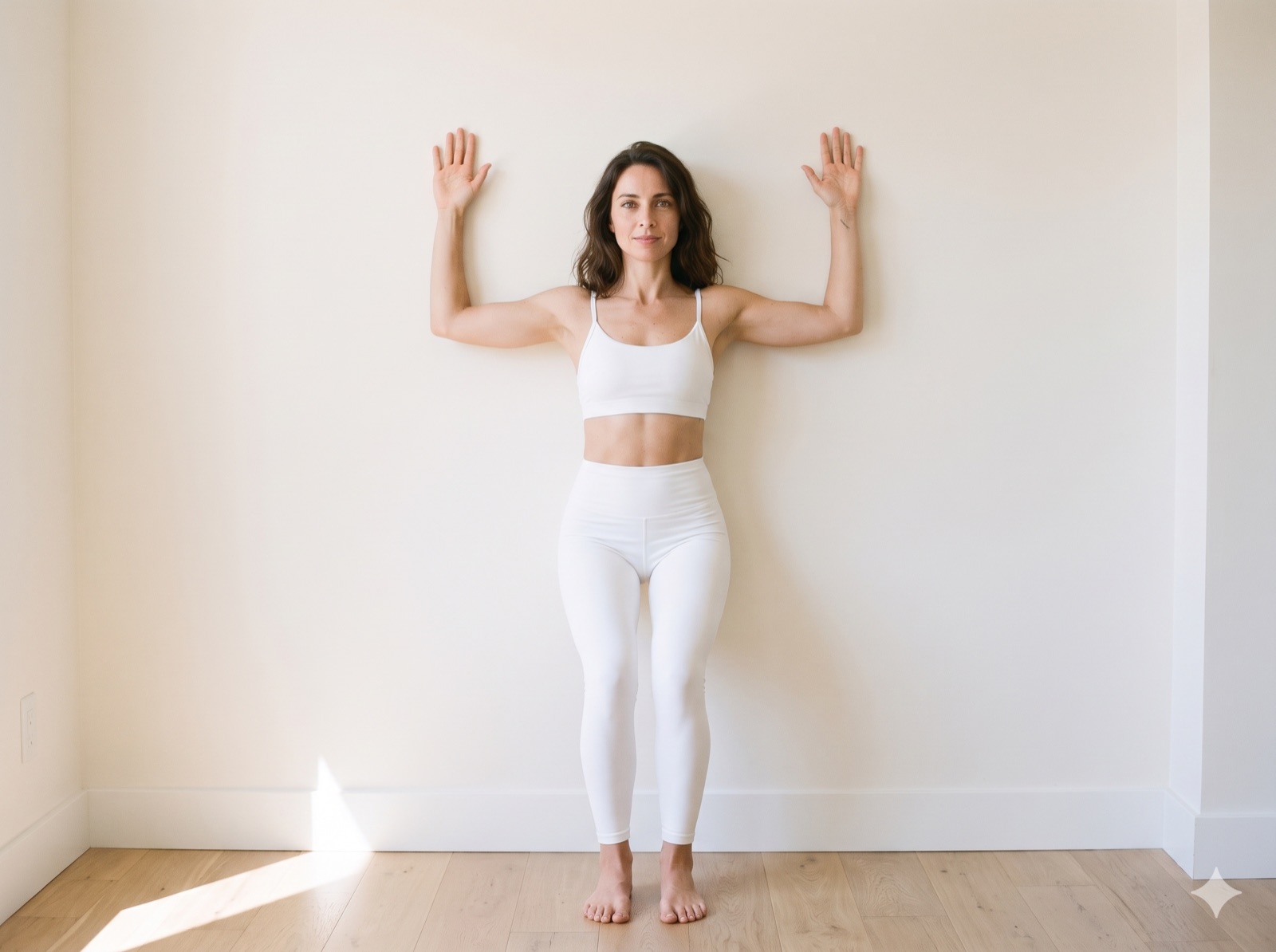
- Stand with your back against the wall, feet a small step out, arms by your sides with your palms facing forward.
- Press the backs of your arms and hands into the wall, drawing your shoulder blades gently together.
- Hold the press for 10 seconds while you breathe, relax for 5 seconds, and repeat five times.
- Easier: press more lightly and hold for 5 seconds.
- Harder: lift your arms out to a low V and press from there.
A 12-minute Wall Pilates arms routine
This routine pairs pushing moves with upper-back moves so the front and back of your shoulders work in balance. Work for the time shown, rest for 15 seconds between moves, and go round the main block twice.
| Part | Move | Time | Focus |
|---|---|---|---|
| Warm-up | Wall angel, slow | 45 s | Shoulders, upper back |
| Warm-up | Standing wall rotation | 40 s | Upper back |
| Main block (×2) | Wall push-up | 45 s | Chest, triceps |
| Forearm wall slide | 40 s | Shoulder blades | |
| Narrow wall push-up | 40 s | Triceps | |
| Back-to-wall arm press | 40 s | Upper back | |
| Forearm wall plank | 30 s | Shoulders, core | |
| Cool-down | Wall chest opener | 30 s each side | Chest, biceps |
If 12 minutes is too much on day one, do the main block once. If you’d rather follow along, our free Wall Pilates for arms and posture workout is a voice-guided 10-minute version built from the filmed moves.
How do you make Wall Pilates arm exercises harder?
Move your feet further from the wall, slow the lowering phase, add a pause, then move to a lower surface. Each change asks your arms to handle more of your body weight or to work for longer.
The angle matters most. In a lab study of push-up variations, push-ups with the hands raised on a box put less force through the arms than push-ups on the floor, and raising the feet put more through them [1]. A wall push-up is the most upright version of the same idea, which is why it’s a good place to start and why a single step backward makes a difference.
A sensible ladder looks like this:
- Wall, feet close. Learn the straight body line and the elbow angle.
- Wall, feet further back. Add a slower lowering phase, then a pause near the wall.
- Kitchen counter or sturdy table. Same move, lower hands, more load.
- A low step or the bottom of a staircase, then knees on the floor, then a full floor push-up.
You don’t need heavy weights to build muscle. A review that pooled 21 studies found that muscle growth was similar with light and heavy loads when sets were taken close to failure, although heavy loads built more maximal strength [2]. In practice, a light move only works this way if the last few reps feel genuinely hard. When 15 slow reps feel easy, it’s time for the next rung.
Can Wall Pilates tone or slim your arms?
Wall Pilates can make your arm and shoulder muscles stronger and firmer, but it can’t remove fat from your arms in particular. Where your body loses fat is set by your body as a whole, not by the muscle you train.
This has been tested directly on arms. In one study, 104 adults trained only one arm for 12 weeks. Scans showed that the fat change was spread across the body rather than concentrated on the trained arm, which supports the view that spot reduction doesn’t happen [3]. The same holds for the belly: six weeks of abdominal exercise, five days a week, improved endurance but didn’t reduce belly fat [4].
What arm training can honestly do:
- Build muscle under the skin, which changes how your arms look and feel over months.
- Make everyday tasks easier, like carrying shopping, lifting a child or pushing a heavy door.
- Support posture, because the upper-back moves counter a rounded-shoulder habit.
If your goal includes a change in body fat, that comes from your overall activity, what you eat, your sleep and time, not from extra arm reps. Exercise also can’t tighten loose skin; if that worries you, a doctor or dermatologist can tell you what is realistic.
How often should you do Wall Pilates for arms?
Two or three sessions a week, with a rest day between them, suits most beginners. That matches US guidance, which advises adults to do muscle-strengthening activity, such as push-ups, on at least two days each week, working all major muscle groups [5].
- Spread it out. Monday, Wednesday and Friday works well; muscles adapt in the days between sessions.
- Train the rest of you too. Pair an arms day with legs, glutes and core across the week. Our weekly exercise minutes calculator helps you see how your week adds up.
- Gentle moves can be daily. The chest opener and slow wall angels are fine on most days if they feel good.
When will you notice a difference?
Most people notice that the moves feel easier within two to four weeks, as their body learns them. Strength and endurance take longer. In a study of active middle-aged adults, two hour-long mat Pilates classes a week for 12 weeks improved upper-body muscular endurance, along with abdominal endurance and hamstring flexibility, compared with a group that didn’t take the classes [6]. Visible changes vary a lot from person to person, so judge progress by what you can do: more reps, a slower lowering phase or a step further from the wall.
Is Wall Pilates safe for your wrists and shoulders?
For most people, yes: leaning against a wall puts much less weight through the wrists and shoulders than floor work, and you control the load with every step. Still, a few habits keep it comfortable.
- Wrists. Spread your fingers and press through the whole hand, not just the heel. If your wrists ache, make a loose fist against the wall or switch to forearm moves.
- Shoulders. Keep your elbows at about 45 degrees in push-ups rather than flared straight out, and keep overhead slides in a range where your hands stay on the wall.
- Neck. Let your head stay in line with your spine. Reaching with your chin is a sign the move is too hard; step closer.
- Feet. Bare feet or grippy shoes on a non-slip floor stop you sliding as you lean.
If you have a shoulder, elbow or wrist injury, arthritis, osteoporosis or recent surgery, or you’re pregnant, check with your doctor or physical therapist before starting, and ask which versions of these moves suit you.
The bottom line
Wall Pilates arms exercises use your body weight against a wall to build pushing strength, steadier shoulders and a stronger upper back, with a difficulty you can change one step at a time. Start close to the wall, move slowly, and train two or three times a week.
They won’t burn fat from your arms in particular, and nothing will. What they will do is make your arms stronger and more capable, and that is worth the 12 minutes. When the wall gets easy, move to a counter, then a step, and keep going.
Sources
Every source was read before it was cited. Numbers in the text, like [1], point here.
- [1]Kinetic analysis of several variations of push-upsEbben and colleagues, Journal of Strength and Conditioning Research, 2011
- [2]Strength and hypertrophy adaptations between low- vs. high-load resistance training: a systematic review and meta-analysisSchoenfeld and colleagues, Journal of Strength and Conditioning Research, 2017
- [3]Subcutaneous fat alterations resulting from an upper-body resistance training programKostek and colleagues, Medicine & Science in Sports & Exercise, 2007
- [4]The effect of abdominal exercise on abdominal fatVispute and colleagues, Journal of Strength and Conditioning Research, 2011
- [5]Top 10 things to know about the second edition of the Physical Activity Guidelines for AmericansUS Office of Disease Prevention and Health Promotion, 2018
- [6]Pilates for improvement of muscle endurance, flexibility, balance, and postureKloubec, Journal of Strength and Conditioning Research, 2010
Found this useful? Pass it on