Easy wall exercises: 10 beginner moves for small spaces
A wall takes some of your body weight, steadies your balance and shows you when your form slips, so it is one of the easiest ways to start strength training at home. Here are ten beginner wall moves, how to do each one well, and a 15-minute routine that puts them together.
By the TrueMe team · Published · 12 min read · How we write
Easy wall exercises are simple strength and mobility moves that use a wall for support. The wall takes some of your body weight, steadies your balance and shows you where your body is, so you can train your legs, upper body and core at home with no equipment and very little space.
That makes them one of the most practical ways to start. You need about an arm’s length of clear floor, a stretch of wall with nothing hanging on it, and 10 to 15 minutes. Below are ten beginner moves grouped by body area, with how to set up, what to feel, and an easier and a harder version of each. They are the same moves we filmed for the TrueMe exercise library, so every one links to a looping demo.
What makes wall exercises good for beginners?
A wall lowers the two things that stop most beginners: how much of your body weight you have to move, and how much you have to balance. You can change both in seconds by stepping closer to the wall or further away.
- Less load to start with. A push-up against a wall moves much less of your body weight than one on the floor. In a lab study, raising the hands made push-ups lighter and raising the feet made them heavier, which is exactly the dial a wall gives you [3].
- Balance is taken care of. A hand on the wall lets you practise lunges and single-leg work without worrying about a wobble. The US National Institute on Aging suggests keeping a sturdy chair or a wall nearby for support for exactly this reason [4].
- Feedback you can feel. Your back, head or hands touching the wall tell you when your posture drifts. In a wall angel, the moment your hands lift off the wall you know you have gone past your current range.
- No kit and no setup. A clear wall and a floor that is not slippery are enough, so a session fits into a lunch break or the gap before dinner.
Wall work is real training, too. The CDC lists exercises that use your body weight for resistance, such as push-ups, as muscle-strengthening activity [2].
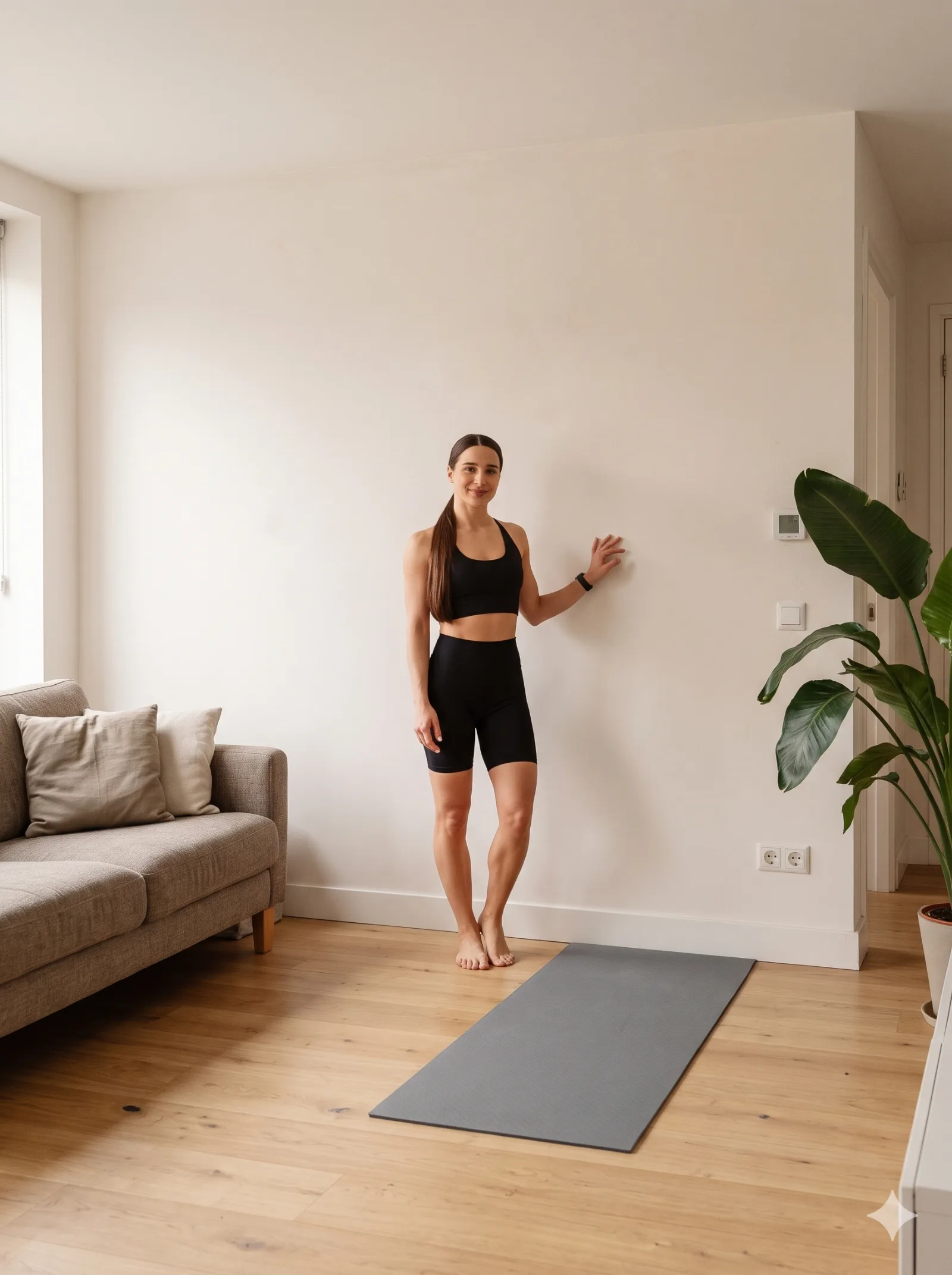
Which easy wall exercises work the upper body?
The best easy wall exercises for the upper body are the wall push-up, the wall angel and the wall chest opener. Together they cover pressing strength in the chest, shoulders and arms, the upper-back muscles that help you stand tall, and a stretch for the front of the shoulders that tightens up after a day at a desk.
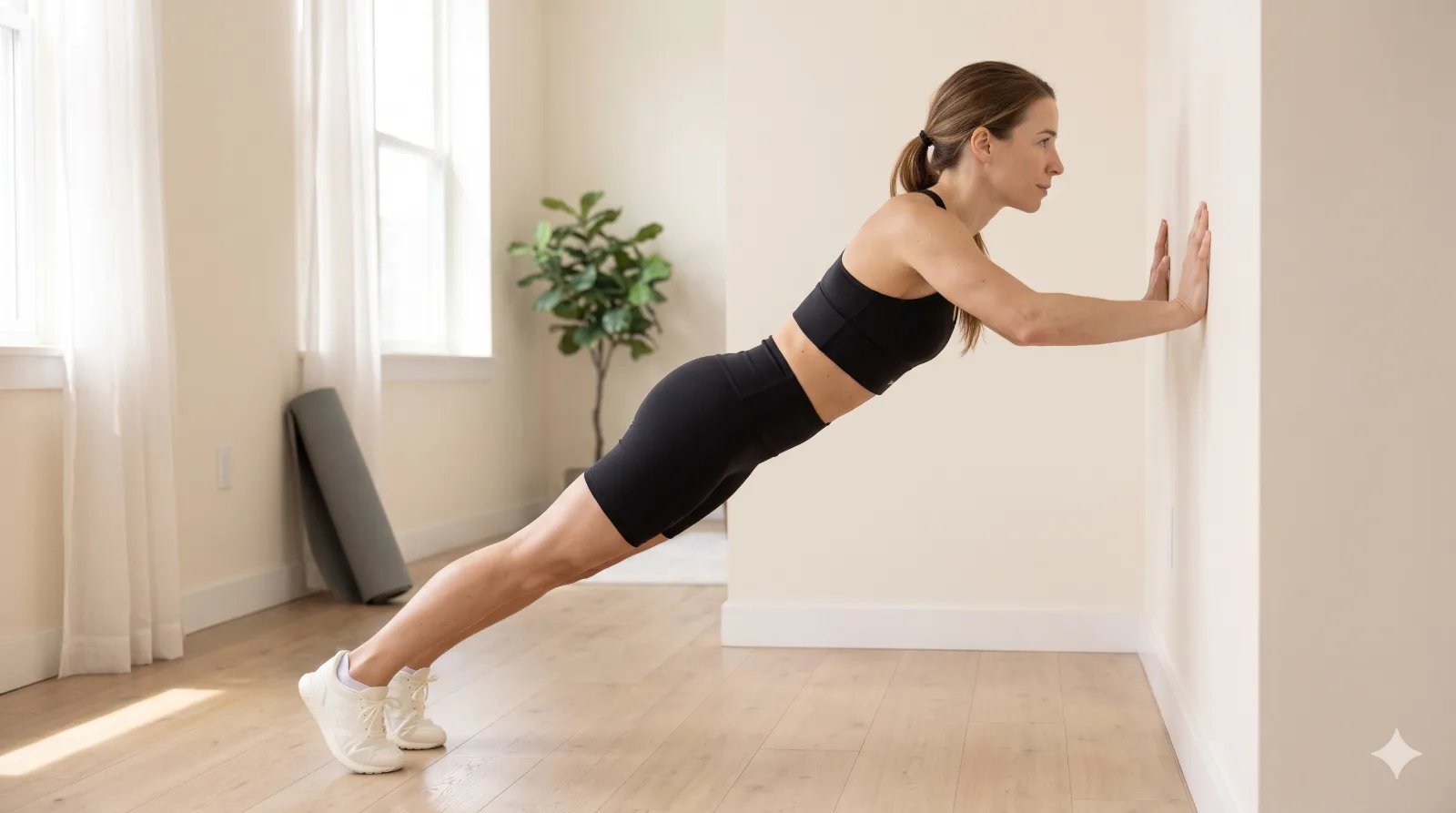
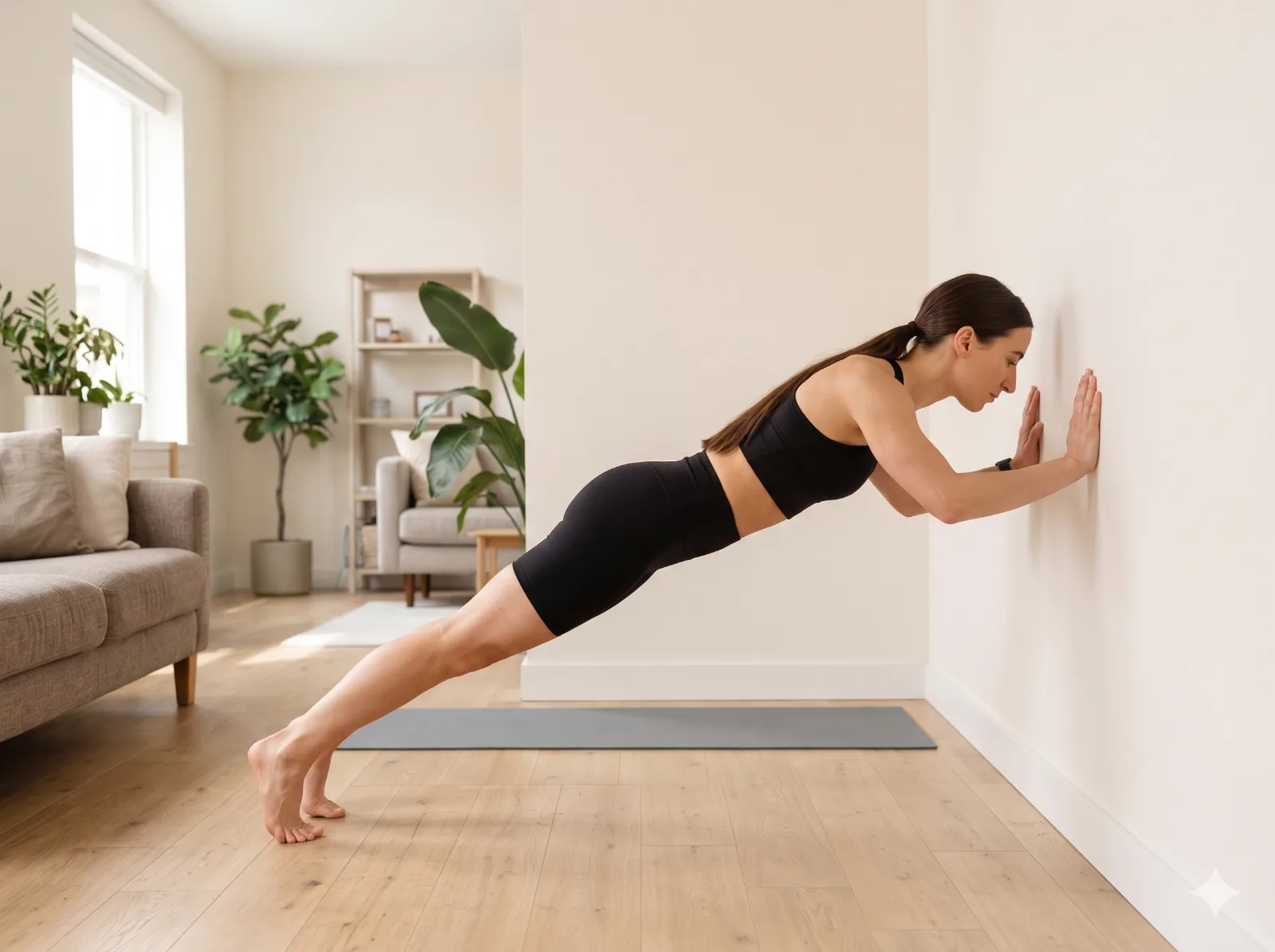
1. Wall push-up
Works: chest, shoulders, triceps and core.
- Face the wall and place your hands on it at chest height, a little wider than your shoulders.
- Step your feet back until you are leaning in with your body in one straight line from head to heels.
- Bend your elbows to bring your chest, not your forehead, toward the wall. Let the elbows travel back at about 45 degrees rather than flaring out to the sides.
- Push the wall away to return.
Easier: stand closer to the wall. Harder: step further back, or take four seconds to lower on every repetition. Because raising the hands lightens a push-up [3], the wall is the gentlest version and a floor push-up is what you are building toward. See the wall push-up demo.
2. Wall angel
Works: upper back, shoulders and the small rotator cuff muscles.
- Stand with your back, head and arms against the wall, feet a small step out from it.
- Bend your elbows to 90 degrees with the backs of your hands touching the wall, like a goalpost.
- Slide your arms up only as far as your hands and elbows can stay in contact, then slide them back down, slower on the way up than on the way down.
- Keep your ribs down. Arching your lower back to reach higher defeats the point.
Easier: slide one arm at a time and stop at shoulder height. Harder: step your feet closer to the wall, which takes the slack out of the whole position. See the wall angel demo.
3. Wall chest opener
Works: a stretch across the chest, the front of the shoulders and the biceps.
- Stand side-on to the wall and place one palm flat on it just behind you, at shoulder height.
- Slowly turn your chest away from the wall until you feel a stretch across the front of that shoulder.
- Breathe out into the stretch for 20 to 30 seconds, then switch sides.
Easier: lower the hand toward hip height, which shortens the lever. Harder: raise the hand a little above shoulder height and turn slightly further. A strong pull is the ceiling: stretching should never hurt [4]. See the chest opener demo.
Which easy wall exercises target the legs and glutes?
Wall squats, wall sits, wall glute presses and wall-supported reverse lunges are the easiest ways to train your legs and glutes with a wall. The wall supports your back or your balance, so you can focus on where your knees and hips are instead of on staying upright.
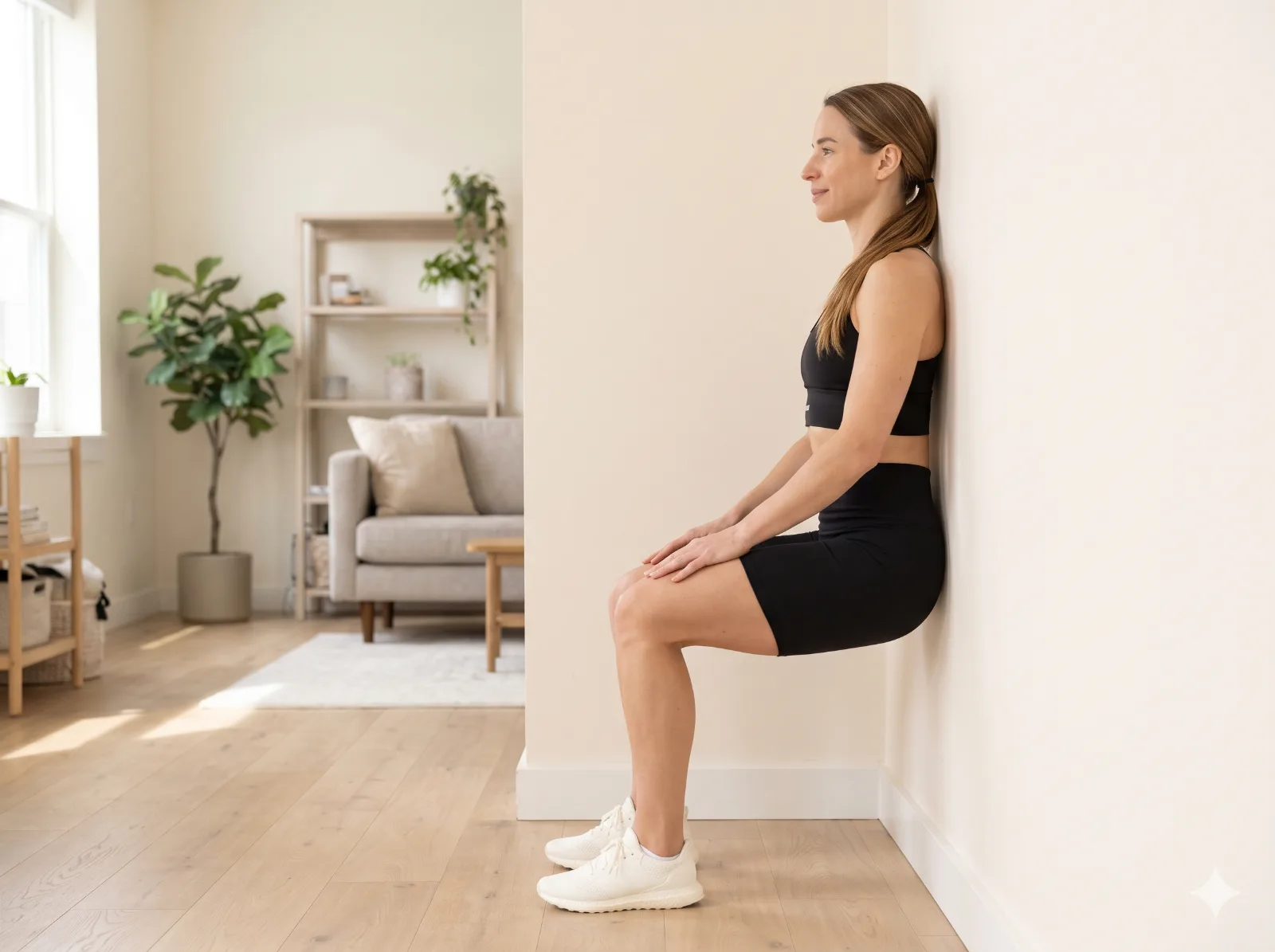
4. Wall squat
Works: thighs, glutes and hamstrings.
- Stand with your back flat against the wall, feet a step forward and hip-width apart, weight in your heels.
- Slide down only as far as your back stays in full contact with the wall.
- Keep your knees pointing over your toes. The common fault is letting them drift inward.
- Push the floor away to slide back up.
Easier: go a quarter of the way down and pause there. Harder: slide lower and hold for two seconds at the bottom of each repetition. See the wall squat demo.
5. Wall sit
Works: thigh endurance, glutes and core.
Set up as for the wall squat, but stop at a depth you can hold and stay there, thighs moving toward parallel with the floor. Keep your weight in your heels (you should be able to lift your toes) and keep breathing. Holding your breath while you strain is something the National Institute on Aging specifically advises against in strength work [4]. Start with holds of 15 to 20 seconds and end each one when your thighs start to shake, not when the timer says so.
Easier: sit higher. A shallow hold you can breathe through beats a deep one you can’t. Harder: work toward a right angle at the knee and a longer hold. See the wall sit demo.
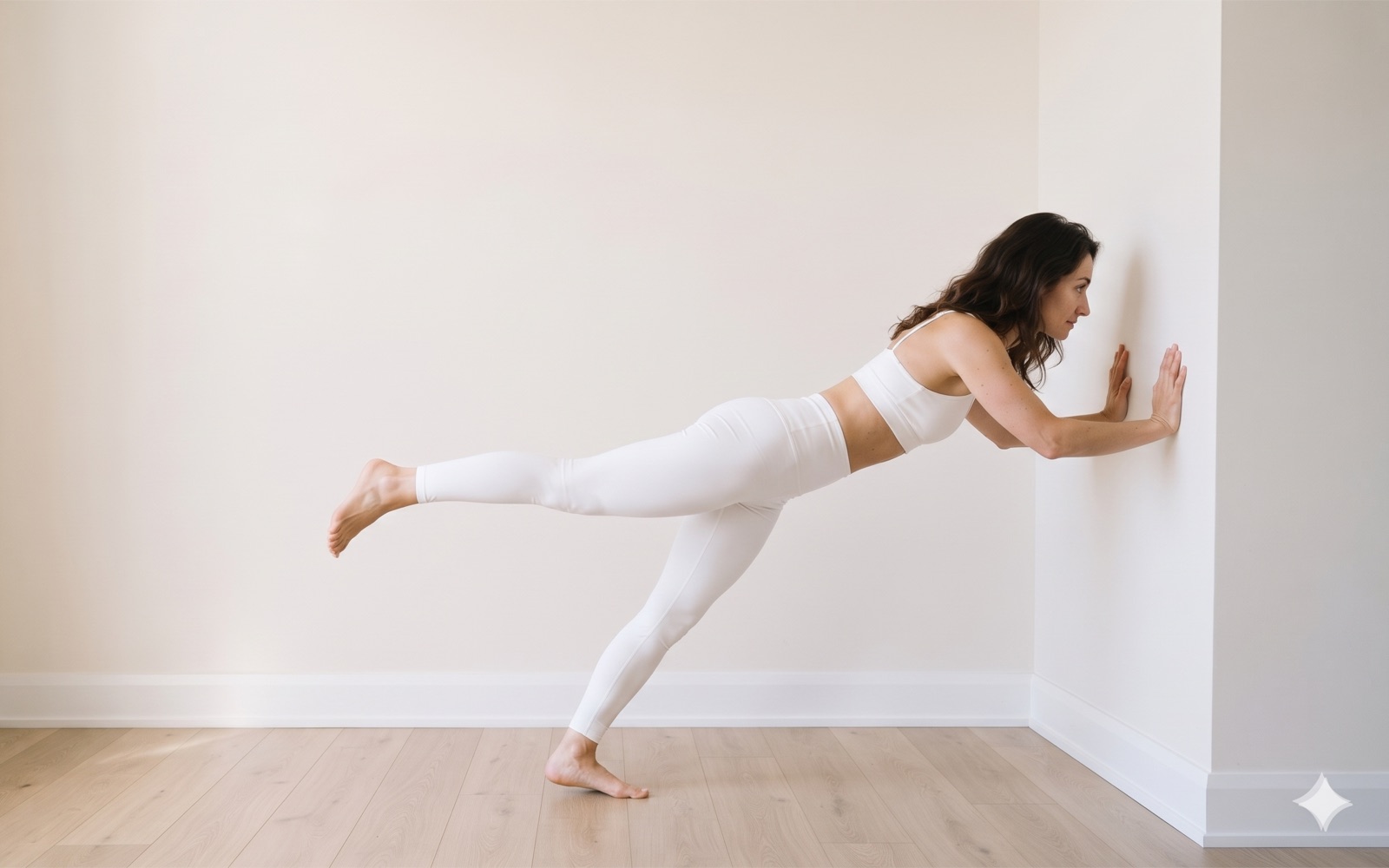
6. Wall glute press
Works: glutes and hamstrings.
- Face the wall with your hands flat on it at chest height and lean in slightly.
- Shift your weight onto one leg and rest the other foot lightly behind you.
- Press the back leg backward and up from the glute, and squeeze for a full second at the top.
- Keep your hips square to the wall and your lower back still. If your back arches, make the movement smaller.
Easier: keep the toe on the floor and press through a smaller range. Harder: straighten the leg fully and hold the squeeze for two seconds. See the glute press demo.
7. Wall-supported reverse lunge
Works: glutes, thighs and the small muscles that steady your hips.
- Stand side-on to the wall with one hand resting on it and your feet under your hips.
- Step the outside leg straight back, not out to the side, and bend both knees, lowering only as far as you can control.
- Keep your front knee over your ankle and your chest tall.
- Push through the front foot to return. Finish your set, then turn around and switch sides.
The hand is there for balance, not to hold you up. Easier: take a shorter step and lower only a few inches. Harder: hover the hand just off the wall so your balance does the work. See the reverse lunge demo.
Which wall exercises engage the core?
Wall marching, the standing wall rotation and the wall roll down all train your core without getting down on the floor. Each one uses the wall as a reference point, so you can feel the moment your lower back or hips start to move and keep the work in your trunk.
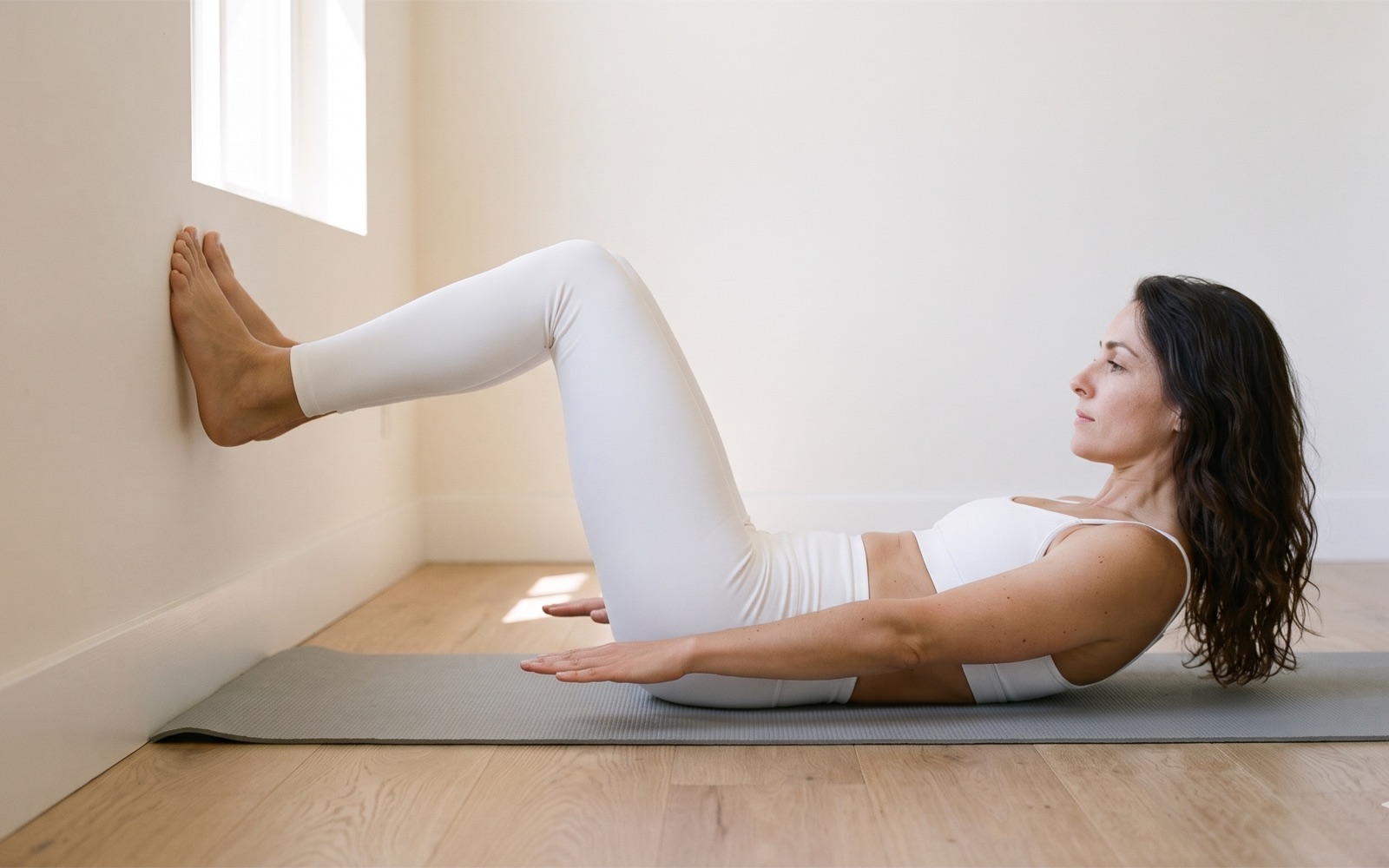
8. Wall marching
Stand with your back against the wall and your hands resting lightly on it beside your hips. Slowly lift one knee toward hip height without letting your lower back peel away from the wall, lower it, then switch sides. This is slow core control, not a march: the slower you go, the harder your deep abdominal muscles work.
Easier: lift only the heel and keep the toe on the floor. Harder: take your hands off the wall and hold each knee up for two seconds. See the wall marching demo.
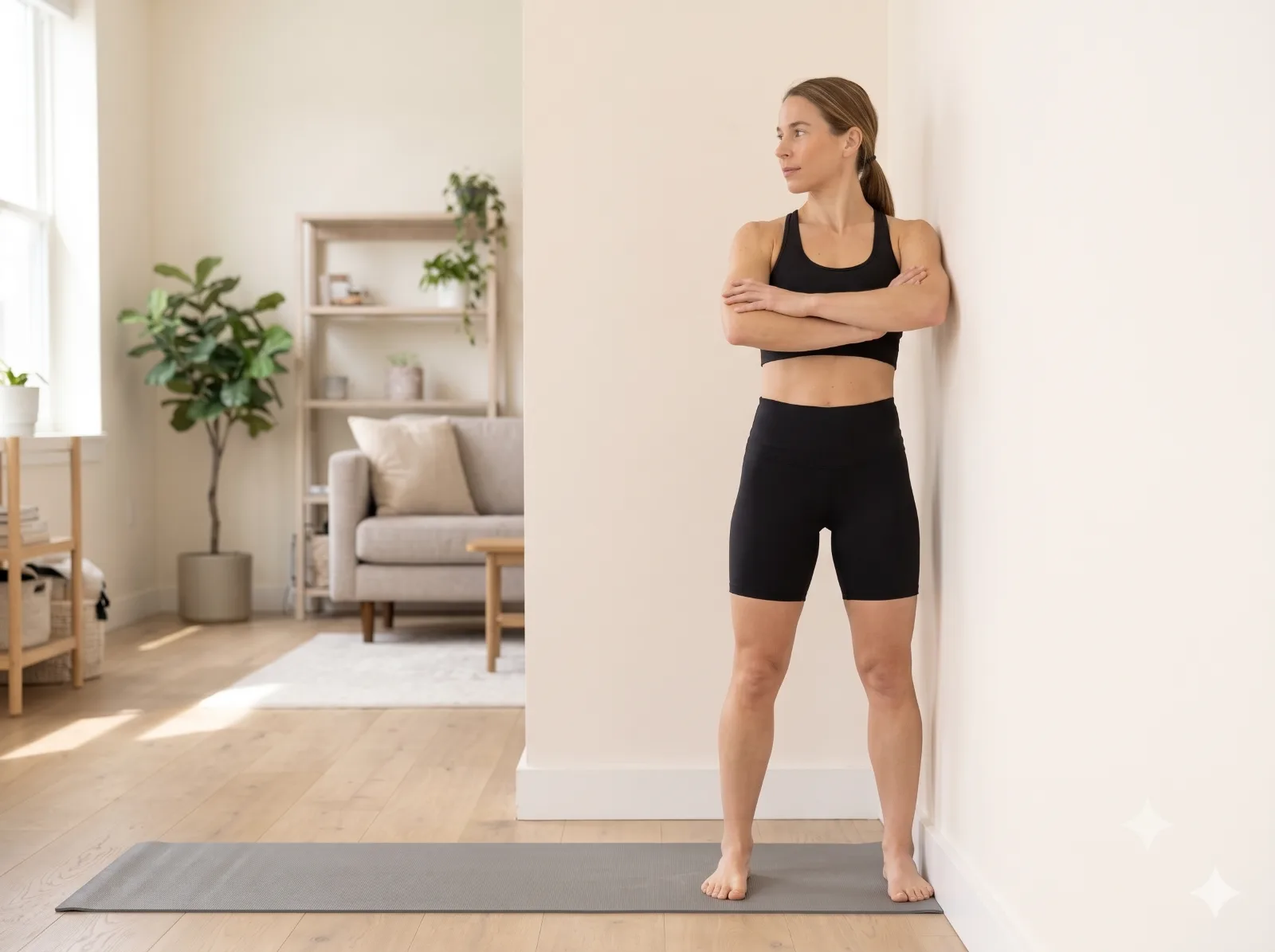
9. Standing wall rotation
Stand with your back about a foot from the wall, feet planted and arms folded at chest height. Turn from your ribs toward the wall on one side, keeping your hips facing forward, then come back through the middle and turn to the other side. Go only as far as you can without a foot moving.
Easier: turn through a smaller range and touch the wall for reference. Harder: reach your arms long as you turn and pause for two seconds at the end of each turn. See the rotation demo.
10. Wall roll down
Stand with your back against the wall and your feet a step forward. Drop your chin toward your chest and peel your spine away from the wall one section at a time, letting your head and arms hang heavy. Go only as far as is comfortable, then rebuild from the bottom up, stacking your spine back against the wall.
Easier: roll down only as far as your ribs, then come back up. Harder: rest at the bottom for three slow breaths before you rebuild. See the roll down demo.
Want a move that raises your heart rate too? Wall knee drives are the one higher-effort move in our library: hands on the wall, body leaning in, driving one knee at a time toward your chest at a pace you can keep up.
What is a simple 15-minute wall workout?
A simple 15-minute wall workout is two rounds of six moves, with 40 seconds of work and 20 seconds of rest for each. Warm up first with two minutes of easy marching on the spot and slow shoulder rolls, and finish with a minute of roll downs and chest openers.
| Move | Work, then rest | What it trains |
|---|---|---|
| Wall squat | 40 s, 20 s | Thighs and glutes |
| Wall push-up | 40 s, 20 s | Chest, shoulders and arms |
| Wall glute press | 20 s each side, 20 s | Glutes |
| Wall angel | 40 s, 20 s | Upper back and posture |
| Wall marching | 40 s, 20 s | Deep core |
| Wall sit | 30 to 40 s, 20 s | Thigh endurance |
That is 2 minutes of warm-up, 12 minutes of work and rest, and 1 minute to cool down. If a set starts to fall apart, stop it early: two clean repetitions are worth more than ten rushed ones. Use the easier version of any move whenever you need to, and move up to the harder one only when the easier version feels steady.
Prefer to be talked through it? Our free 15-minute full-body Wall Pilates workout plays every move with a timer and voice cues in your browser, and the workout builder makes a 5 to 20 minute session for the area you want to focus on.
How can you make easy wall exercises harder?
Make wall exercises harder by changing one thing at a time: your distance from the wall, how deep you go, how slowly you move, or how long you hold. Small changes add up quickly, and changing one at a time tells you which one made the difference.
- Distance. Step further from the wall in push-ups and knee drives, and closer to it in wall angels.
- Depth. Squat lower, and move your wall sit closer to a right angle at the knee.
- Tempo. Take three or four seconds to lower in squats and push-ups.
- Pauses. Hold for two seconds at the hardest point of each repetition.
- Less support. Hover your hand in reverse lunges and take your hands off the wall in marching.
- More rounds. Add a third round once two feel comfortable.
A useful signal that it is time to progress: when you can do 12 clean repetitions of a move with energy to spare, make it harder. The CDC’s guide to muscle-strengthening work is sets of about 8 to 12 repetitions, done until another repetition would be hard without help [2].
How often should you do wall exercises?
Two or three non-consecutive days a week is a good starting point for wall strength work. That meets the CDC recommendation of muscle-strengthening activity on at least 2 days a week that works all the major muscle groups: legs, hips, back, abdomen, chest, shoulders and arms [1].
Wall exercises cover the strength part of the week, not all of it. Adults are also advised to get at least 150 minutes of moderate aerobic activity, such as brisk walking, every week [1], and adults 65 and older are advised to add activities that improve balance [5]. Supported lunges and slow wall marching are a gentle place to start on balance. Our weekly exercise minutes calculator shows how your week adds up against those numbers.
If that sounds like a lot, start smaller. The CDC is clear that some physical activity is better than none [1]. One 10-minute wall session this week is a real start.
What common wall-exercise mistakes should you avoid?
Most mistakes come from standing in the wrong place, rushing, or letting the wall do the work for you. Check these before you blame the exercise:
- Feet in the wrong spot. Too close to the wall and push-ups feel like nothing; too far and your hips sag. Adjust in small steps until the last few repetitions feel hard but clean.
- An arching lower back. In wall angels, glute presses and marching, a lower back that peels off the wall or arches means the range is too big. Make the movement smaller.
- Knees falling inward. In squats, sits and lunges, keep your knees pointing over your toes.
- Holding your breath. Breathe out on the effort and in as you relax [4].
- Rushing. Fast repetitions use momentum instead of muscle. Slow down, especially on the way down.
- Socks on a smooth floor. Your feet can slide out in squats and sits. Train barefoot or in shoes with grip [4].
Are wall exercises safe for everyone?
For most healthy adults, easy wall exercises are a low-impact and well-supported way to start. Check with your doctor or a physical therapist first if you have a heart condition, a joint problem or injury, recent surgery, are pregnant, or are unsure whether a particular movement suits you [4].
During any session, stop if a move causes pain, and stop and get help if you feel dizzy, have chest pain or pressure, or feel sick [4]. Use a wall with nothing hanging on it, move rugs and furniture out of the way, and keep a little space on either side of you for lunges and rotations.
The bottom line
Easy wall exercises let you start strength and mobility training at home with nothing but a wall and a few minutes. The wall lightens the load, steadies your balance and tells you when your form slips, and every move can be made easier or harder in seconds.
Pick four to six of the moves above, do them two or three times a week, and progress one thing at a time when a move feels easy. Pair them with regular walking or other movement you enjoy, and you are covering the basics the CDC recommends for adults [1].
Sources
Every source was read before it was cited. Numbers in the text, like [1], point here.
- [1]Adult activity: an overviewUS Centers for Disease Control and Prevention, 2023
- [2]What counts as physical activity for adultsUS Centers for Disease Control and Prevention, 2023
- [3]Kinetic analysis of several variations of push-upsEbben and colleagues, Journal of Strength and Conditioning Research, 2011
- [4]Three types of exercise can improve your health and physical abilityUS National Institute on Aging, n.d.
- [5]Older adult activity: an overviewUS Centers for Disease Control and Prevention, 2025
Found this useful? Pass it on