Advanced wall Pilates: 7 harder moves and how to progress
Advanced wall Pilates uses the wall for less support and more challenge: single-leg work, longer holds, slower lowering and feet-on-wall positions. Move up once beginner moves feel steady for every rep, and change one thing at a time.
By the TrueMe team · Published · 8 min read · How we write
Advanced wall Pilates means using the wall for less support and more challenge: one leg instead of two, longer holds, slower lowering and positions where your body weight works against you. It is the next step once beginner moves like the wall squat and wall push-up feel easy for every rep.
This guide explains what makes a wall Pilates move advanced, how to tell if you’re ready, seven harder moves with step-by-step cues, and how to progress safely. It also gives an honest answer on calories and how long it takes to reach an advanced level.
What counts as advanced wall Pilates?
A wall Pilates move becomes advanced when it asks for more strength or control with less help from the wall. The exercises often look similar to beginner versions, but the leverage, balance or time under tension is much harder.
There is no official scale of Pilates levels, so it helps to think about what you change rather than which moves you know. Strength training guidelines describe the same idea: muscles keep adapting when you gradually raise the challenge, for example through harder exercise choices, single-limb work, more sets, or slower, controlled lowering [1]. At the wall, that looks like this:
| Beginner | Advanced |
|---|---|
| Two feet on the floor | One leg working, the other lifted |
| Wall supports your back or hands fully | Wall supports only your feet, or nothing at all |
| Short holds of 15–20 seconds | Holds of 45–60 seconds with steady breathing |
| Normal tempo | Three- to four-second lowering |
| One round | Two or three rounds with short rests |
Are you ready for advanced wall Pilates?
You’re ready when you can do the beginner moves with clean form for all their reps, without holding your breath or feeling joint pain. Most people need at least a couple of months of regular practice to get there.
A practical checklist:
- You can hold a wall sit with your thighs close to parallel for 45 to 60 seconds.
- You can do 12 to 15 wall push-ups with your body in one straight line.
- You can do a wall glute press without your lower back arching.
- Your sessions feel moderately hard, not exhausting, and you recover by the next day.
If you’re not there yet, the 15-minute full-body Wall Pilates workout is a good bridge. If you have high blood pressure, a heart condition, joint problems or an injury, check with your doctor or physical therapist before adding long holds or positions with your feet higher than your hips.
7 advanced wall Pilates moves
Warm up for five minutes first with marching, arm circles and a few easy wall squats. Do each move below for the reps shown, rest 30 to 45 seconds between moves, and complete one to three rounds.
1. Single-leg wall sit
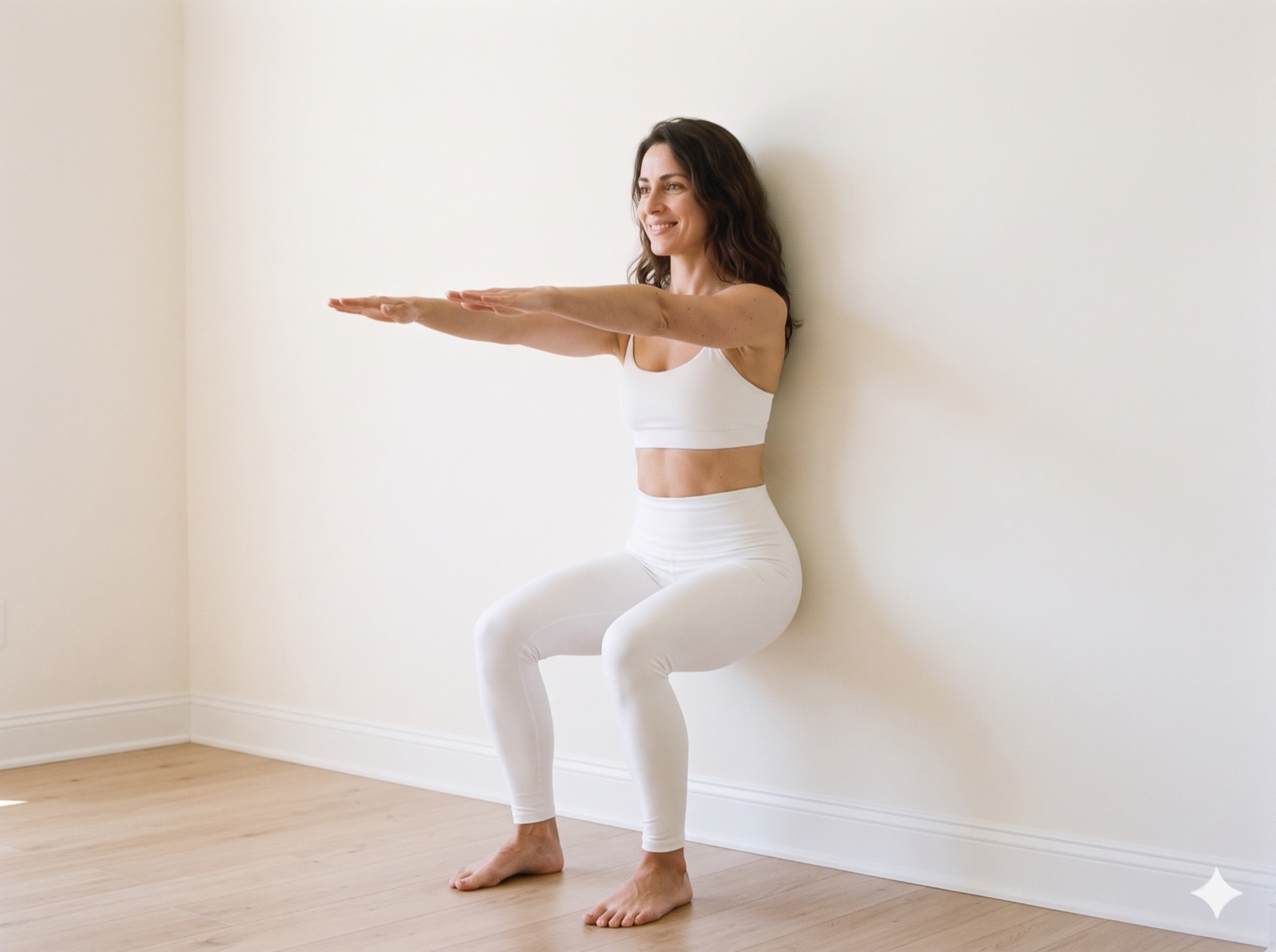
Slide down the wall into a wall sit with your thighs close to parallel to the floor and your knees over your ankles. Keeping your hips level, straighten one leg in front of you at knee height and hold. 15–20 seconds each side. Easier: lift the heel only, keeping the toes down.
2. Wall bridge with leg lift
Lie face up with your hips a little way from the wall and your feet flat on the wall, knees bent at about 90 degrees. Press through your feet to lift your hips, then lift one foot off the wall and reach that leg toward the ceiling without letting your hips drop. 6–8 reps each side. Easier: keep both feet on the wall and hold the bridge for three breaths.
3. Wall-supported teaser
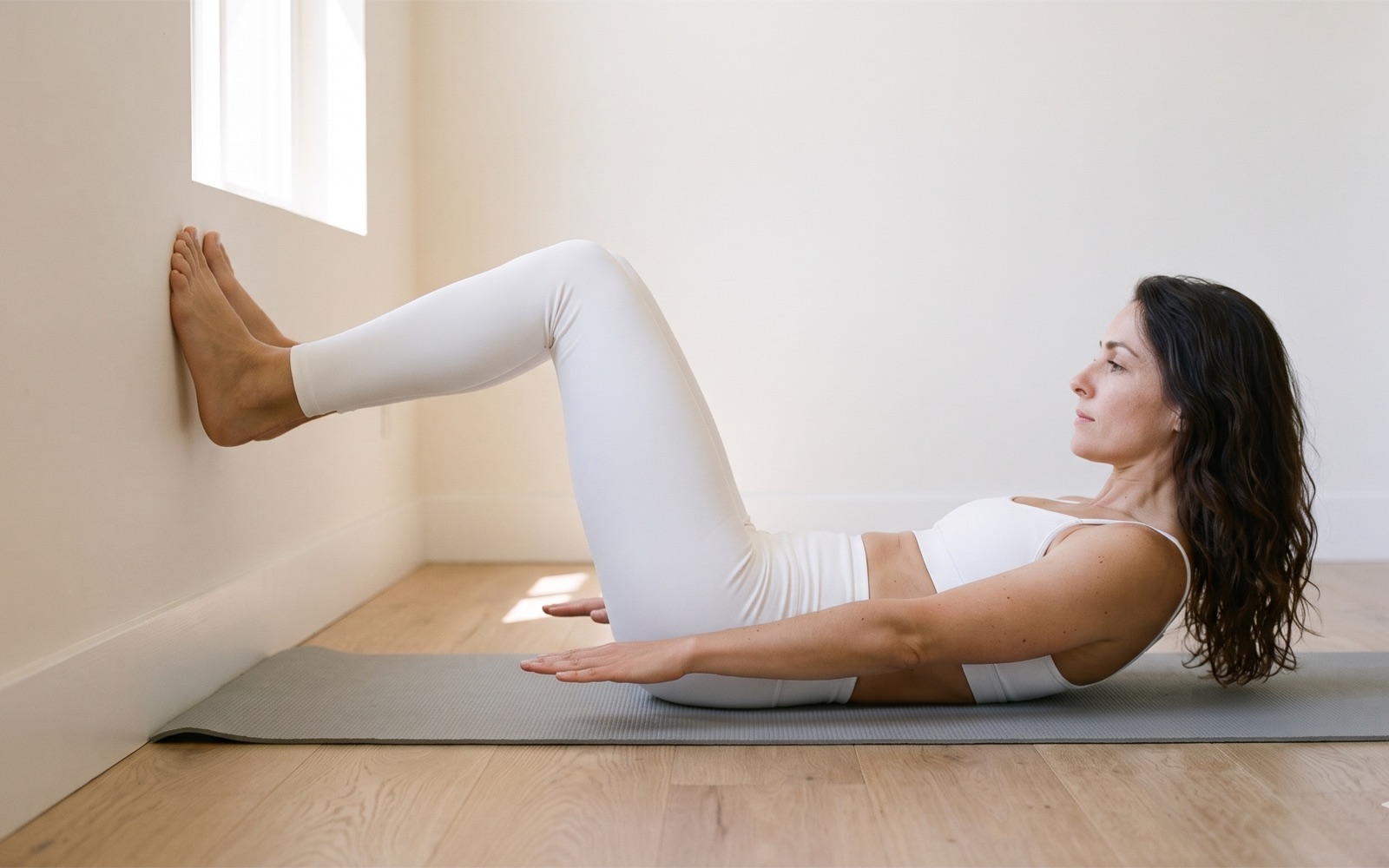
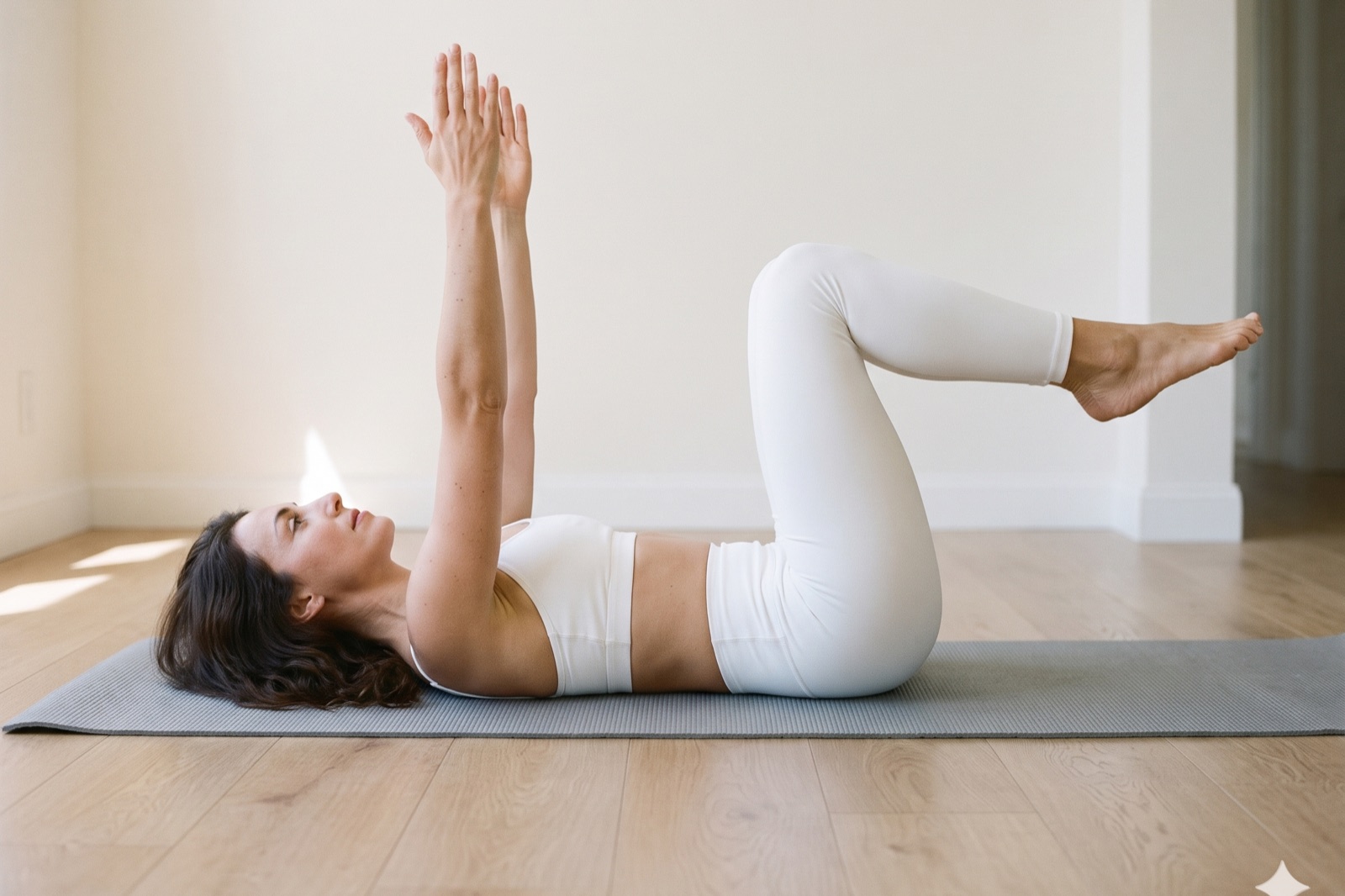
Lie face up with your feet on the wall, knees bent, shins roughly parallel to the floor. Reach your arms toward the wall, curl your head and shoulders up and roll up through your spine until you’re balanced in a V, then roll back down slowly. 5–6 reps. Easier: hold the backs of your thighs as you roll up and down.
4. Side plank with feet against the wall
Lie on your side on a forearm, elbow under your shoulder, with the soles of your stacked feet against the wall. Lift your hips into a straight line from head to heels, then raise your top leg a few inches and lower it. 6–8 leg lifts each side. Easier: bend your bottom knee and hold the side plank without the leg lift.
5. Feet-on-wall plank
Start on hands and knees facing away from the wall, hands under your shoulders. Place one foot, then the other, on the wall at about knee height, straightening your legs so your body forms a line slightly higher at the heels. Hold with your core firm and your lower back flat. 20–30 seconds. Easier: do a regular plank on the floor first.
6. Wall push-up with leg lift
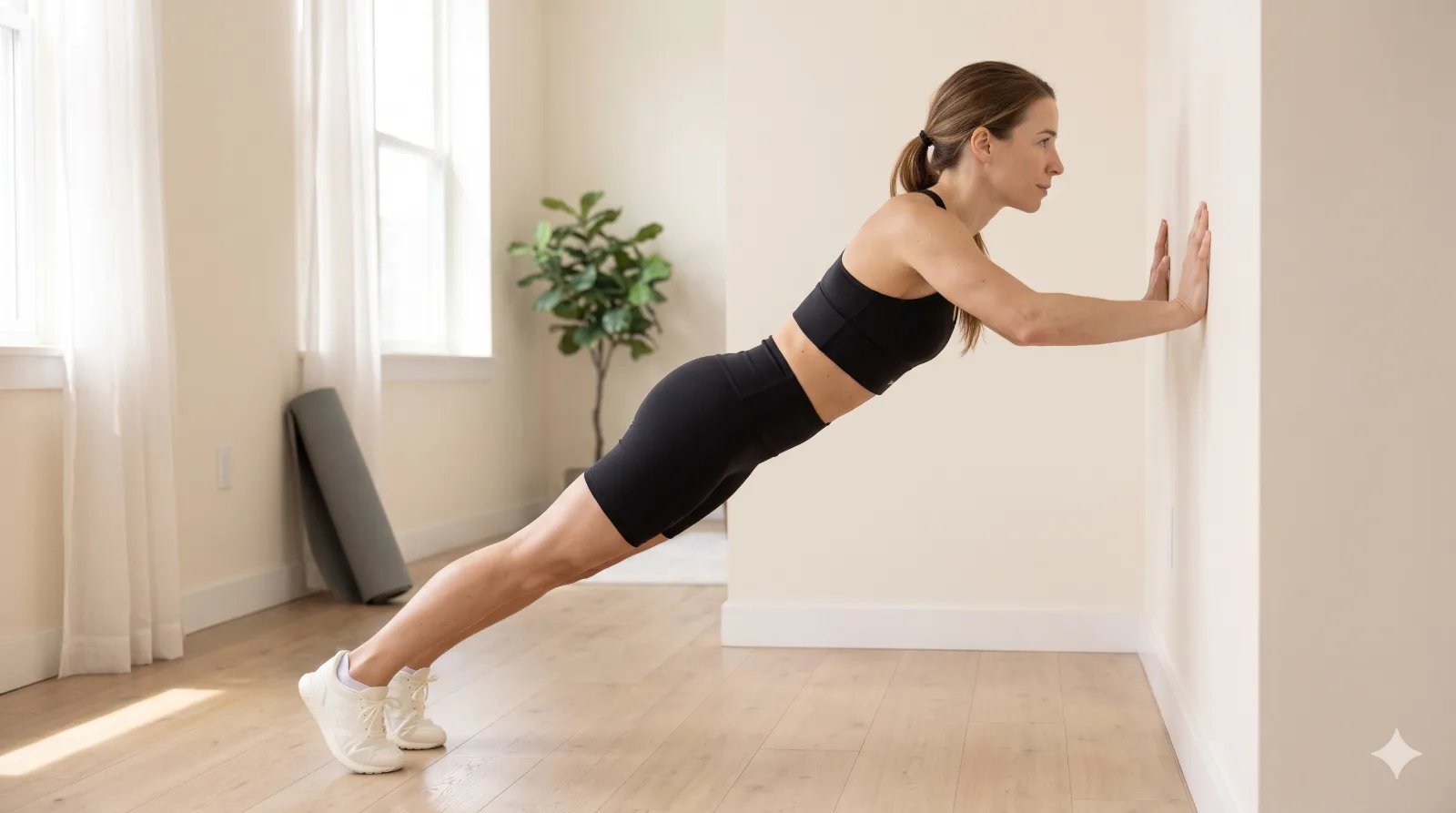
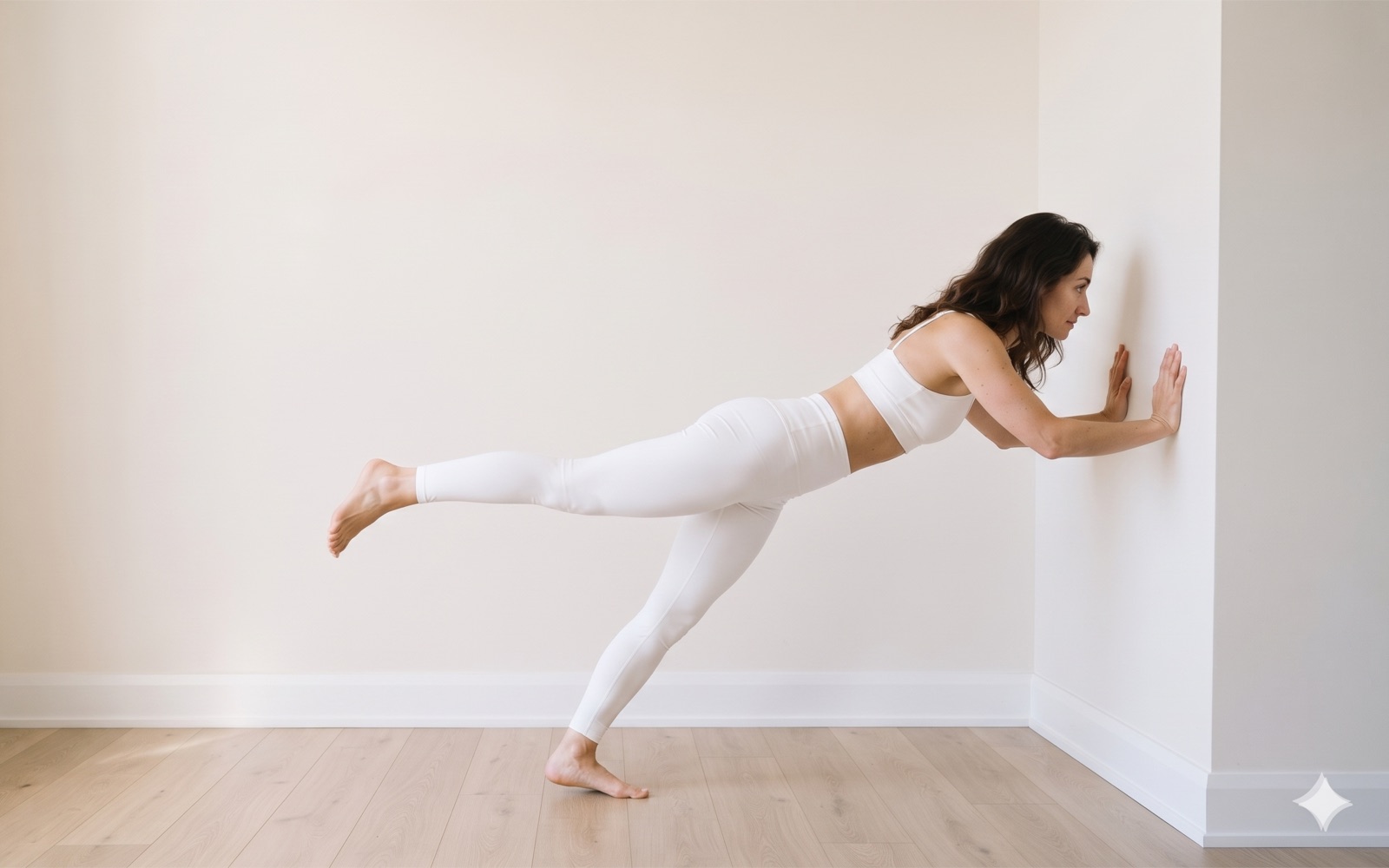
Set up for a wall push-up with your feet further back than usual. Lift one leg a few inches behind you, then lower your chest toward the wall over three counts and press back. Switch legs halfway. 8–10 reps. Easier: keep both feet down and slow the lowering instead.
7. Wall sit with heel raises
Hold a wall sit, then rise onto the balls of both feet and lower your heels again without changing the angle of your knees. 10–12 raises. Easier: do the heel raises standing tall with a hand on the wall, then add a short wall sit afterwards.
How do you progress wall Pilates safely?
Change one thing at a time and only when the current version feels steady for every rep. Progressing gradually lets your joints and tendons keep up with your muscles.
Strength guidelines suggest raising the load by a small step once you can do one or two more repetitions than your target, and recommend two to three sessions a week for people new to strength training, rising to three or four as you become more experienced [1]. A 2026 update from the American College of Sports Medicine found that regular resistance training improves strength, endurance, balance and physical function compared with no exercise, and that training at least twice a week and through a full range of motion were among the habits linked with bigger strength gains [2].
At the wall, small steps look like this:
- Add five seconds to a hold.
- Slow the lowering to three or four counts.
- Move from two legs to one, with the other foot only just lifted.
- Add a second round.
- Step further from the wall, or rely on it less.
Keep breathing throughout, especially in holds such as the single-leg wall sit, and stop any move that causes sharp or joint pain.
How hard should advanced wall Pilates feel?
It should feel hard enough that the last few reps take real concentration, but you should still be able to keep good form and breathe steadily. Roughly a 6 or 7 out of 10 effort is a good working range.
Pilates is usually light to moderate rather than intense. A 2026 review of the limited studies on Pilates intensity found that sessions were generally rated light to moderate on a standard effort scale, and that shorter rests between exercises, of 60 seconds or less, were linked with higher intensity [3]. That gives you a simple lever: keep the moves the same and shorten your rests to make a session harder.
How many calories does advanced wall Pilates burn?
Not a lot. Pilates is light to moderate in intensity, so even advanced sessions burn fewer calories than brisk walking or cycling for the same time.
The most reliable studies in the 2026 review put a typical Pilates session at about 3 METs, which works out to roughly 3 calories a minute for many adults [3]. A lab comparison found a mat session used about 1.9 calories a minute and a reformer session about 2.6 [4]. Harder variations and shorter rests will push your numbers up somewhat. For a personal estimate based on your weight and session length, try our Pilates calories burned calculator.
The real value of advanced wall Pilates is strength, control and balance. For calorie burn and heart health, add regular walking or another aerobic activity.
How long does it take to become advanced in wall Pilates?
Expect a few months of regular practice. Trials of Pilates two to three times a week usually show measurable gains in muscle endurance within 5 to 12 weeks [5], and strength guidelines describe intermediate trainees as people with about six months of consistent training [1].
Your timeline depends on where you start, how often you practise, your age, sleep and any injuries. A realistic path for most beginners:
| Stage | Roughly | What it looks like |
|---|---|---|
| Learning | Weeks 1–4 | Beginner moves, short holds, focus on form |
| Building | Months 2–3 | Longer holds, slower lowering, two rounds |
| Advanced | Month 4 onward | Single-leg and feet-on-wall moves, short rests |
What does an advanced wall Pilates week look like?
Two or three advanced sessions, with lighter days and walking in between, is plenty. You’ll make more progress from steady, recoverable training than from pushing hard every day.
| Day | Session |
|---|---|
| Monday | Advanced wall Pilates, 2–3 rounds of the 7 moves |
| Tuesday | 30-minute brisk walk |
| Wednesday | Mat core work or a gentle stretch session |
| Thursday | Advanced wall Pilates |
| Friday | 30-minute brisk walk |
| Saturday | Advanced wall Pilates, or rest |
| Sunday | Rest |
That fits US guidelines, which ask adults for muscle-strengthening activity on two or more days a week plus 150 to 300 minutes of moderate aerobic activity [6]. If you want a change of pace, our Wall Pilates guide covers how wall work fits with mat and reformer Pilates.
The bottom line
Advanced wall Pilates uses the same wall in a harder way: less support, single-leg work, longer holds and slower lowering. Move on to it once beginner moves feel steady for every rep, and progress one change at a time.
It won’t burn many calories, and it doesn’t need to. Its strength is building control, balance and strength that carry into daily life. Train two or three times a week, walk on other days, and give each new level a few weeks before you raise the challenge again.
Sources
Every source was read before it was cited. Numbers in the text, like [1], point here.
- [1]American College of Sports Medicine position stand: progression models in resistance training for healthy adultsAmerican College of Sports Medicine, Medicine and Science in Sports and Exercise, 2009
- [2]American College of Sports Medicine position stand: resistance training prescription for muscle function, hypertrophy, and physical performance in healthy adults: an overview of reviewsCurrier and colleagues, Medicine and Science in Sports and Exercise, 2026
- [3]Metabolic intensity and energy cost of Pilates exercises: an exploratory systematic review and meta-analysis of limited and heterogeneous evidenceVitor and colleagues, Systematic Reviews, 2026
- [4]What is the exercise intensity of Pilates? An analysis of the energy expenditure, blood lactate, and intensity of apparatus and mat Pilates sessionsde Souza Andrade and colleagues, Journal of Bodywork and Movement Therapies, 2021
- [5]Effect of the Pilates method on physical conditioning of healthy subjects: a systematic review and meta-analysisCampos and colleagues, Journal of Sports Medicine and Physical Fitness, 2016
- [6]Top 10 Things to Know About the Second Edition of the Physical Activity Guidelines for AmericansOffice of Disease Prevention and Health Promotion (ODPHP), U.S. Department of Health and Human Services, 2025
Found this useful? Pass it on