Pilates before bed: a gentle 10-minute routine to wind down
Gentle Pilates before bed is fine for most people and can help you wind down. Research finds evening exercise rarely harms sleep unless it's vigorous and close to bedtime, and regular Pilates has been linked with better sleep quality in small trials.
By the TrueMe team · Published · 9 min read · How we write
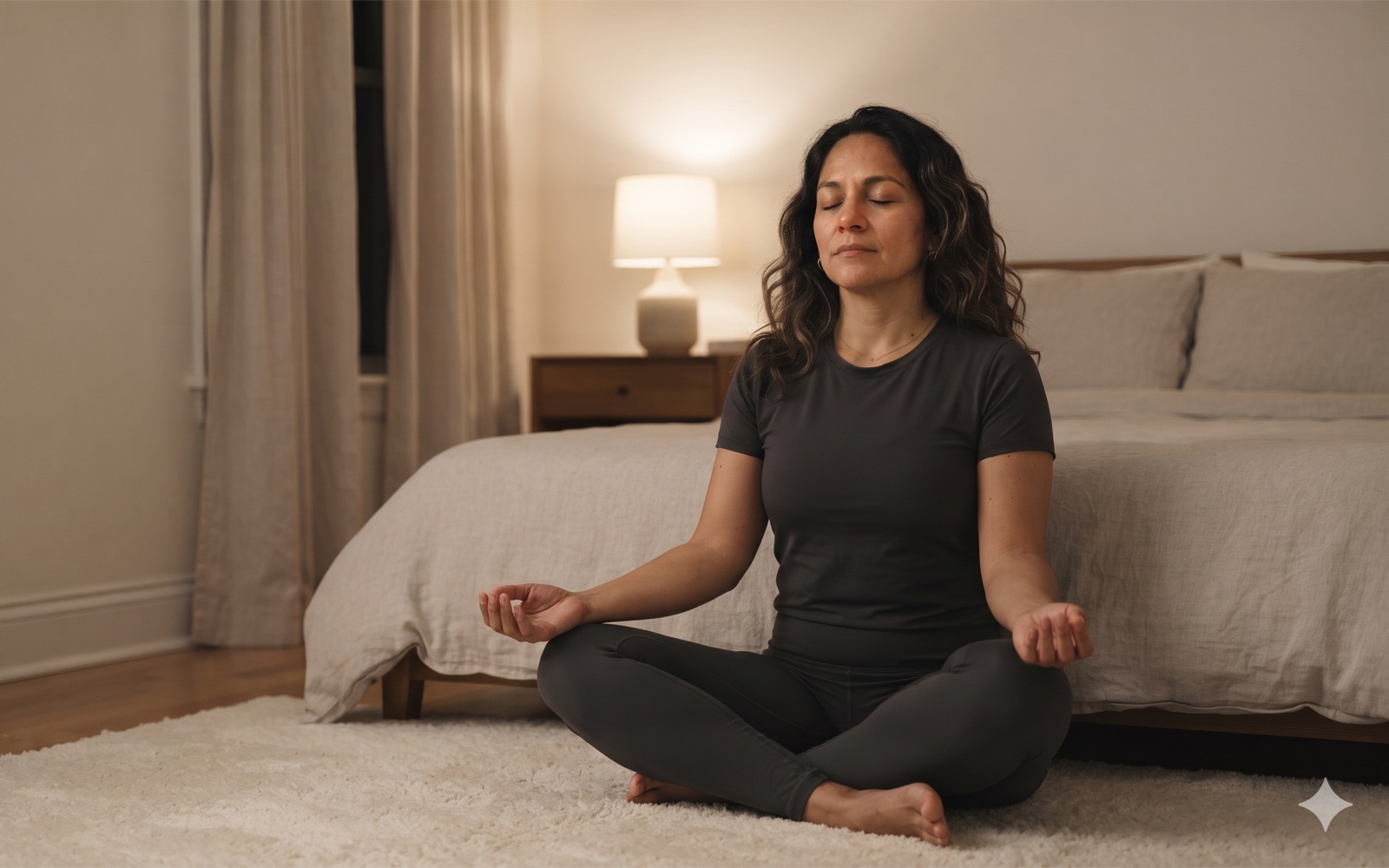
Pilates before bed is a good idea for most people, as long as you keep it slow and gentle. Calm floor moves, long exhales and easy stretches can help you switch from a busy day to a quieter body and mind, without the heart-pumping effort that can keep you awake.
This guide explains what research says about exercising in the evening, whether Pilates can help you sleep better, which moves suit the last half hour of your day, and a 10-minute routine you can do on the floor beside your bed.
Is it OK to do Pilates before bed?
Yes. Gentle Pilates in the evening is unlikely to disturb your sleep, and for many people it becomes a helpful part of winding down. The kind of session matters more than the time on the clock.
Slow mat work keeps your heart rate low, and the focus on breathing and control gives your mind something simple to follow. That makes it very different from a hard interval class or a fast run late at night.
Two things are worth keeping in mind:
- Keep the effort low. You should finish feeling looser and calmer, not out of breath or buzzing.
- Watch how you sleep. Everyone responds a little differently. If evening movement leaves you wide awake, move your practice earlier and keep only the breathing and stretches for bedtime.
What does research say about exercising in the evening?
For healthy adults, evening exercise doesn’t usually harm sleep. The exception is hard exercise that ends shortly before you go to bed.
A meta-analysis of 23 studies compared sleep after a single evening workout with sleep after no exercise. Overall, evening exercise did not make sleep worse and even came with slightly more deep sleep. However, the authors noted that falling asleep, total sleep time and sleep efficiency might suffer after vigorous exercise that ends an hour or less before bedtime [1].
A later network meta-analysis ranked light, moderate and high-intensity evening exercise. The differences between them were small, but high-intensity sessions slightly reduced REM sleep, while light sessions showed a trend toward falling asleep a little faster [2]. In one lab study, 40 minutes of hard cycling in the late evening raised heart rate at bedtime by about 26 beats a minute and delayed sleep by around 14 minutes, while moderate exercise did not [3].
| Evening session | What the research suggests |
|---|---|
| Gentle stretching, breathing, slow mat moves | Unlikely to disturb sleep; may help you relax |
| Moderate exercise | Generally fine, especially if it ends an hour or more before bed |
| Vigorous exercise ending within an hour of bed | May make it harder to fall asleep |
US health advice gives the same practical message from the other side: exercise regularly, but not too close to bedtime [8], and plan harder workouts earlier in the day [9]. A gentle Pilates routine sits comfortably within that advice.
Can Pilates help you sleep better?
Regular Pilates may improve how well you sleep, although the studies are small and their results vary. It works best as one part of good sleep habits, not as a cure for a sleep problem.
A meta-analysis of six randomized trials found that people who did Pilates programs reported better sleep quality than people who didn’t exercise. The effect was not significant in the smaller groups of healthy adults over 40 and postmenopausal women, and the trials differed a lot, so the authors called for larger studies [4].
One of the better trials followed 110 women aged 60 and over. After 12 weeks of Pilates, they reported longer sleep and fewer sleep disturbances than the control group, along with less anxiety, depression and fatigue [5]. A 2024 network meta-analysis of 27 trials found that Pilates, yoga and traditional Chinese exercises such as tai chi all improved sleep quality compared with no exercise, and Pilates ranked highest [6].
These were programs done over several weeks, usually during the day, so they show what regular Pilates can do rather than proving that bedtime is the best moment for it. The benefit comes from practising consistently.
What kind of Pilates is best before bed?
Choose slow floor work that lengthens your spine, opens your hips and back, and pairs every move with a long exhale. Save planks, jumps and fast ab work for earlier in the day.
Slow breathing has its own research. A systematic review of slow breathing (fewer than 10 breaths a minute) found it was linked with higher heart rate variability, a sign of a calmer nervous system, and with people feeling more relaxed and less anxious [7]. In Pilates, that means making each exhale a little longer than the inhale and letting the movement follow the breath.
| Good before bed | Better earlier in the day |
|---|---|
| Breathing on your back, pelvic tilts | The hundred, fast ab curls |
| Knee rocks, spine twists, cat-cow | Planks, side planks, push-ups |
| Child’s pose, seated stretches | Wall sits and long holds |
| Legs resting up the wall | Anything that leaves you out of breath |
Somatic Pilates, which slows movement down even further and puts the focus on how it feels, also suits the evening. Our somatic Pilates guide explains how it works.
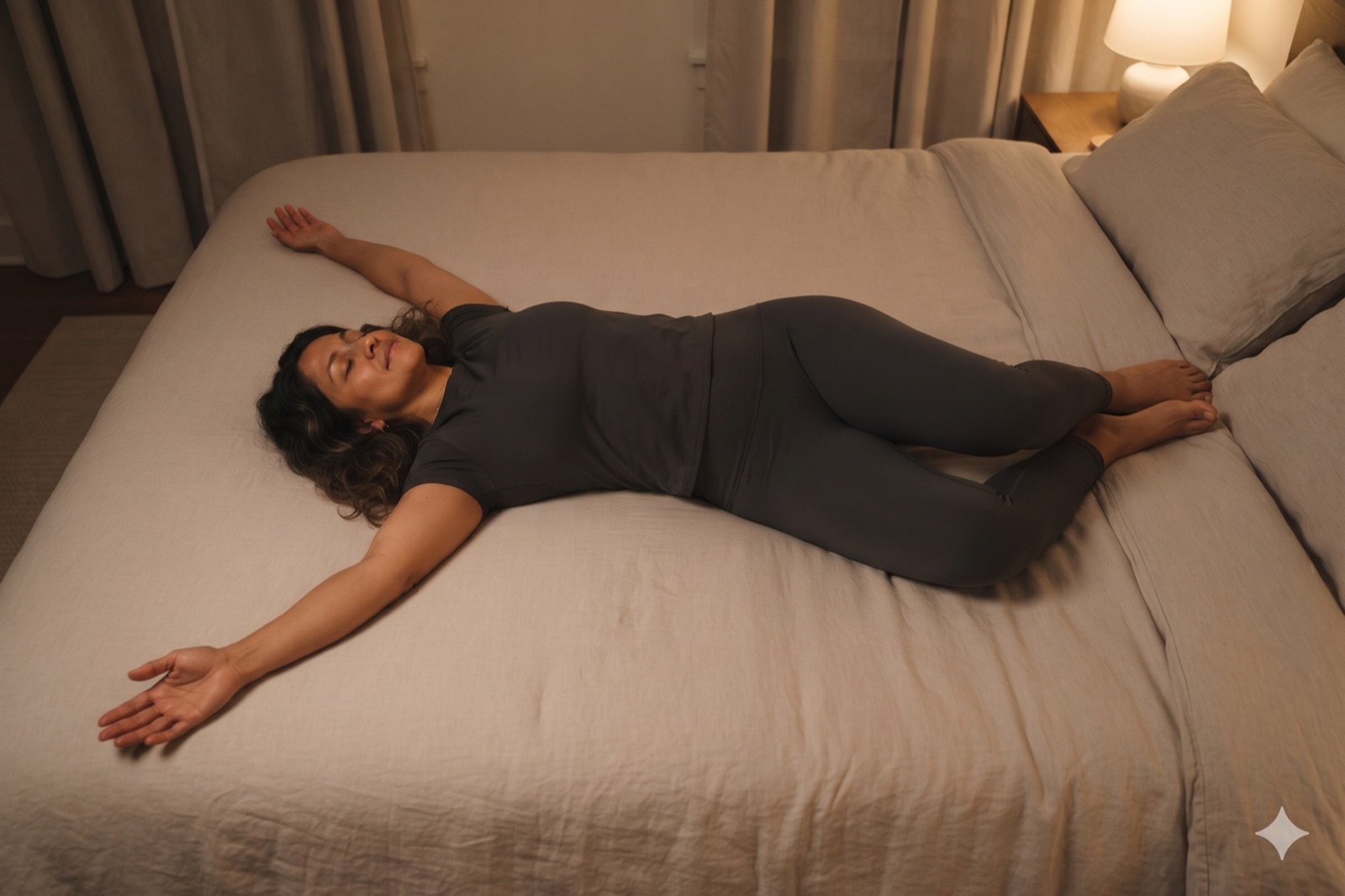
8 Pilates exercises to do before bed
Do these on a mat or rug beside your bed, or on a firm mattress for the moves that are marked. Breathe in through your nose and out slowly through your mouth, and move only within a range that feels easy.
1. Breathing on your back
Lie face up with your feet planted and knees pointing to the ceiling, one hand on your chest and one on your lower ribs. Breathe in for a count of four, feeling your ribs widen into your hand, then breathe out for a count of six. Six to eight breaths. Works on the bed too.
2. Pelvic tilts
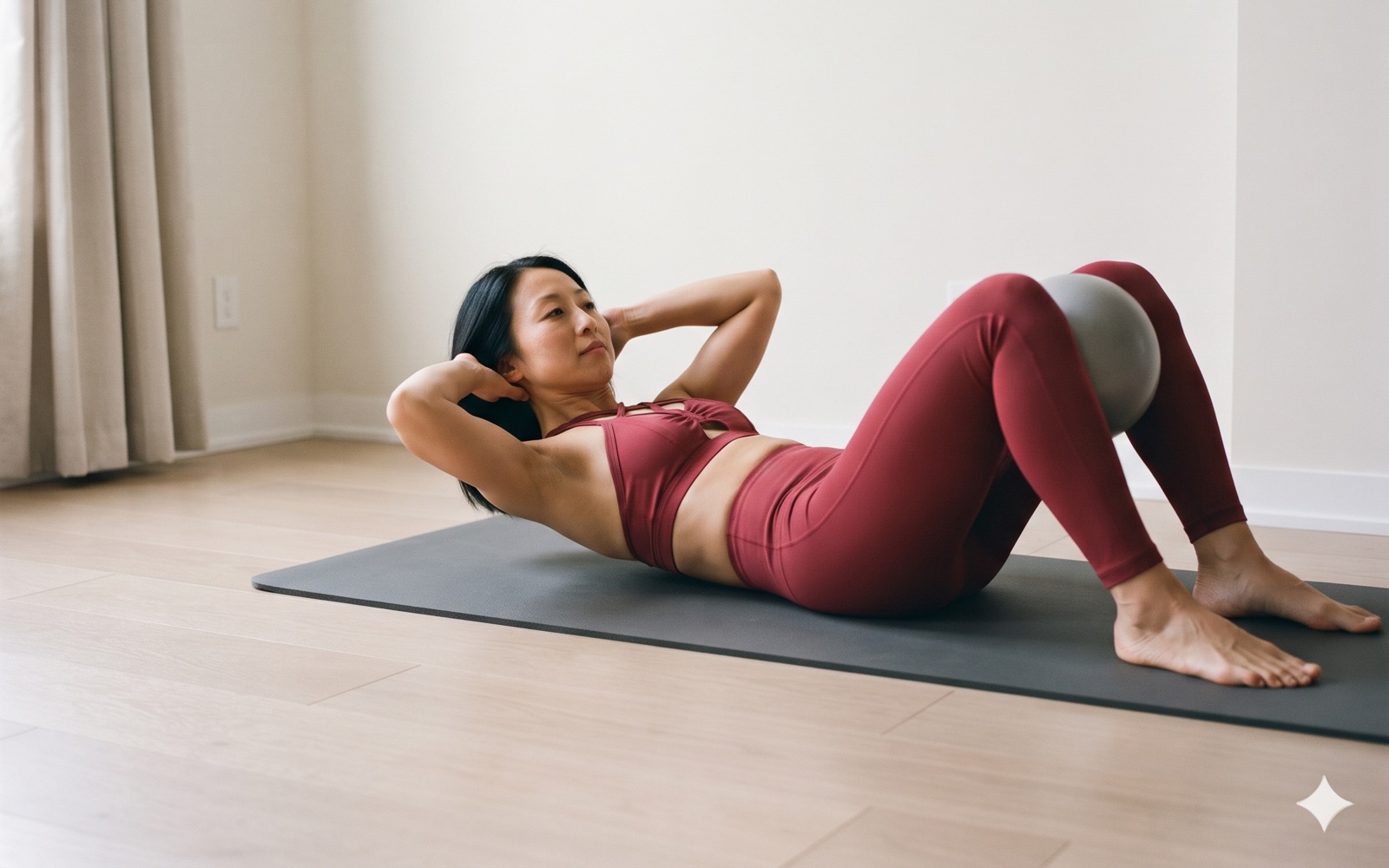
From the same position, breathe out and gently tilt your pelvis so your lower back sinks toward the floor, then breathe in and let it return to a small natural curve. 8–10 slow reps. Keep your buttocks relaxed and let the movement come from your lower belly.
3. Knee rocks
Hug both knees toward your chest, holding the backs of your thighs or your shins. Rock slowly from side to side, letting your lower back massage against the floor. About 30 seconds. Works on the bed.
4. Supine spine twist
With your knees bent and together, stretch your arms out wide at shoulder height. Breathe out as you lower both knees to one side, keeping your shoulders heavy, and stay for three breaths before switching sides. 3 times each side. Put a pillow under your knees if they don’t reach the floor. Works on the bed.
5. Cat-cow
Come onto your hands and knees. Breathe out as you arch your back up like a cat and let your head drop, then breathe in as you lengthen through a flat back into a gentle arch. 6 slow reps. Make the movement smaller, not faster, if your wrists or back complain.
6. Child’s pose
From hands and knees, sit your hips back toward your heels, with your knees as wide as feels comfortable, and rest your forehead on the floor or on a cushion. Breathe into your back ribs. Five slow breaths.
7. Seated spine stretch forward
Sit tall with your legs straight and hip-width apart, or with your knees bent if your hamstrings are tight. Breathe out as you nod your chin and roll forward through your spine, reaching your hands along the floor, then roll back up to sitting. 4–5 reps.
8. Legs up the wall
Sit with one hip close to a wall, then swing your legs up the wall as you lower your back to the floor. Rest your arms by your sides and breathe slowly. One to three minutes. Bend your knees or slide a little further from the wall if your hamstrings feel tight.
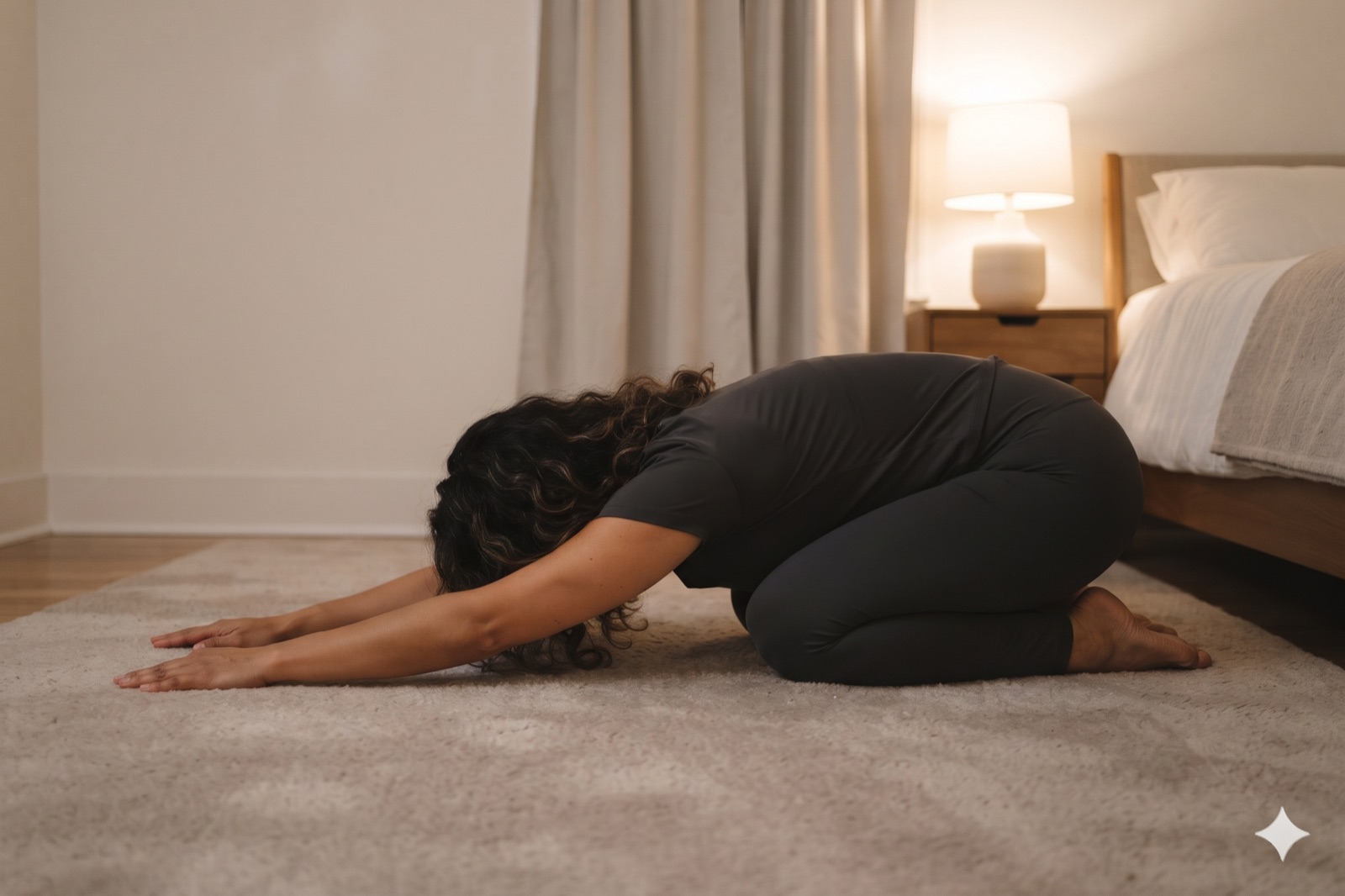
A 10-minute Pilates before bed routine
Do the moves in this order, without rushing between them. Dim the lights first and put your phone out of reach.
| Order | Exercise | Time or reps |
|---|---|---|
| 1 | Breathing on your back | 6–8 breaths |
| 2 | Pelvic tilts | 8–10 |
| 3 | Knee rocks | 30 seconds |
| 4 | Supine spine twist | 3 each side |
| 5 | Cat-cow | 6 |
| 6 | Child’s pose | 5 breaths |
| 7 | Seated spine stretch forward | 4–5 |
| 8 | Legs up the wall | 1–3 minutes |
If you want a standing version for earlier in the evening, the Wall Pilates stretch session and the wall roll-down are gentle options.
Can you do Pilates in bed?
You can do some gentle moves in bed, but a mattress is too soft for most Pilates exercises. It’s fine for breathing, knee rocks, pelvic tilts and twists, which need little support.
A soft surface makes it harder to feel where your spine and pelvis are, and it lets your wrists and knees sink in moves such as cat-cow. For anything on your hands and knees or anything that asks for control, a mat or rug on the floor gives you a steadier base. Many people like to do the floor moves first, then finish with breathing in bed.
How close to bedtime should you do Pilates?
Gentle Pilates can be the last thing you do before turning off the light. Leave a longer gap, ideally an hour or more, after any session that gets you breathing hard [1].
A few habits make evening practice more relaxing:
- Keep the lights low and the room cool and quiet; a cool, dark, quiet bedroom supports sleep [8].
- Skip screens during and after your routine, and follow along from memory or a printed list instead.
- Keep the same time each evening, so your routine becomes a signal that the day is ending.
- Don’t force it. If you still can’t sleep after about 20 minutes in bed, get up and do something quiet until you feel sleepy [9].
Most adults need seven to nine hours of sleep a night [8]. If you often struggle to fall or stay asleep, snore loudly, or feel tired even after a full night, talk with your doctor, because a sleep disorder needs its own care [9]. If you have back pain, are pregnant or are recovering from an injury, check with your doctor or physical therapist which of these moves suit you.
For a lighter start to your day, the 5-minute morning Wall Pilates session makes a good partner to this evening routine.
The bottom line
Pilates before bed is a gentle way to end the day. Research suggests that evening exercise rarely harms sleep unless it’s vigorous and close to bedtime, and regular Pilates programs have been linked with better sleep quality in several small trials.
Keep your evening session slow, pair every move with a long exhale, and save harder work for earlier. Try the 10-minute routine above for two weeks and notice how you fall asleep, and talk with your doctor if poor sleep keeps returning.
Sources
Every source was read before it was cited. Numbers in the text, like [1], point here.
- [1]Effects of evening exercise on sleep in healthy participants: a systematic review and meta-analysisStutz and colleagues, Sports Medicine, 2019
- [2]Different intensities of evening exercise on sleep in healthy adults: a systematic review and network meta-analysisYue and colleagues, Nature and Science of Sleep, 2022
- [3]Sleep onset is disrupted following pre-sleep exercise that causes large physiological excitement at bedtimeOda and Shirakawa, European Journal of Applied Physiology, 2014
- [4]Effect of Pilates on sleep quality: a systematic review and meta-analysis of randomized controlled trialsChen and colleagues, Frontiers in Neurology, 2020
- [5]Effects of Pilates training on sleep quality, anxiety, depression and fatigue in postmenopausal women: a randomized controlled trialAibar-Almazán and colleagues, Maturitas, 2019
- [6]The optimal exercise intervention for sleep quality in adults: a systematic review and network meta-analysisXie and colleagues, Preventive Medicine, 2024
- [7]How breath-control can change your life: a systematic review on psycho-physiological correlates of slow breathingZaccaro and colleagues, Frontiers in Human Neuroscience, 2018
- [8]Healthy SleepMedlinePlus, U.S. National Library of Medicine, 2025
- [9]Get Enough SleepMyHealthfinder, Office of Disease Prevention and Health Promotion (ODPHP), 2025
Found this useful? Pass it on