Standing Pilates exercises: 9 moves and a 15-minute routine
Standing Pilates exercises train your core, legs and balance without getting down on the floor. Trials in older adults show Pilates improves balance, strength and fall-risk measures, and a chair or counter keeps standing moves safe while you build confidence.
By the TrueMe team · Published · 7 min read · How we write
Standing Pilates exercises take the control, breathing and core focus of mat Pilates and move them onto your feet. They suit anyone who finds getting down to the floor awkward, wants to practise balance, or likes the idea of a short session in the kitchen or garden without a mat.
This guide explains how standing Pilates compares with mat work, what research says about Pilates for balance and strength, nine standing moves with step-by-step cues, a 15-minute routine, and how to make it easier or harder.
What is standing Pilates?
Standing Pilates is a set of Pilates-based exercises done upright, often with a chair, counter or wall nearby for support. It trains your core, hips, legs and posture while you hold yourself steady on one or two feet.
Pilates is usually defined as a mind-body exercise that focuses on strength, core stability, flexibility, muscle control, posture and breathing [1]. Standing versions keep all of that, and add a job your body does all day long: staying balanced while you shift your weight, reach and turn. Many classic mat moves have standing cousins, such as a standing roll-down, a standing leg lift or a standing spine twist.
| Standing Pilates | Mat Pilates | |
|---|---|---|
| Position | On your feet, with support nearby | Lying, sitting or kneeling on a mat |
| Equipment | None; a chair or counter helps | A mat |
| Balance work | Built into most moves | Less, as the floor supports you |
| Core work | Steady, upright control | More direct ab and back work |
| Good for | Getting started, balance, people who avoid the floor | Deeper core strength, flexibility |
Is standing Pilates effective?
Yes, for balance, leg strength and everyday control it can be. Most research tests mixed Pilates programs rather than standing-only routines, but standing moves are a big part of what helps with balance.
A meta-analysis of 39 trials in adults aged 60 and over found that Pilates improved balance, strength, flexibility and everyday function compared with no exercise or usual activity, and lowered measures of fall risk [2]. Another review of six randomized trials in healthy older adults found a clear effect of Pilates on postural balance, the kind of steadiness you need when standing still or shifting your weight [3].
For a stronger core and more flexibility, mat work still adds something that standing moves can’t. In one trial, middle-aged adults who did twice-weekly mat Pilates for 12 weeks improved abdominal endurance and hamstring flexibility [4]. A balanced week can include both, or start with standing work and add the mat once you feel ready.
Who is standing Pilates good for?
Standing Pilates suits beginners, older adults, people who find it hard to get up from the floor, and anyone who wants short sessions during the day. It is also a good option if lying flat is uncomfortable.
Falls often come from balance problems and leg weakness, and regular exercise can lower that risk by strengthening muscles and improving balance [5]. US guidelines also note that for older adults, physical activity lowers the risk of falls and of injuries from falls [6]. Standing Pilates trains both strength and balance at once, and a sturdy chair keeps it safe while you build confidence.
9 standing Pilates exercises
Stand near a sturdy chair, counter or wall. Breathe out on the effort, stand tall with your ribs over your hips, and hold on whenever you need to. Start with the easier option if you’re new.
1. Standing breath and arm pump
Stand tall, feet under your hips and arms by your sides. Lift your arms a few inches forward and pump them up and down in small, quick beats while you breathe in for five beats and out for five. Five rounds of 10 breaths. This is a standing take on the classic Pilates hundred.
2. Standing roll-down
Stand with your knees soft. Breathe out, nod your chin and roll down through your spine one section at a time, letting your arms hang, then roll back up the same way. 5–6 reps. Only go as far as feels easy, and try the wall roll-down for more support. Skip this one if you have osteoporosis (see below).
3. Standing knee lift
Hold your support with one hand. Shift your weight onto one leg and slowly lift the other knee to hip height, then lower it with control. 8 reps each side. Harder: let go of the support, or hold the lifted knee for three breaths. The wall marching page shows a similar move.
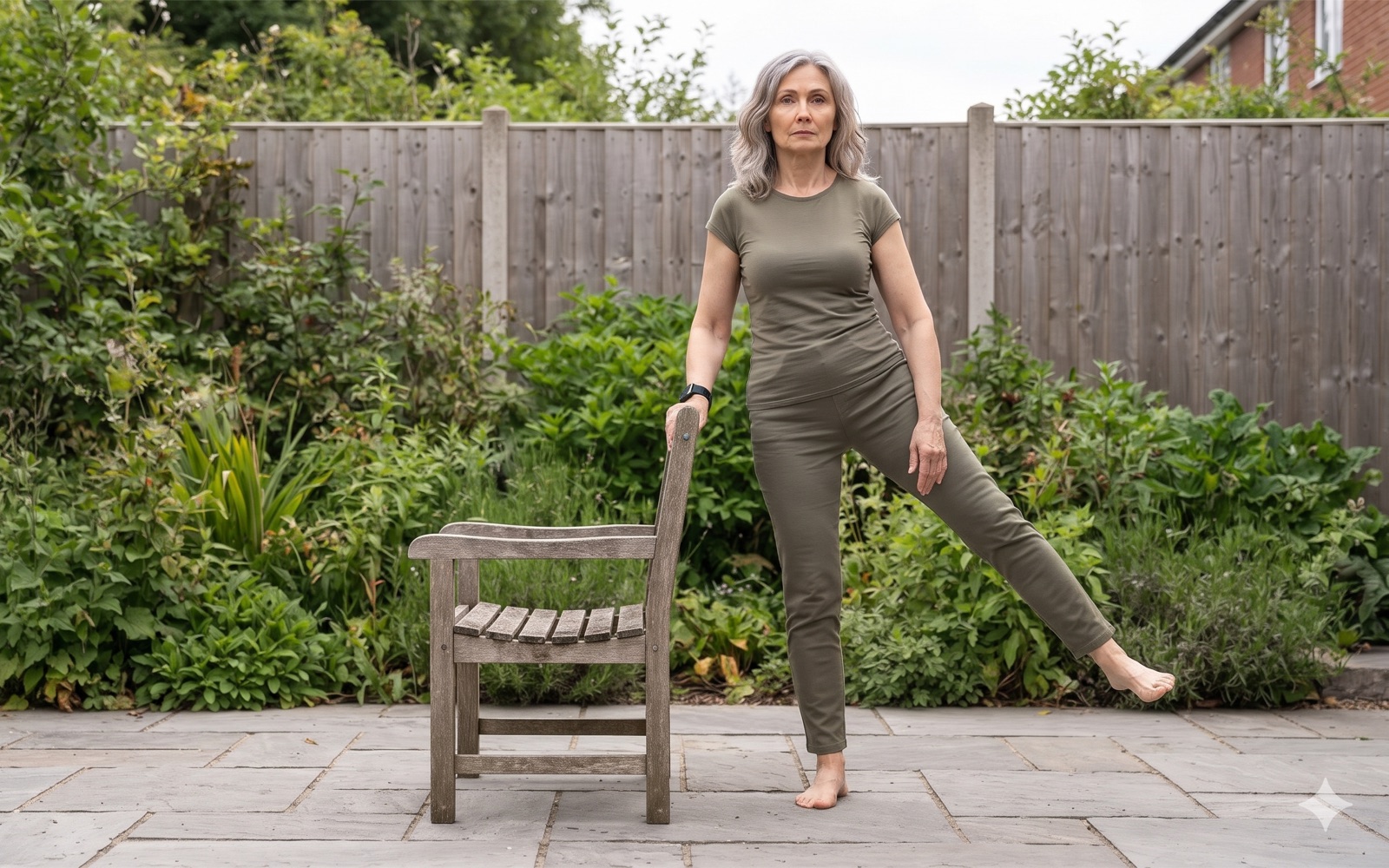
4. Standing side leg lift
Stand side-on to your support with one hand on it. Keeping your toes pointing forward and your body upright, lift your outside leg a little way out to the side, then lower it. 10 reps each side. Keep the lift small so your trunk doesn’t lean.
5. Standing leg press back
Face your support with both hands on it. Lean slightly forward from your hips and press one leg straight back a few inches, squeezing your buttock, then return. 10 reps each side. Keep your lower back still; the wall glute press uses the same idea.
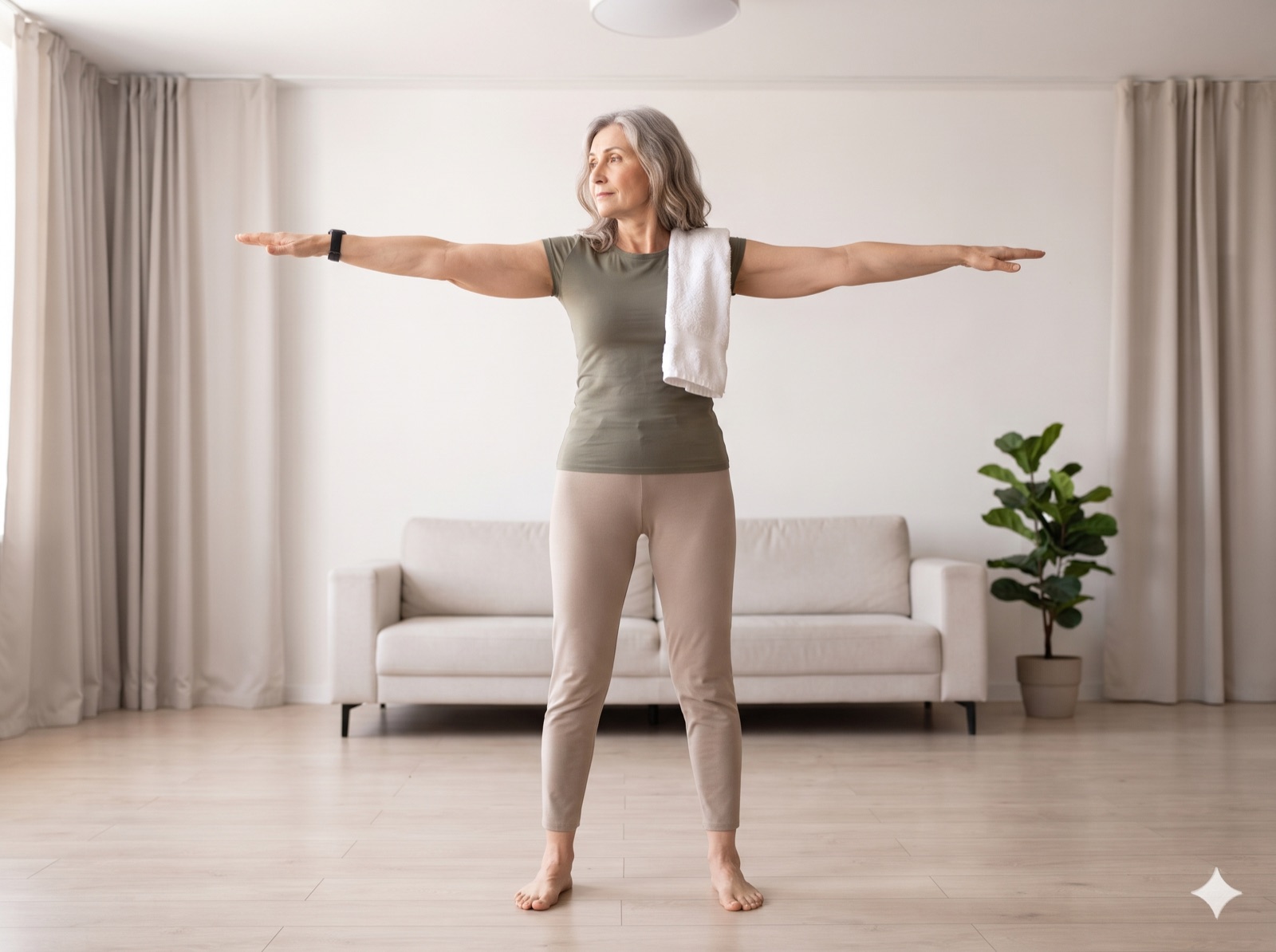
6. Standing spine twist
Stand tall, feet under your hips, and stretch your arms out wide at shoulder height. Breathe out and turn your upper body to one side, keeping your hips facing forward, then breathe in back to the center. 6 reps each side. Make the turn smaller if you have back pain. The standing wall rotation is a supported version.
7. Standing side bend
Stand tall with one hand on your support. Reach your free arm up and over your head as you bend gently to the side, then return. 5 reps each side. Keep both feet grounded and your chest open.
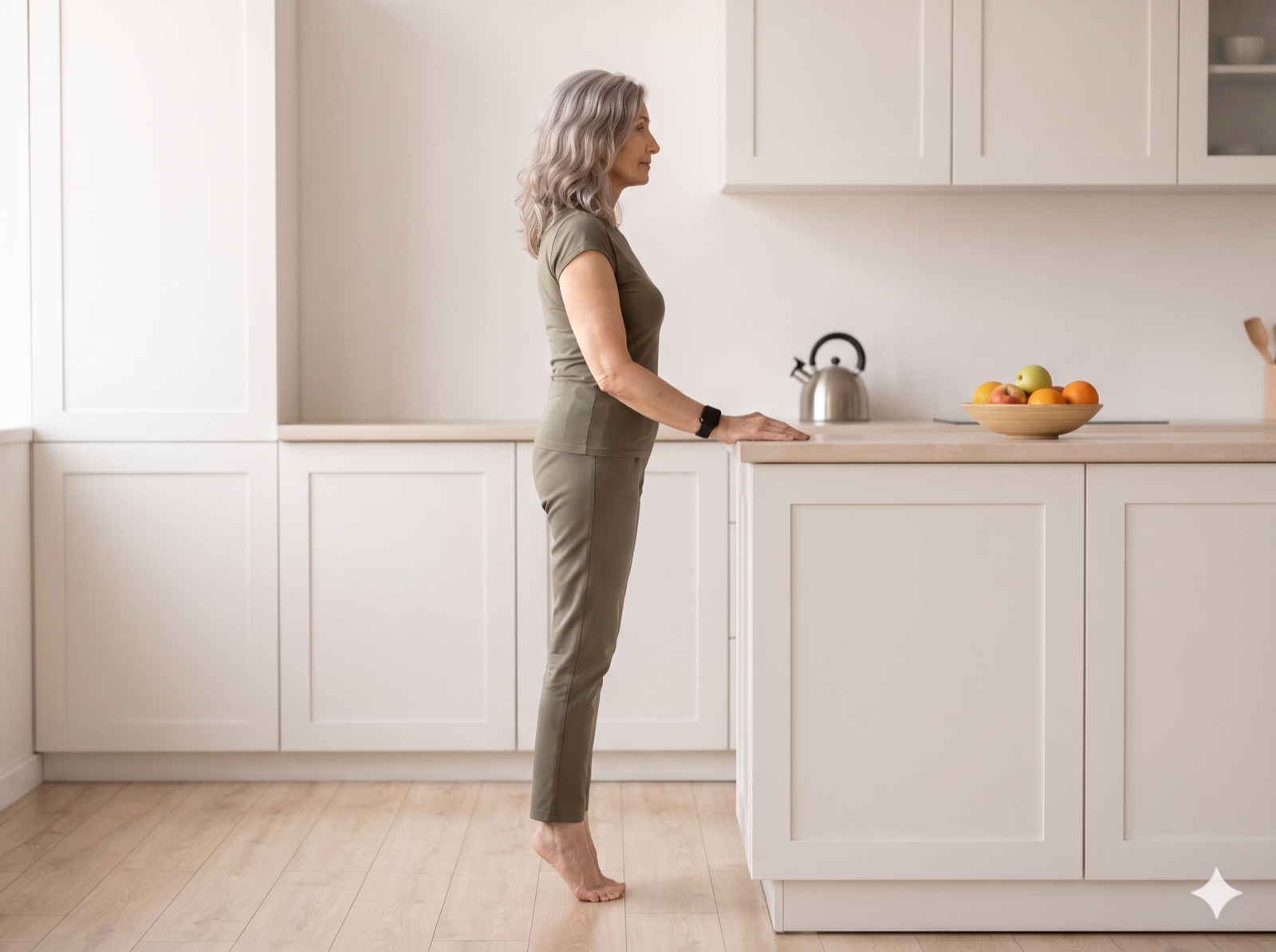
8. Heel raises
Rest your hands on a counter or chair back. Rise slowly onto the balls of your feet, pause, then lower your heels over three counts. 12–15 reps. Harder: lift one foot and do single-leg raises with support.
9. Wide-leg squat
Stand with your feet wider than your hips and toes turned slightly out, hands on your hips or on your support. Bend your knees in line with your toes and lower a few inches, then press back up. 10–12 reps. Keep your back upright and your weight even across both feet.
A 15-minute standing Pilates routine
Do one round in order, rest for a minute, then do a second round. Three times a week is a good target.
| Order | Exercise | Reps |
|---|---|---|
| 1 | Standing breath and arm pump | 5 × 10 breaths |
| 2 | Standing roll-down | 5–6 |
| 3 | Standing knee lift | 8 each side |
| 4 | Standing side leg lift | 10 each side |
| 5 | Standing leg press back | 10 each side |
| 6 | Standing spine twist | 6 each side |
| 7 | Standing side bend | 5 each side |
| 8 | Heel raises | 12–15 |
| 9 | Wide-leg squat | 10–12 |
For a guided session that uses the wall for support, try gentle Wall Pilates for seniors.
How do you make standing Pilates easier or harder?
Change your support, your base and your speed. Holding on with two hands and keeping both feet down makes moves easier; one hand, one foot and slower lowering make them harder.
| To make it easier | To make it harder |
|---|---|
| Hold your support with both hands | Use one finger, or let go |
| Keep the lift or bend small | Lift higher, with the same control |
| Feet a little wider apart | Feet closer together, or stand on one leg |
| Fewer reps with rests | Slower lowering, holds of three breaths |
| Eyes open, looking ahead | Turn your head slowly during balance moves |
Progress one thing at a time, and only when the current version feels steady for every rep. You can also hold light hand weights for the arm pump and squats once the moves feel easy.
Is standing Pilates safe for everyone?
For most people, yes, especially with a sturdy support close by. A few conditions call for changes or a check with your doctor first.
- Osteoporosis: avoid movements that bend forward from the waist or twist the spine strongly [7]. Skip the roll-down and keep twists small and gentle.
- Dizziness or a recent fall: practise beside a counter or in a corner, where two walls stop you from tipping, and ask your doctor about the cause.
- Joint replacement, recent surgery or pregnancy: ask your doctor or physical therapist which moves suit you.
Wear supportive shoes or go barefoot on a non-slip floor, clear the space around you, and stop any move that causes sharp pain.
The bottom line
Standing Pilates brings the slow control of Pilates onto your feet, with balance training built in. Trials in older adults show Pilates programs improve balance, strength and fall-risk measures, and standing moves are an easy, floor-free way to start.
Try the nine moves above three times a week, keep a chair or counter within reach, and add mat work later if you want deeper core strength. Check with your doctor first if you have osteoporosis, dizziness or a recent fall.
Sources
Every source was read before it was cited. Numbers in the text, like [1], point here.
- [1]Defining Pilates exercise: a systematic reviewWells and colleagues, Complementary Therapies in Medicine, 2012
- [2]Pilates improves physical performance and decreases risk of falls in older adults: a systematic review and meta-analysisFernández-Rodríguez and colleagues, Physiotherapy, 2021
- [3]Pilates exercise and postural balance in older adults: a systematic review and meta-analysis of randomized controlled trialsCasonatto and Yamacita, Complementary Therapies in Medicine, 2020
- [4]Pilates for improvement of muscle endurance, flexibility, balance, and postureKloubec, Journal of Strength and Conditioning Research, 2010
- [5]FallsMedlinePlus, U.S. National Library of Medicine, 2025
- [6]Top 10 Things to Know About the Second Edition of the Physical Activity Guidelines for AmericansOffice of Disease Prevention and Health Promotion (ODPHP), U.S. Department of Health and Human Services, 2025
- [7]OsteoporosisMedlinePlus, U.S. National Library of Medicine, 2025
Found this useful? Pass it on