Pilates for mental health: what research shows, plus 6 calming moves
Small trials link regular Pilates with fewer symptoms of anxiety and depression, less fatigue and more energy, and even one session can lift your mood. Slow breathing and focused movement are a big part of why it feels calming, but it is not a substitute for care.
By the TrueMe team · Published · 8 min read · How we write
Pilates for mental health is a real, research-backed idea: controlled trials link regular Pilates with fewer symptoms of anxiety and depression, less fatigue and more energy. The slow pace, steady breathing and focus on how your body moves give your mind a break from racing thoughts, while the exercise itself does the rest.
This guide covers what the research shows and where it falls short, why you often feel calmer after a session, six calming Pilates exercises with a 12-minute routine, how often to practise, and when to look for more support.
How does Pilates affect your mental health?
Pilates combines three things that each support mood: regular exercise, slow controlled breathing and focused attention on your body. Together they can lower tension and leave you feeling calmer and more energized.
Pilates is described in research as a mind-body exercise focused on strength, core stability, flexibility, muscle control, posture and breathing [1]. That mix matters. You move slowly enough to notice what you’re doing, each exercise asks for concentration, and the breathing pattern sets a calm rhythm. Many people find that 20 minutes of this leaves less room for worry than a workout they can do on autopilot.
| What happens in Pilates | How it may help your mood |
|---|---|
| Regular physical activity | Supports mood and energy over weeks and months |
| Slow, long exhales | Linked with a calmer nervous system and feeling more relaxed |
| Focus on precise movement | Gives your attention a simple task away from worries |
| A short, achievable routine | A small win you can repeat, even on hard days |
Does Pilates help with anxiety and depression?
The evidence is encouraging: trials consistently find that Pilates reduces symptoms of anxiety and depression compared with not exercising. The studies are mostly small, though, so Pilates is best seen as a helpful addition to care, not a replacement for it.
A meta-analysis of eight controlled trials found that Pilates led to large reductions in depressive and anxiety symptoms and in feelings of fatigue, and to increases in feelings of energy. The authors noted that the trials were small, compared Pilates with no exercise rather than other treatments, and varied in quality [2]. A later meta-analysis of 18 randomized trials in 827 women with depressive or anxiety symptoms reported moderate evidence that Pilates improved both, and suggested it as a possible add-on program [3].
In one trial of 110 women aged 60 and over, 12 weeks of Pilates reduced anxiety and depression scores and fatigue, and improved sleep, compared with a control group [4]. Better sleep and better mood often go together, which is one more reason to keep moving.
Exercise in general has strong evidence for depression. A large 2024 network meta-analysis of 218 trials in people with depression found moderate benefits from walking or jogging, yoga and strength training, among others, with bigger effects at higher intensities [7]. Pilates fits comfortably among these options.
Why do you feel so good after Pilates?
Even a single session can lift your mood. Part of that comes from exercise itself, and part from the slow breathing and focus that Pilates builds in.
In one study, 87 young men did one 30-minute mat Pilates session. Afterward they reported less anxiety, less fatigue and lower overall mood disturbance, and more energy, including those who had high anxiety or depressive symptoms at the start [5]. Slow breathing likely plays a part too: a systematic review found that breathing at fewer than 10 breaths a minute was linked with higher heart rate variability, a sign of a calmer nervous system, and with people feeling more relaxed and less anxious [6].
Some people also feel emotional during or after a session, and occasionally cry. That is a common response to slowing down and relaxing tension, and nothing to worry about on its own. If strong feelings come up often or stay with you, talk to someone you trust or a health professional.
Pilates for mental health: 6 calming exercises
Move slowly and let your breath set the pace: breathe in through your nose, and make each exhale a little longer than the inhale. Use a mat on the floor and stay within a comfortable range.
1. Seated rib breathing
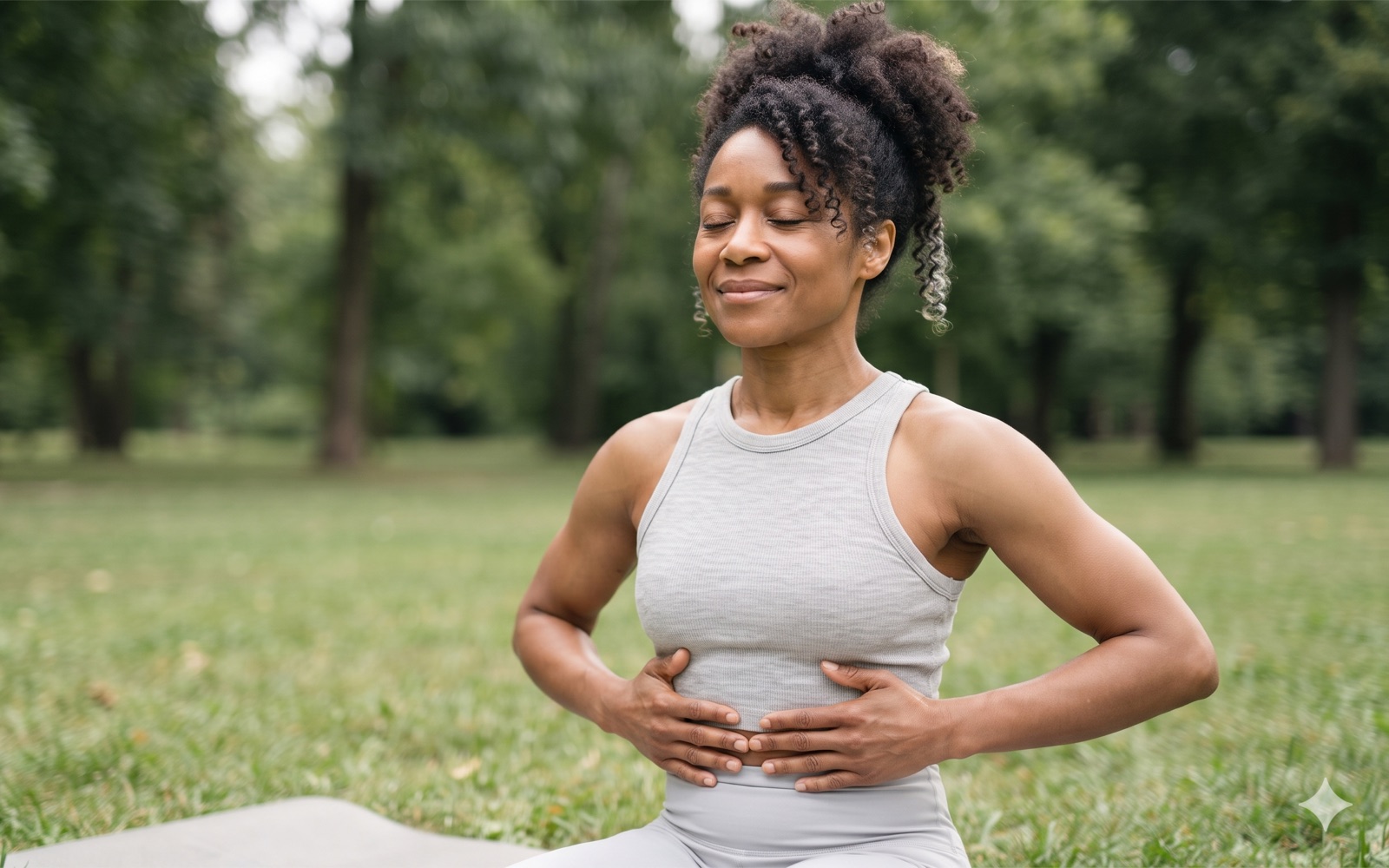
Sit tall on a cushion or chair with your hands wrapped around your lower ribs. Breathe in through your nose and feel your ribs widen sideways into your hands, then breathe out slowly through your mouth and feel them draw in. Eight slow breaths. Keep your shoulders relaxed and away from your ears.
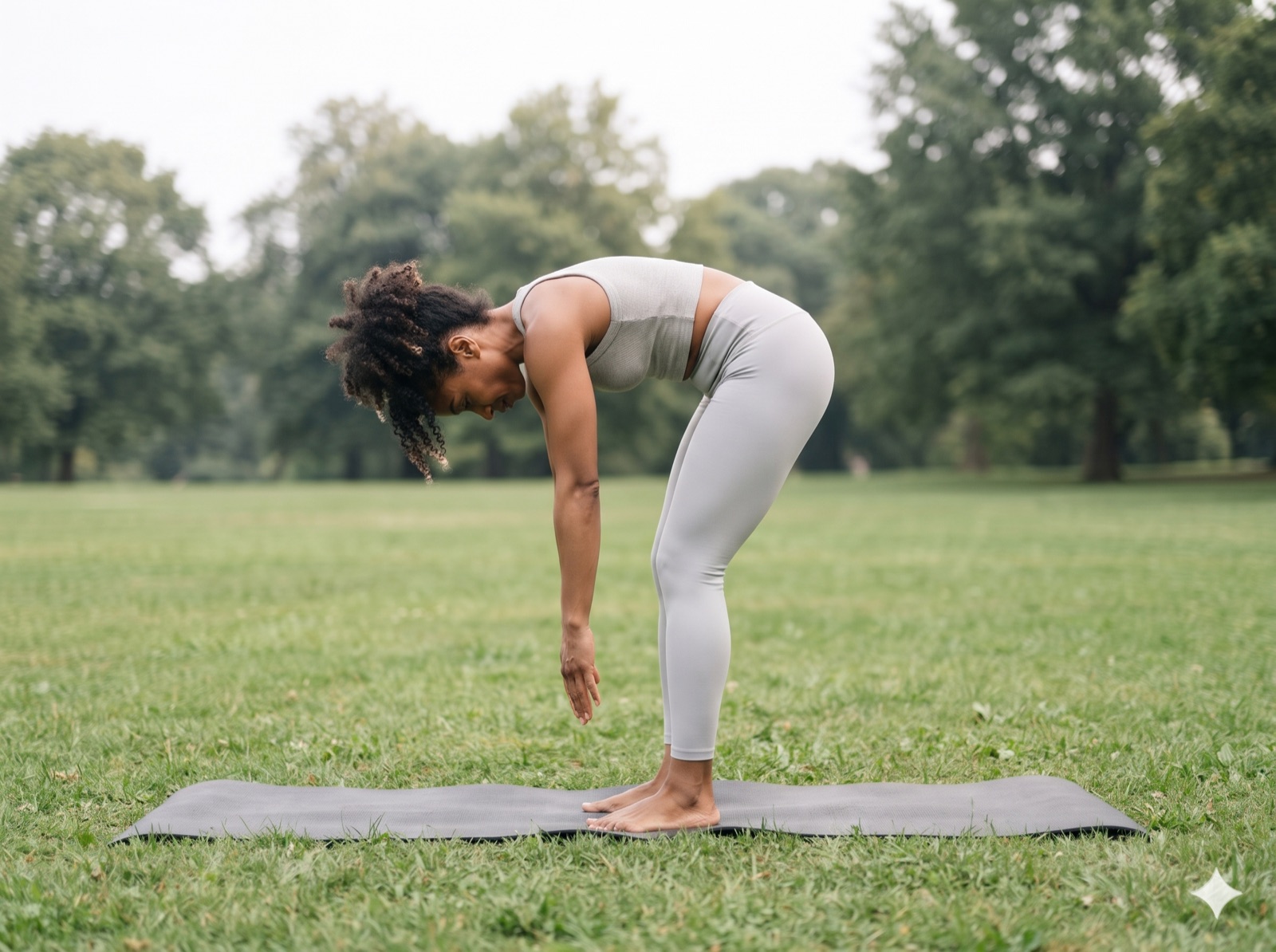
2. Roll-down
Stand with your feet hip-width apart and knees soft. Breathe out, nod your chin and roll down through your spine one section at a time, letting your arms and head hang heavy, then roll back up as you breathe in. 4–5 reps. The wall roll-down gives your back extra support.
3. Pelvic curl
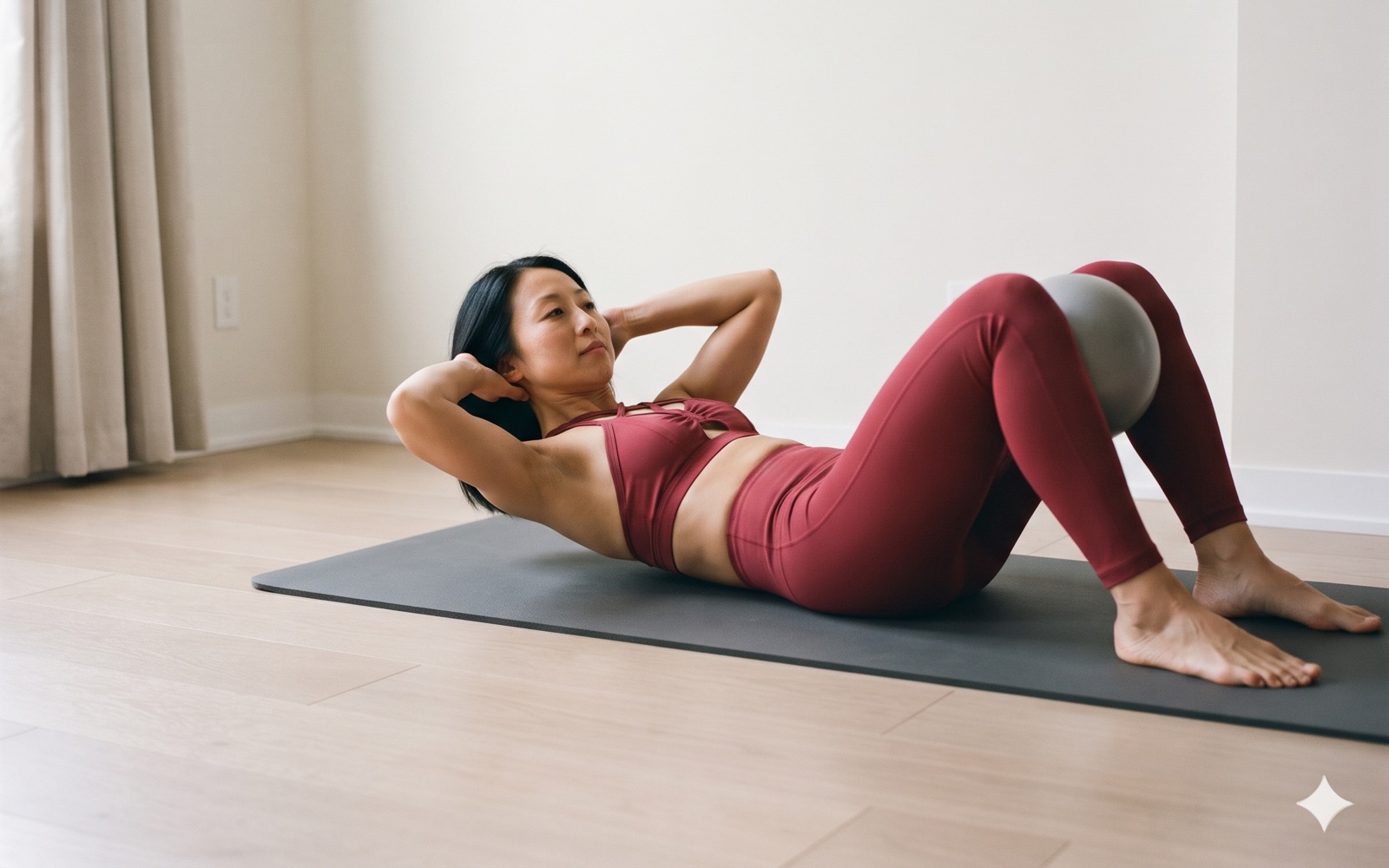
Lie face up with your feet planted and knees pointing up. Breathe out and peel your spine off the mat from your tailbone until your knees, hips and shoulders form a line, then breathe in at the top and roll down slowly, one section at a time. 6–8 reps. Think of it as moving through each part of your back in turn.
4. Seated spine twist
Sit tall with your legs crossed or straight in front of you and your arms crossed over your chest. Breathe out as you turn your upper body to one side, grow taller as you breathe in, then return to the center. 4 reps each side. Keep the turn small and smooth.
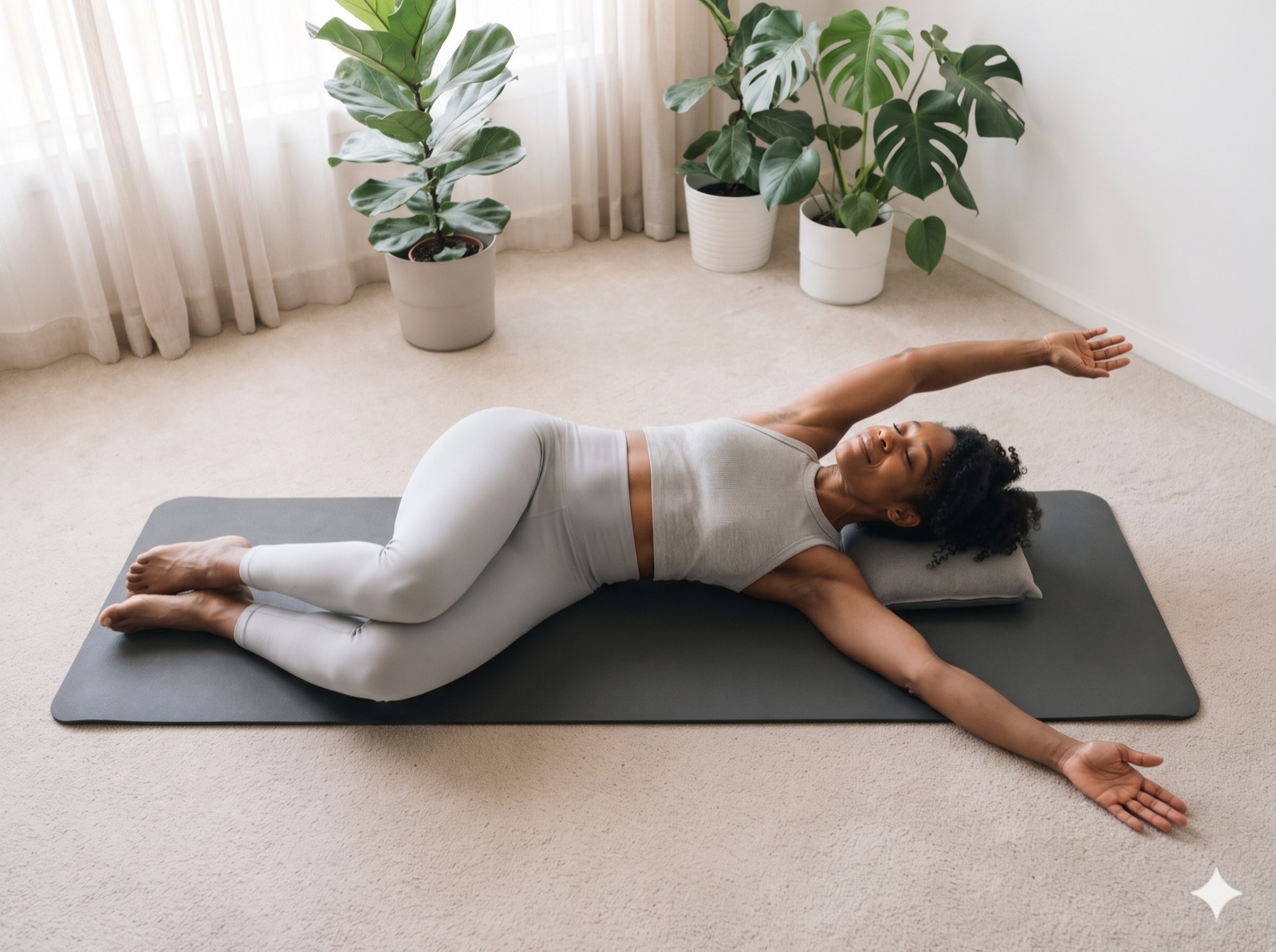
5. Side-lying open book
Lie on your side with your knees bent in front of you and your arms reaching forward, palms together. Breathe in as you lift your top arm up and over to open your chest toward the ceiling, letting your eyes follow your hand, then breathe out as you bring it back. 5 reps each side.
6. Constructive rest
Lie face up with your feet planted a little wider than your hips and let your knees fall in to rest against each other. Place one hand on your belly and one on your chest. Breathe in for a count of four and out for a count of six. Two to three minutes.
A 12-minute calming Pilates routine
Use this routine whenever you feel tense or scattered, or at the same time each day to build a habit. Leave your phone in another room if you can.
| Order | Exercise | Reps or time |
|---|---|---|
| 1 | Seated rib breathing | 8 breaths |
| 2 | Roll-down | 4–5 |
| 3 | Pelvic curl | 6–8 |
| 4 | Seated spine twist | 4 each side |
| 5 | Side-lying open book | 5 each side |
| 6 | Constructive rest | 2–3 minutes |
For an evening version, see our Pilates before bed routine. The Wall Pilates stretch session is a good standing option.
How often should you do Pilates for your mental health?
Aim for two or three sessions a week, plus short breathing breaks on other days. Regular practice matters more than long sessions.
The trials that found benefits ran Pilates programs over several weeks, such as the 12-week program for women aged 60 and over [4], so think in terms of a regular habit rather than a one-off fix [2]. For mood more broadly, US mental health experts recommend regular exercise as part of self-care and note that even 30 minutes of walking a day can boost mood, and that small amounts add up [8]. A practical week might combine two Pilates sessions, a couple of brisk walks and a few minutes of rib breathing whenever you need a reset.
The large depression review found bigger benefits from more vigorous exercise [7], so once gentle Pilates feels easy, it’s worth adding sessions that ask a little more of you, such as our Pilates leg workout.
Is Pilates or yoga better for mental health?
Neither is clearly better. Both combine movement, breathing and focus, and both have trials showing benefits for mood. The best choice is the one you enjoy and will keep doing.
Yoga has more research behind it so far. In the 2024 depression review it was one of the more effective options and, with strength training, one of the easiest for people to stick with [7]. Pilates has fewer and smaller trials, but they point the same way [2][3]. If you like slow, precise strength work, Pilates is a great fit; if you prefer longer holds and stretching, yoga may suit you more. Many people do both. Our Pilates vs yoga vs barre guide compares them in more detail.
When should you get more help?
Pilates can support your mental health, but it is not a treatment for anxiety, depression or other mental health conditions. If low mood, worry or stress affect your daily life for more than a couple of weeks, talk to your doctor or a mental health professional.
A primary care provider can help you understand what’s going on and refer you to a psychologist, psychiatrist or counselor if needed [8]. Keep up any treatment you already have, and see exercise as something that works alongside it. If you or someone you know is in crisis or having thoughts of suicide, call or text 988 in the US to reach the Suicide and Crisis Lifeline, or call 911 in an emergency [8].
The bottom line
Pilates for mental health has real support: small trials link regular Pilates with fewer anxiety and depression symptoms, less fatigue and more energy, and even one session can lift your mood. Slow breathing and focused movement are a big part of why it feels so calming.
Try the 12-minute routine two or three times a week, add walks and short breathing breaks on other days, and treat Pilates as one helpful tool alongside sleep, connection and professional care when you need it.
Sources
Every source was read before it was cited. Numbers in the text, like [1], point here.
- [1]Defining Pilates exercise: a systematic reviewWells and colleagues, Complementary Therapies in Medicine, 2012
- [2]The effects of Pilates on mental health outcomes: a meta-analysis of controlled trialsFleming and Herring, Complementary Therapies in Medicine, 2018
- [3]The impact of Pilates exercise for depression symptoms in female patients: a systematic review and meta-analysisJu and colleagues, Medicine (Baltimore), 2023
- [4]Effects of Pilates training on sleep quality, anxiety, depression and fatigue in postmenopausal women: a randomized controlled trialAibar-Almazán and colleagues, Maturitas, 2019
- [5]Acute effects of Pilates on mood states among young adult malesFleming and colleagues, Complementary Therapies in Medicine, 2020
- [6]How breath-control can change your life: a systematic review on psycho-physiological correlates of slow breathingZaccaro and colleagues, Frontiers in Human Neuroscience, 2018
- [7]Effect of exercise for depression: systematic review and network meta-analysis of randomised controlled trialsNoetel and colleagues, BMJ, 2024
- [8]Caring for Your Mental HealthNational Institute of Mental Health (NIMH), 2025
Found this useful? Pass it on